
 Facebook
 Google
 GitHub
 Linkedin
Is Self-Propelled Ice the Next Renewable Energy Source?
Virginia Tech engineers have demonstrated a novel method to harvest energy from melting ice.
In the high desert of California’s Racetrack Playa, rocks mysteriously glide across the flat lakebed, leaving trails etched into the soil.
The phenomenon, known as “sailing stones,” is now understood to result from thin sheets of ice, wind, and meltwater acting in concert. Inspired by this natural puzzle, researchers at Virginia Tech’s Nature-Inspired Fluids and Interfaces Lab have engineered a controllable effect: self-propelled ice disks moving across a grooved metal surface.
Watch as the ice slides across an engineered surface. Video used courtesy of Virginia Tech/Jack Tapocik
Their findings, published in ACS Applied Materials & Interfaces, show how simple phase transitions—solid ice turning into liquid water—can be harnessed for directed mechanical work. Unlike traditional engines, the system requires no motors or pumps. Instead, geometry and thermodynamics guide the motion.
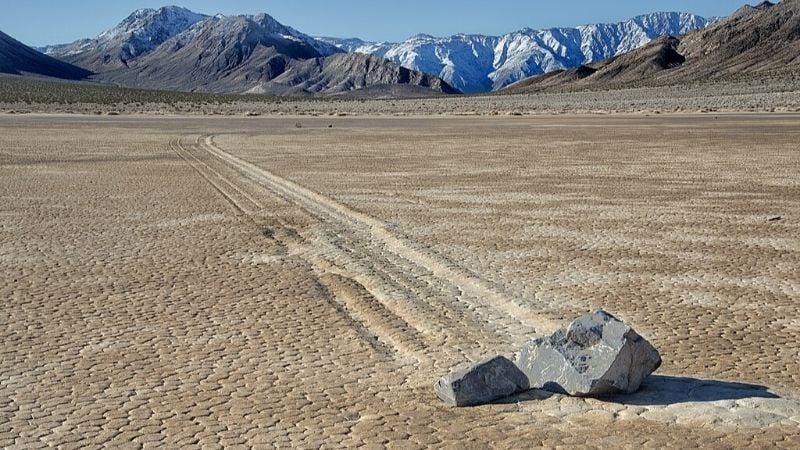
Could self-propelled ice, moving like these “sailing stones” in the desert, create energy? Image used courtesy of Wikimedia Commons
The Herringbone Ratchet Effect
The ice energy generation system uses aluminium plates patterned with microscale V-grooves arranged in a herringbone geometry. When an ice disk is placed on the plate and begins to melt, water flows through these grooves. Because the grooves guide the water preferentially in one direction, a net forward force is generated. The mechanism works like a microscopic ratchet, allowing the water to advance but preventing it from slipping backward, producing steady self-propulsion.
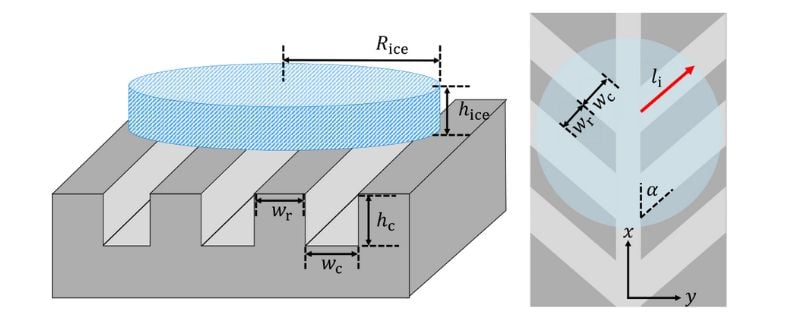
The ice disk on the herringbone-patterned aluminum substrate. Image used courtesy of Tapocik et al
The team documented velocities ranging from a few millimeters per second to sudden bursts of rapid sliding after applying hydrophobic coatings. In the coated cases, meltwater built up until adhesion was overcome, releasing the ice into fast forward motion. This interplay between surface chemistry, temperature, and geometry suggests that the effect can be tuned for speed or force output depending on application needs.
Harnessing Motion for Energy
While sliding ice may seem a niche effect, the Virginia Tech team emphasizes its potential as a renewable energy source. If the herringbone pattern is fabricated in a circular arrangement, melting ice disks can rotate continuously. Coupling such a rotating disk to magnets or microturbines could generate small amounts of electricity without requiring active input.
The principle resembles traditional hydroelectricity, but scaled down. Instead of flowing rivers, it uses the predictable melt of ice, channeled by surface design. Researchers suggest that in cold climates or in industrial settings where ice forms naturally, this system could provide localized, maintenance-free energy harvesting.
_creates_movement_through_ratcheting_on_the_herringbone_(center),_resulting_in_a_slingshot_across_the_surface_(right).jpg)
The phase change (left) creates movement through ratcheting on the herringbone (center), resulting in a slingshot across the surface (right). Image used courtesy of Tapocik et al
Applications Beyond Power
The study also outlines applications beyond electricity. In aerospace or infrastructure, self-propelled melting could be used for passive ice removal, clearing surfaces without heating elements or mechanical scrapers. In microfluidic systems, the same principle could replace pumps, enabling droplet transport powered solely by melting or condensation. In self-cleaning coatings, ice could automatically shed away from critical areas as it propels itself.
Significant challenges remain for scaling the system. The herringbone grooves must be fabricated with high precision, and practical energy outputs will require larger surface areas and optimized thermal management. Still, the research marks the first demonstration that ice can act as a self-propelled agent.
By showing how a simple phase transition can be turned into mechanical work, the research team has opened an inquiry that merges surface science, thermodynamics, and renewable energy engineering. As energy systems diversify, unconventional sources like self-propelled ice may carve out a role in niche environments where other options fall short.











Answer: No. Lawrence Coomber