Facebook
 Google
 GitHub
 Linkedin
Hitachi Report: Power Demand Directly Linked to Data Centers
The six-month analysis attributes the increasing energy load to data centers, especially in certain regions, while renewable energy and capacity are growing steadily.
Data center expansion and industrial electrification are driving a massive surge in energy demand, particularly on the regional level. While power generation is shifting steadily toward renewable energy, its capacity is still not reaching its potential, according to Hitachi Energy’s Grid Pulse report, which provides a snapshot of the American energy system.
Hitachi executives Debashis Bose and Elsa Martin met with journalists to review the findings and provide insights. “The growth rate is pretty phenomenal,” said Bose, senior renewable energy advisory consultant.
Power demand varies, with the largest loads in states where data centers and industrial electrification are concentrated. “It looks like energy-intensive applications, like data centers, Bitcoin mining, and other things are actually contributing to that increase,” he stated.
The Hitachi Grid Pulse data covers the six months between October 2025 and March 2026. Hitachi stated that the data and trend analysis can help energy leaders better understand trends, evaluate risks, and make operational decisions.
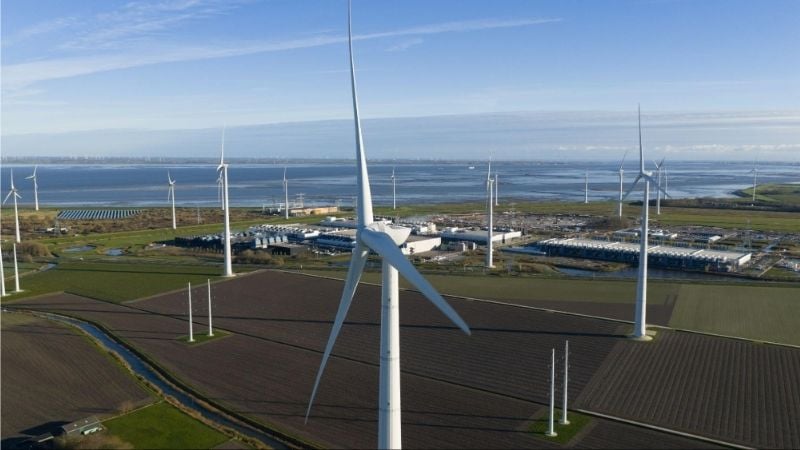
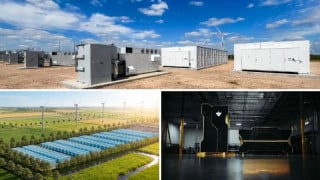
Wind turbines near a data center. Image used courtesy of Adobe Stock
Regional Load Increases Match Data Center Growth
Energy loads are growing faster than the historical norm, but not evenly across the country, according to Grid Pulse. While national growth increased about 2% compared to last year, ERCOT, which covers Texas, rose by about 9%. It’s no surprise that Texas hosts 350 data centers, with about 250 more planned or under construction.
Also leading in energy demand growth were California, Arizona, Florida, Illinois, and Oklahoma. Surprisingly, the state with the most data centers—Virginia—was not among the leaders.
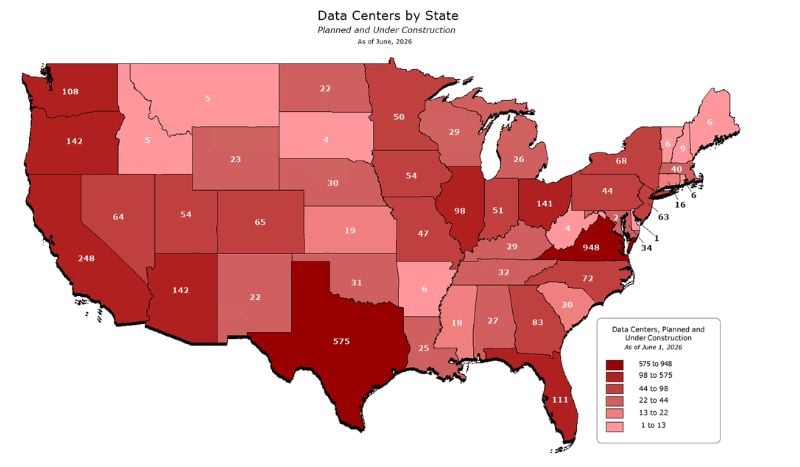
Data centers by state.
As regions consider how to meet this unprecedented demand, two factors become paramount: generation sources and capacity.
Renewables Gaining but Gas Remains Dominant
The U.S. added 28.4 GW of new energy resources from all sources, with renewables leading the way. Solar was the top source of new generation during the period studied, representing an 18% share of energy generation.
Renewable energy now accounts for 24% (300 GW) of available capacity in the 48 contiguous U.S. states. Likewise, battery energy storage expanded significantly, increasing by about 61% compared to the previous period Hitachi studied.
However, Bose said renewable energy generation is still inconsistent. “That sort of indicates the intermittency, that wind and solar are not available all the time,” Bose said.
The intermittency may soon be mitigated as installations of battery energy storage systems (BESS) surge. BESS were second only to solar in capacity additions during the period studied.
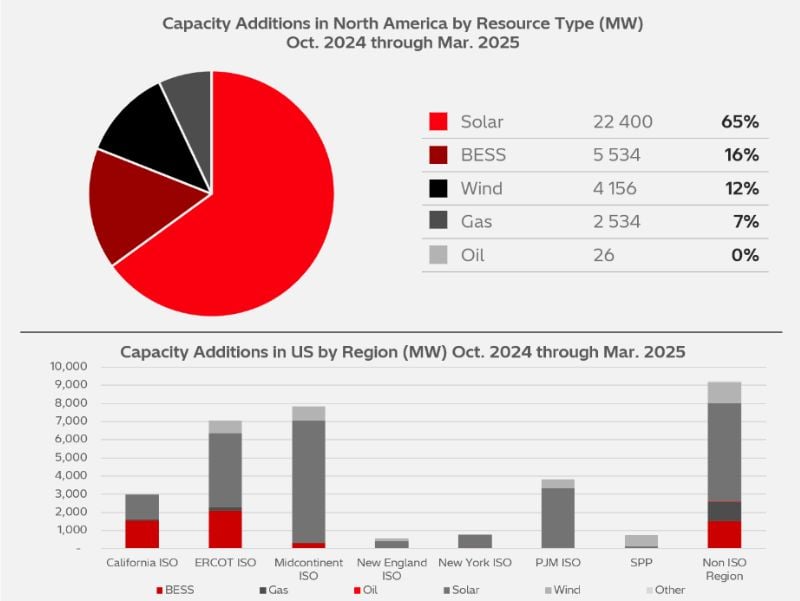
Capacity additions by source and region.
While the ERCOT region led in demand, it also far outpaced other areas by adding the most new generation, accounting for a 24% increase (6.8 GW) of total additions. Midcontent ISO followed with 23% (6.4 GW), and CAISO with 11% (3.1 GW).
Despite the growth of renewables, fossil fuels remain the dominant energy sources, with gas, nuclear, and coal comprising 74% of total generation. Solar and wind provided about 344 GW of capacity, while conventional sources contributed around 793 GW of capacity. Battery capacity reached about 50 GW, and nuclear represented 57 GW of installed capacity.
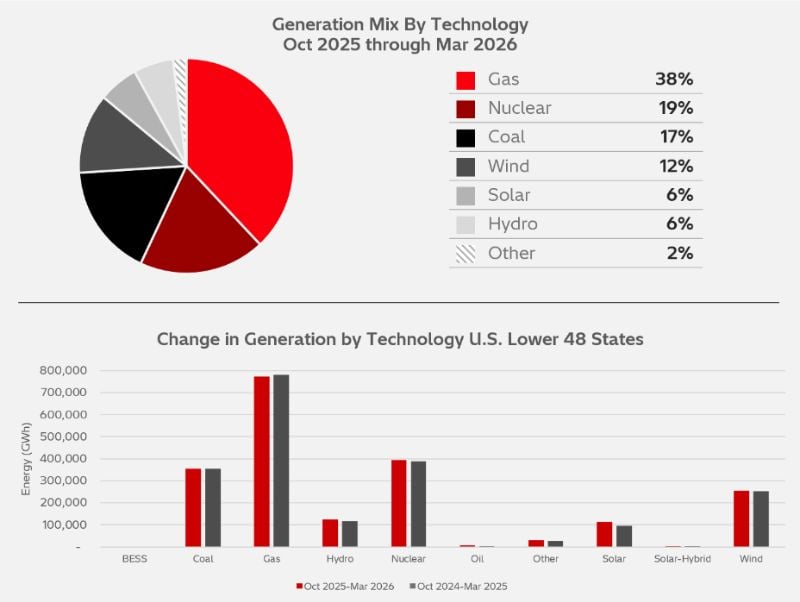
Generation sources.
Hitachi reported that these proportions have remained steady compared with previous reports, even as renewables grow and older fossil-fuel plants retire.
In terms of capacity, six states—Texas, California, Arizona, Florida, Illinois, and Oklahoma—contributed more than half of all U.S. new capacity from all sources in the period studied.
Can Generation and Capacity Keep Up With Data Center Demand?
Bose summarized by stating that load growth in the U.S. has been “quite aggressive” and clearly links to data centers, cryptocurrency mining, and other intensive uses.
While new generation sources and capacity are also growing, the question lingers about whether energy increases can keep up with demand. Hitachi Energy states it will continue to analyze the changing energy industry.
“We are definitely performing studies to analyze load growth and what transmission upgrades need to be done and when those upgrades need to be,” Bose advised.
All data and images used courtesy of Hitachi Market Insights