 Facebook
 Google
 GitHub
 Linkedin
Could Iron Powder Produce Net-Zero Energy in Europe?
A study in Germany found that retrofitting coal plants to burn green-hydrogen-reduced iron would rival gas reserves for energy storage and save up to €18 billion a year.
Iron powder could serve as a third climate-neutral source of dispatchable power and heat for Europe alongside hydrogen and carbon capture, potentially saving the continent €15 billion to €18 billion a year between 2035 and 2045.
That's according to a modeling study by the Institute of Energy Economics at the University of Cologne (EWI). The report, commissioned by TU Darmstadt's Metal Energy Hub and the DESERTEC Foundation, found that most of the savings come from converting existing coal and lignite plants to burn iron rather than building new hydrogen or gas-with-CCS capacity.
The concept has been under development since 2021 as part of the Clean Circles project at TU Darmstadt and the Karlsruhe Institute of Technology (KIT). The study used a European energy-system model to test whether it lowers total costs.
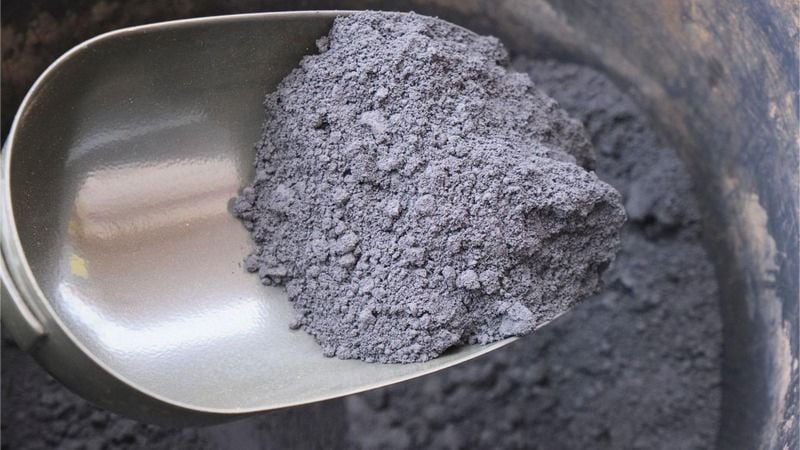
Iron powder. Image used courtesy of Adobe Stock
How the Iron Cycle Works
Finely ground iron burns in air at high temperature and releases no carbon dioxide; the product is iron oxide. Running that oxide through a reduction process with green hydrogen strips the oxygen back out and yields iron powder again, which is the charging step.
Wind and solar energy are stored chemically in the reduced metal, which can sit in a silo for months without pressurization, cooling, or boil-off. They can move by ship, rail, or truck on existing bulk infrastructure.
The energy accounting is far from flattering, though. EWI put the electricity input at about 1.4 kWh per kWh of iron produced, and reconversion efficiency in a retrofitted steam plant at 0.42 to 0.47 kWh of electricity per kWh of iron. That worked out to 3.0 to 3.4 kWh of electricity in for every 1 kWh out, against 2.25 to 3.9 kWh for a hydrogen pathway depending on the turbine.
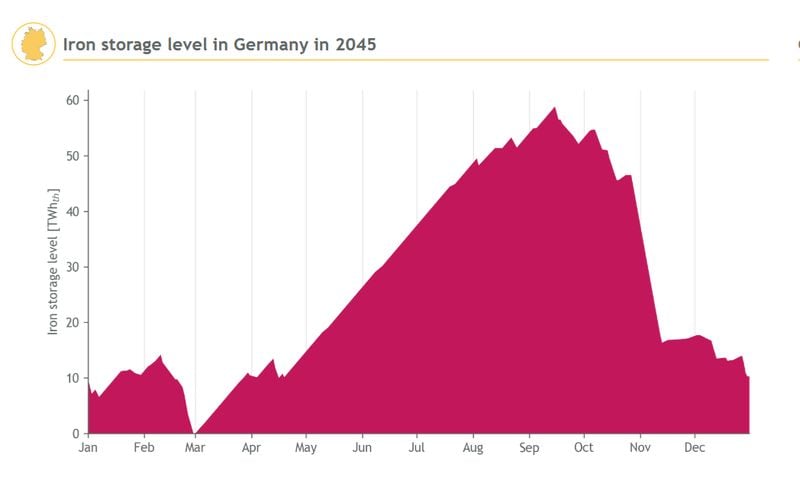
The iron storage level is in the same order of magnitude as current German gas storage facilities. Image used courtesy of EWI
Iron is also three to five times heavier than hard coal for the same energy content. The case for iron rests on cheap storage and transport, and reusing existing boilers, turbines, and grid connections. Because pulverized iron behaves like coal dust in a burner, the report assumed retrofitted plants reach an electrical efficiency 2% higher than the hard-coal units they replace.
What the Model Found
EWI ran the HYEBRID model of the European electricity, hydrogen, and district-heating system from 2030 to 2045, comparing a reference scenario with hydrogen and CCS against a base scenario that adds iron. Renewable and nuclear capacities were fixed from ENTSO-E's TYNDP 2026 national-trends scenario in both.
With iron available, the model retrofitted about 37 GW of German coal and lignite capacity and about 83 GW across the model region by 2045, and built no new iron plants. Net savings reached roughly €15 billion a year in 2035 and €18 billion a year in 2040 and 2045, equivalent to 13% to 14% of total modeled system cost in the reference case. Lower fuel and operating costs drove the early savings. Avoiding capital spending on new plants ultimately became the largest contributor by 2045.
Germany's iron inventory fills from spring to early autumn, peaks at about 58 TWh of thermal energy in September, and is drawn down through November, with a second fill-and-drain cycle in January and February for cold spells. EWI noted that this is on the same order as its current gas storage. Retrofitted combined heat and power plants burning iron could supply roughly 25% of German district heat from 2035 onward in the base scenario. Hydrogen plants would still have more capacity than iron across Europe in every modeled year, and iron would reduce hydrogen generation rather than displace it.
Researchers concluded that the study suggests iron could deliver decarbonization and competitiveness while substantially cutting costs.
Conditions and Caveats
The result depends on whether coal plants slated for closure stay open until retrofits become economical in 2035. EWI estimated that decommissioned coal and lignite plants would need to be preserved to capture the benefit.
Another factor is whether Europe might build enough electrolysis and iron-reduction capacity. In the base scenario, no iron was imported at all, but with 25% less renewable capacity the model kept more gas turbines running, retrofitted fewer plants in 2035 (26 GW versus 36 GW in Germany), and substituted CCS for part of the hydrogen fleet.
Keywords: iron powder, net-zero energy, energy transition, coal, green hydrogen, decarbonization, EWI
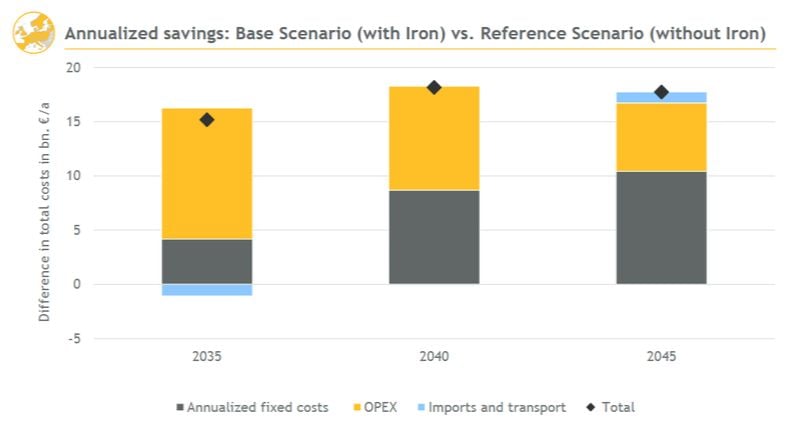
Annualized costs and savings. Image used courtesy of EWI
Raising assumed iron costs by 50% trims the retrofitted fleet only slightly, to 78 GW from 83 GW, and reduces the annual savings from €10 billion to €13 billion.
The researchers modeled batteries in line with the TYNDP but did not jointly optimize them with iron, which they identified as a limitation. They also noted that the technology-readiness, infrastructure, and business-model risks facing hydrogen and CCS also apply to iron.
Pilot-scale iron combustion is already running, with Dutch startup RIFT supplying iron-fired heat to about 500 households in Helmond, but no utility-scale retrofit has been built yet.