Facebook
 Google
 GitHub
 Linkedin
Can an Iron-Chloride Cathode Cut EV Battery Costs?
Georgia Tech researchers say the novel cathode could boost battery efficiency.
Commercial lithium-ion batteries predominantly use combustible organic electrolytes and rare metal cathodes, which risk safety and sustainability while driving up costs. These issues and the relatively low energy density of widely used cathodes have sparked a global race to develop more affordable and sustainable battery technologies.
A Georgia Tech research team has discovered a cathode material they believe could reshape the future of energy storage. The development addresses shortcomings in cathode materials and offers a path forward.
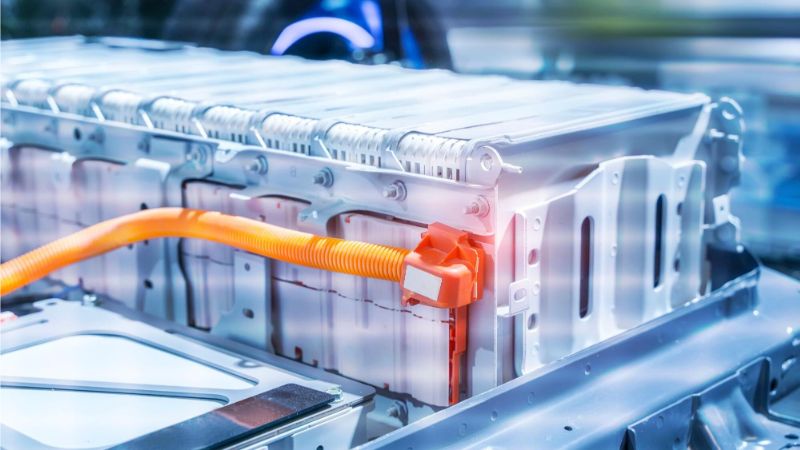
Electric vehicle battery pack. Image used courtesy of Adobe Stock
Battery Insights
Lithium-ion batteries (Li-ions) have become the foundation for all portable electronics since commercializing in the 1990s, and, more recently, they’ve found their way into electric vehicles.
The rapid growth in demand for Li-ions has revealed many challenges, particularly in cost and sustainability. Today, batteries account for about 50% of an electric vehicle's total cost, primarily due to the reliance on expensive materials like nickel and cobalt. These metals also pose environmental and supply chain concerns.
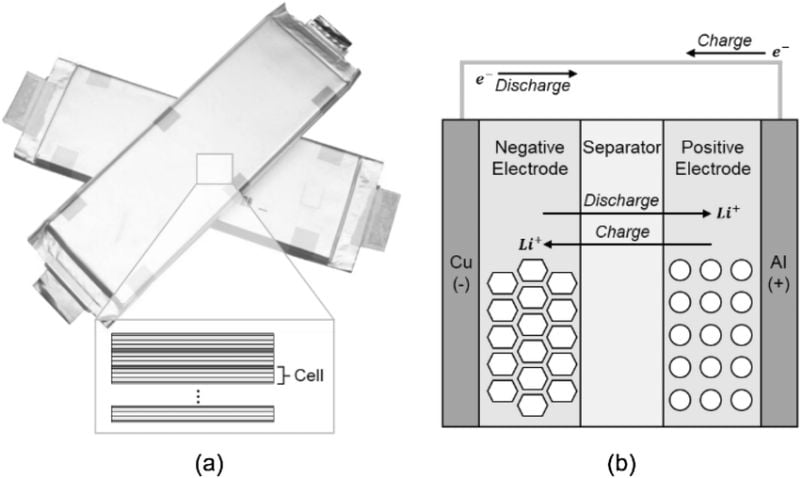
Li-ion pouch cell and electrochemical model. Image used courtesy of Kim et al.
A lithium-ion battery comprises two electrolyte-filled electrodes (cathode and anode), a porous separator saturated with electrolyte, and a sealed case. The cathode typically has the highest weight and greatly impacts the cost and performance, particularly in weight, safety, and lifespan. It stores and releases lithium ions during the charging and discharging processes, respectively. Widely used cathodes like lithium iron phosphate (LiFePO4), lithium cobalt oxide (LiCoO2), lithium manganese oxide (LiMn2O4), and lithium nickel cobalt manganese (NCM or NCA) offer reliable performance.
Unfortunately, these cathode chemistries’ relatively low energy density and specific energy limit broader applications. Additionally, rising costs, resource limitations, environmental challenges in mining, and nickel and cobalt toxicity complicate large-scale adoption.
Georgia Tech’s Iron-Chloride Cathode
A Georgia Tech research team has introduced a new cathode material, iron chloride (FeCl3), designed to improve Li-ion batteries’ performance and reduce costs, specifically for EVs and large-scale energy storage systems.
The research team used advanced spectroscopy techniques to analyze the Li-ion movement and Fe2+/Fe3+ redox mechanisms behind the cathode. The resulting cathode uses only 1-2% of traditional cathode materials like cobalt and nickel but still offers comparable energy storage capacity while addressing material scarcity and cost. Combined with a solid halide electrolyte and lithium-indium alloy anode, it creates a fully solid-state battery, which has advantages over conventional liquid-electrolyte Li-ions by offering higher energy density, increased safety, and reduced leakage risks.

Georgia Tech researchers with their new cathode. Image used courtesy of Georgia Tech
Early tests reveal that this cathode performs as well as or better than existing commercial cathodes, with the added advantage of reducing total battery system costs by 30-40%. According to the research, the FeCl3 cathode shows stable voltage plateaus and maintains 83% capacity after 1000 cycles, with 99.95% Coulombic efficiency. Additionally, the cathode has shown operational voltages superior to commonly used lithium-iron phosphate, delivering higher electrical force and battery efficiency.
Future Prospects
The Georgia Tech research team sees a relatively quick path to market for their battery cathode. According to lead researcher Hailong Chen, the technology could be ready for commercial use in electric vehicles in less than five years. The team remains focused on laboratory refinement, including a better understanding of the underlying mechanisms and further perfecting the material.