Facebook
 Google
 GitHub
 Linkedin
Brine Batteries: Extracting Lithium From Saltwater
Salty water could provide all the lithium needed for electric vehicle batteries, but extraction is tricky. Can researchers devise an efficient method?
Increasing electric vehicles and energy storage demand requires more and more lithium for batteries. However, traditional lithium deposits in hard rocks (spodumene) are finite and are declining. With resources expected to dwindle, scientists seek to extract lithium from briny water in the Earth’s oceans.
The briny seas could provide enough lithium to meet demand if extracted. Studies from engineers at Nanjing University, the University of California, Berkeley, and King Abdullah University of Science and Technology (KAUST) have developed innovative ways to extract and store lithium from briny water.
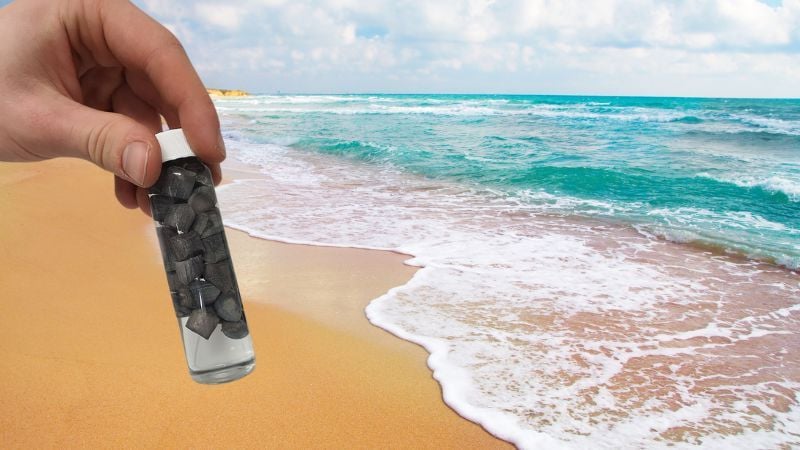
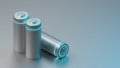
Lithium exists in briny water like oceans. Can it be easily harvested? Adapted from images used courtesy of Canva and Wikimedia Commons
Lithium Extraction for the Supply Chain
Extracting lithium from seawater is not new, but several challenges have slowed developments. These include low lithium concentrations in a given volume of seawater and the presence of other ions, such as sodium, magnesium, and calcium.
However, since seawater contains around 230 billion tons of lithium, many resources are available for extraction. Mining lithium from seawater could become more environmentally friendly than traditional mining, which is energy-intensive. Yet, extraction methods cost 10 times more than traditional mining, so more developments must be made before seawater mining becomes commercially viable.
Iron Phosphate Electrodes: Fundamental Technology
Developments in lithium extraction have turned toward using iron phosphate electrodes to extract lithium from seawater. Iron phosphate particles have thus far been the most effective in removing lithium from a dilute liquid due to their size, charge, and reactivity. When built into an electrode, lithium ions are drawn into the pores of the iron phosphate columns. Through careful engineering, the columns’ porous structure can be tuned to exclude sodium ions (the main ions that are extracted alongside lithium) while intercalating lithium ions.
Overly small and large iron phosphate particles tend to allow more sodium ions to intercalate within the electrode. So, electrode design relies on the pore size and the iron phosphate particle sizes. Particle sizes in between the two extremes have favored lithium ions kinetically and thermodynamically.
Aluminum Oxide Membrane Removes Lithium
Researchers at Nanjing University and the University of California, Berkeley, used a solar transpiration-powered lithium extraction and storage approach from sunlight to extract lithium from brine. This passive device floats on the brine and contains an aluminum oxide membrane embedded with silver nanoparticles. Iron phosphate electrodes in the device can selectively capture lithium ions in various brine environments, including the Dead Sea.
When sunlight hits the device, it creates pressure inside the device that forces lithium ions through the membrane. This separates the lithium ions from the brine, and a ceramic frit with small pores stores the lithium ions as they are pulled from the brine. After the ions are absorbed, they are released into a freshwater compartment. Throughout the process, oxidation of the embedded silver nanoparticles and reduction at a paired counter electrode achieve a charge balance. They also keep the non-lithium cations on the membrane’s salt side.
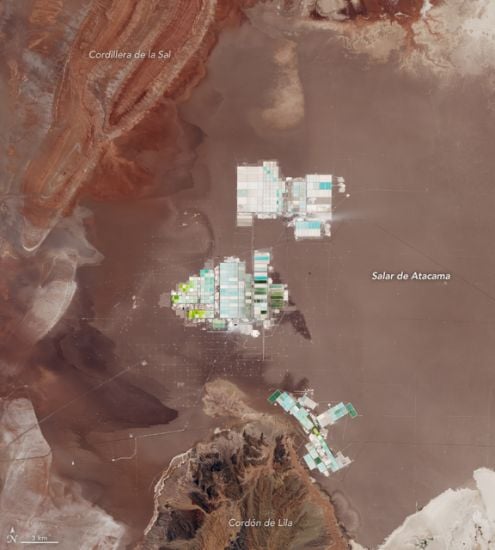
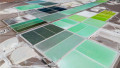
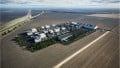
A lithium extraction site in Chile. Image used courtesy of NASA
Membrane Free Extraction Also Removes Lithium from Brine
Researchers at KAUST used iron phosphate electrodes alongside silver/silver halide redox electrodes to remove lithium ions from a brine solution and deposit them into a freshwater compartment. Their device doesn’t use a membrane. Instead, the device relies on the counter electrodes' redox capabilities (where oxidation and reduction occur) to prevent other cations from traveling from the saltwater to the freshwater compartment. The lithium ions removed from the brine are stored in the iron phosphate electrode. So far, a larger cell of 33.75 square meters has been tested with a recovery rate of 84%.
Large Scale Feasibility Needs to Be Determined
Lithium extraction methods from briny water have shown promise in small-scale laboratory tests and pilot scales. Still, it’s unclear whether these technologies will be economically viable once they are scaled up. Scaling up new technologies does reduce their cost, but they will still need to come down to a price point where the industry can adopt them without skyrocketing lithium prices.