Facebook
 Google
 GitHub
 Linkedin
Are Solar Farms on Federal Waters Feasible?
A National Renewable Energy Laboratory study suggests placing floating solar panels on federal waters could generate enough electricity for millions.
Solar farms are often criticized for ruining the scenery or taking up land that could be used for farming or development. What if solar arrays could be placed on unused water instead?
Learn more about floating solar panels on federal land. Video used courtesy of NREL
A National Renewable Energy Laboratory (NREL) study concluded that floating solar panels placed on federally owned or regulated land could generate enough electricity to power 100 million U.S. homes. While no project is underway, if implemented, these panels could supply half the solar energy needed to decarbonize the grid by 2050.
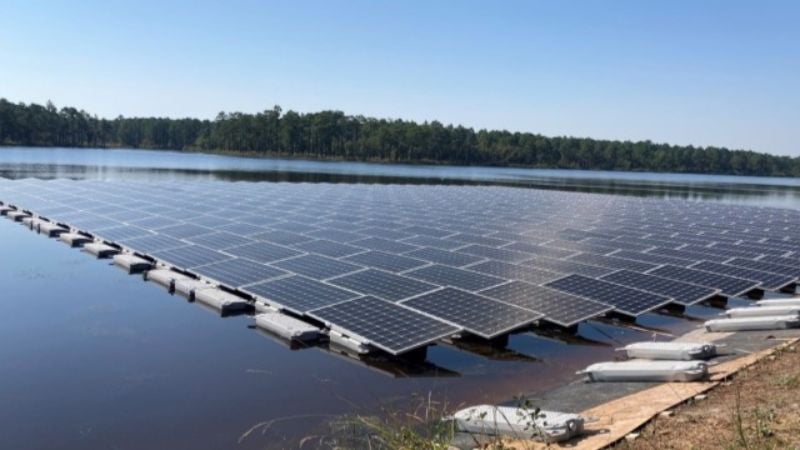
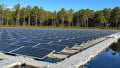
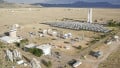
Floating solar panels in North Carolina. Image used courtesy of U.S. Army
Floating Panels: Pros and Cons
Floating photovoltaics (FPVs) function the same way as pole-mounted or rooftop solar panels. Instead, the solar panels are mounted on floating platforms. The platforms are moored to prevent drifting and connected to inverters and transmission cables.
FPVs take up less space than land-based PV systems. The panels can be angled to maximize sun exposure and to take advantage of albedo or reflected energy from the water. Bifacial panels are often used. The water provides natural cooling, which is important for PV efficiency.
While FPV systems may be more expensive and complex to install, the return on investment is quicker. A study in Thailand showed the payback period was about seven years. FPVs have the same predicted lifespan as land-based solar panels.
FPVs also have environmental advantages. The panels shade the water, reducing evaporation and improving water quality. When carefully placed, they have a minimal impact on aquatic ecosystems.
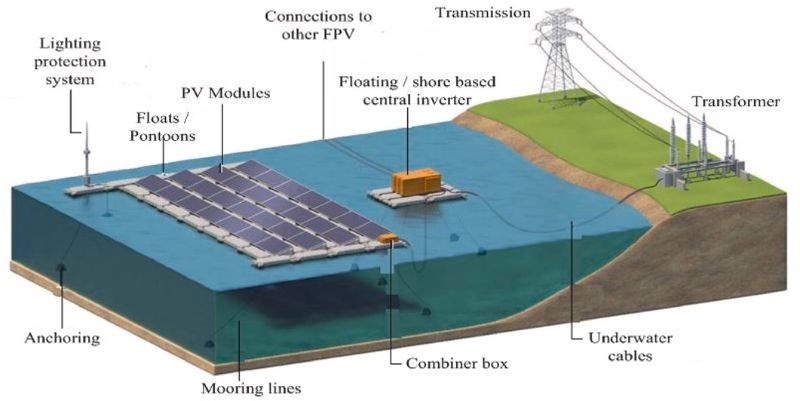
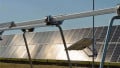
Floating solar array. Image used courtesy of Koondhar et al.
Most floating platforms include walkways for maintenance, but workers may find the unsteady surface challenging. Some areas of FPV systems may be accessible by boat. However, robotics and drones may assist with routine tasks such as cleaning.
Suitable sites for FPVs are limited. The panels cannot be placed on waters with strong currents, choppy water, or areas prone to ice jams or extreme cold.
Floating Solar Panels on Federal Land
NREL scientists investigated the feasibility of placing FPV systems on federal lands. The study in Solar Energy identified enough potential sites to generate between 861 and 1,042 GW of DC, which is enough power for about 100 million homes.
The researchers studied FPVs in lakes and reservoirs on federally owned or regulated land. Since site characteristics varied widely, they used numerous criteria, such as slope, water depth, and volume, to determine the best sites. The waters they chose were not associated with ship navigation or recreation. Areas subject to extreme cold or ice floes were also excluded.
The selected sites are distributed throughout the U.S. but with the greatest concentration in New England, California, the Southeast, and the Texas-Oklahoma-Arkansas region.
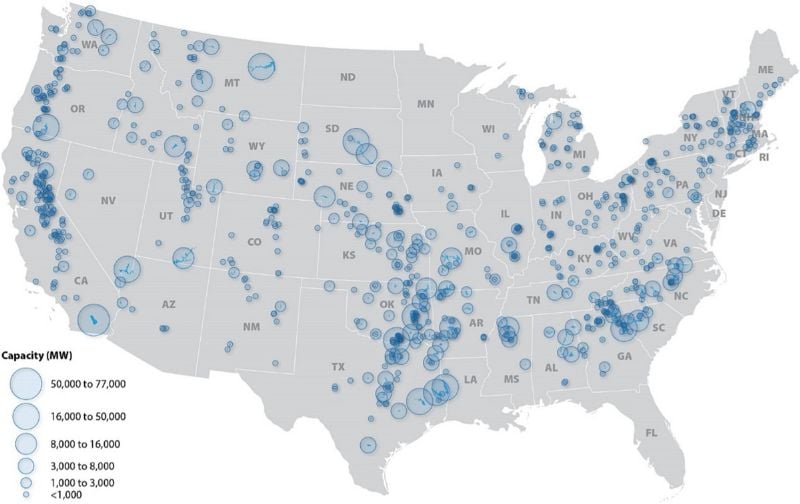
Federal waters with potential for FPVs. Image used courtesy of Rosenlieb et al.
Some sites studied were adjacent to existing hydropower and pumped hydro storage facilities. Since transmission infrastructure already exists at these sites, energy production could increase while costs decrease.
Future of Floating Solar Farms
Several companies already offer FPV panels and installation services for placement on public or private lands. For example, a Fraunhofer ISE study identified 500 lakes at former mining sites that could host FPV facilities.
NREL has teamed up with the Idaho National Laboratory and other government agencies to create the AquaPV website, which advises developers about ideal site characteristics. The AquaPV Techno-Economic Analysis tools can evaluate installation costs, capital investments, operational costs, and potential tax credits. It also estimates the life expectancy for the project.