Facebook
 Google
 GitHub
 Linkedin
5G Boosts Microgrid Resilience, Security
National Renewable Energy Laboratory research demonstrates that fifth-generation cellular technologies’ edge capabilities can improve renewable microgrids’ energy resilience.
National Renewable Energy Laboratory (NREL) has shown the potential benefits of integrating fifth-generation (5G) cellular communication technologies with renewable microgrids to improve energy resilience and communications reliability.
NREL used a replicated military microgrid modeling solar arrays, battery systems, vehicle chargers, and other equipment integrated with a 5G communication network. Researchers exposed the simulated microgrid to a series of resilience challenges and cyberattacks to demonstrate how the microgrid, working in concert with the 5G system, could maintain its power delivery and communication capabilities under various stress conditions.
Resilience in energy management and communications systems is critical to the mission of the Department of Defense (DoD), which funded the NREL research. According to the published report, the testing revealed that energy management and communications could be maintained through various adverse events using a distributed architecture of renewable microgrids and 5G cellular communication sub-systems.
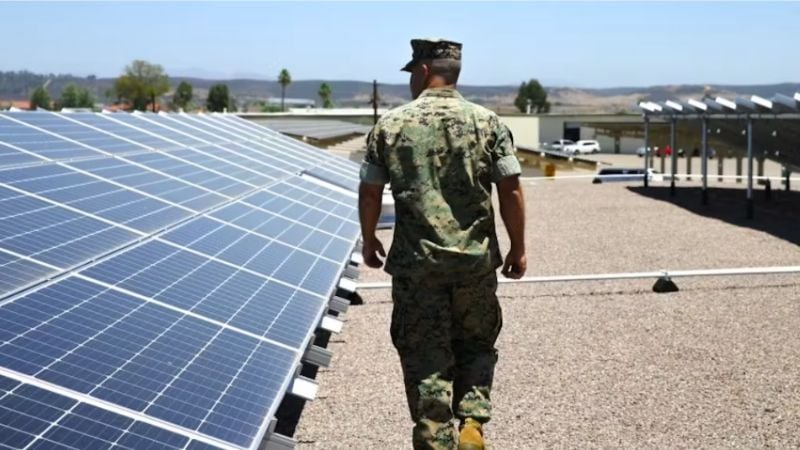
Renewable microgrid on a U.S. military installation. Image used courtesy of the Department of Defense
5G Cellular Technology
Numerous corporate leaders in the telecommunications space cooperated to develop 5G technology, which is governed by the 5G standardization process. 5G aims to improve the cellular network’s speed, capacity, and capabilities compared with legacy systems like 4G.
Data moves within a 5G system fundamentally differently from 4G implementations. With 5G, data management is less centralized and can be moved closer to the edge device. The technology is also designed to handle higher concentrations of devices with reduced data latency for near real-time communication and control of distributed assets. The network is built for data, accommodating a broader range of devices beyond just phones.
To achieve its performance, 5G networks operate at higher bandwidths and frequencies with more distributed access nodes for better precision. The architecture’s distributed nature can improve the system’s overall resilience since the importance of any individual node is lessened.
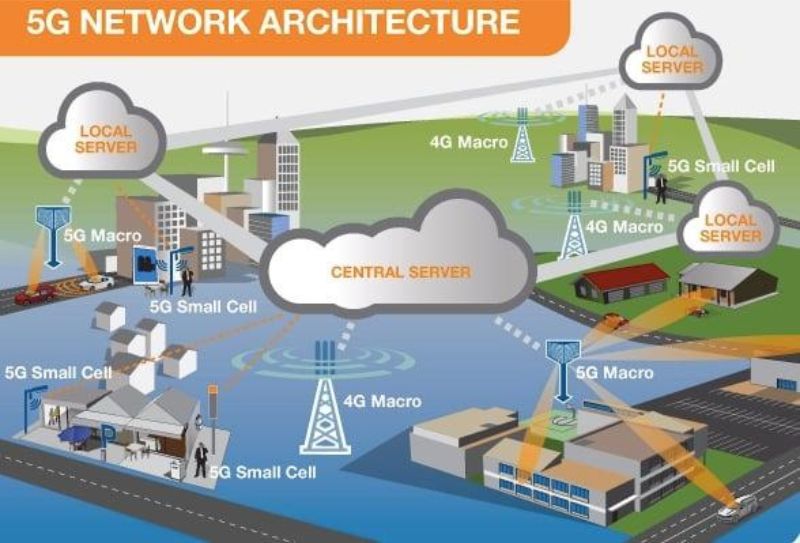
5G network architecture. Image used courtesy of All About Circuits
Microgrids in the Military
The U.S. military is increasingly turning to microgrid energy sources as part of its larger climate strategy and as a tactical necessity. As with other organizations, the military is under pressure to reduce its reliance on carbon-based energy sources without compromising mission capabilities.
But beyond clean energy, renewable microgrids have proven to be a potentially important military asset. Reliable access to power is essential to military operations, and renewable microgrids offer a grid-independent distributed power source, improving energy resilience and reducing vulnerability to adversaries’ cyberattacks.
For the DoD, renewable microgrids add a layer of energy security to military bases, installations, and even forward-deployed units.

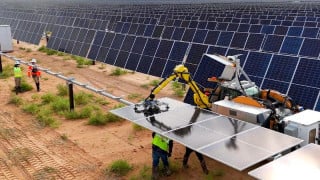
30 MW solar array at Fort Benning, Ga. Image used courtesy of U.S. Army
Promising 5G Results
Some scenarios simulated in the 5G microgrid testing included cell tower failure, crashed microgrid controllers, and network congestion. Throughout the test scenarios, edge computing and other 5G network features allowed the capabilities of both the microgrid and communication systems to be maintained.
However, the benefits of reduced latency for the 5G system were not fully realized as lower frequency bands were still required for longer distance communications between more widely dispersed microgrid assets.
Also, since 5G systems are typically constructed from COTS (commercial off-the-shelf) components, their resilience to cyber threats remains a concern and warrants further evaluation for military use.