Facebook
 Google
 GitHub
 Linkedin
3 Alternatives: Energy Storage Options Move Beyond Lithium
Alternate materials could provide cheaper, more sustainable, and longer-lasting batteries
As global demand for renewable energy integration and electric mobility solutions accelerates, energy storage is becoming more important. Lithium-ion batteries, the current standard, offer substantial performance but present significant drawbacks, including high costs, safety concerns, and limited material availability.
Single-crystal electrodes could improve lithium-ion batteries. Image used courtesy of Canadian Light Source
These limitations have spurred global efforts to explore alternatives, such as thermal and magnesium-based batteries, which promise better affordability, safety, and sustainability. Simultaneously, advanced lithium-ion designs seek to mitigate degradation issues restricting their operational lifespan.

Thermal energy storage. Image used courtesy of Rondo Energy
Magnesium Electrolyte Battery
University of Waterloo researchers have achieved a breakthrough in magnesium-based battery technology as an alternative to lithium-based technology.
The invention addresses the longstanding challenge of developing magnesium-based batteries with competitive voltage and efficiency compared to lithium-ion batteries. Magnesium anodes have poor electrodeposition efficiency in halogen-free electrolytes at high capacities, mainly due to an insulating SEI layer formed by electrolyte breakdown. The researchers addressed this by designing a groundbreaking magnesium electrolyte enabling reversible magnesium electrodeposition.
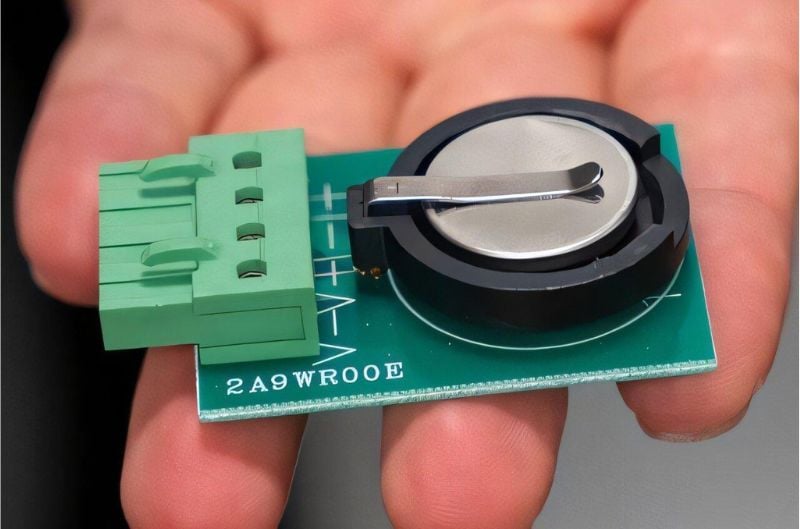
A coin cell using a magnesium metal anode. Image used courtesy of University of Waterloo
Fast magnesium plating forms thin platelets with nearly 100% efficiency, achieving capacities up to 50 mAh/cm². Unlike earlier magnesium-based batteries that operated at just 1 V, their new electrolyte achieves up to 3 V, a significant improvement made possible through enhanced chemical stability and electrochemical properties.
This development is a breakthrough because previous similar studies could not achieve the same results. Some researchers succeeded but used expensive materials that could hinder commercial use. Moreover, unlike the earlier studies, the current study uses non-corrosive and non-flammable electrolytes.
Thermal Batteries
Thermal batteries store excess electricity from renewable sources like wind and solar as heat in materials like bricks or graphite, which can reach temperatures exceeding 3,000°F.
Rondo Energy deployed its first commercial thermal battery in California, storing solar energy as heat in clay bricks. According to reports, the solution enables storage of more energy per pound than lithium-ion at only 10% of the cost. The systems are designed to deliver high-temperature heat on demand, making them particularly suitable for energy-intensive industries like steel, cement, and chemical manufacturing.
The company targets 90 GWh annual production by 2027, which could reduce carbon dioxide emissions by 12 million tons. Market education and high initial costs have been identified as major roadblocks to overcome.
The Single Crystal Electrode Battery
Lithium-ion batteries degrade after approximately 2,400 cycles, or about eight years of operation, due to microcracking in the electrode materials caused by repeated expansion and contraction. Scientists from Dalhousie University used Canadian Light Source to study a single-crystal electrode battery that maintained 80% capacity after 20,000 cycles over six years, equivalent to 8 million km of driving range.
The electrode’s single-crystal structure material minimizes mechanical stress and degradation because the particles comprise a single, cohesive crystal, similar to an ice cube, compared to the fragile, snowball-like clusters in conventional designs. This durability was confirmed using synchrotron light imaging, which revealed negligible internal damage even after six years of continuous cycling.
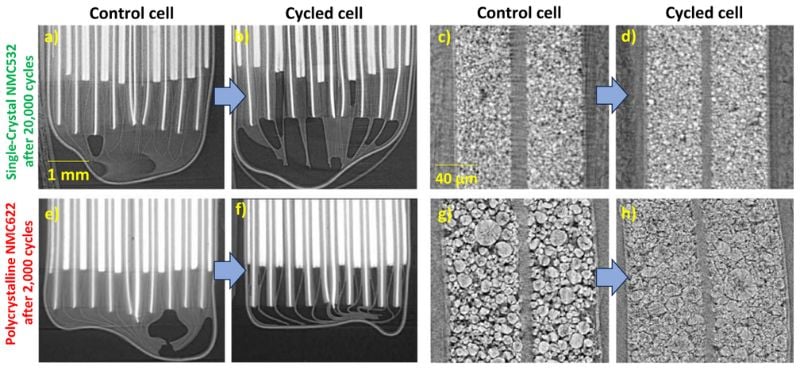
A comparison of the degradation between the crystals. Image courtesy of Bond et al.
The study explored the degradation mechanisms of lithium-ion cells under extensive cycling, focusing on polycrystalline NMC622 and single-crystal NMC532 cathodes. Using synchrotron X-ray diffraction, researchers analyzed a polycrystalline NMC622 cell cycled for 2.5 years and a single-crystal NMC532 cell with over 20,000 cycles. NMC622 cells exhibited extensive cathode microcracking, electrode swelling, and localized delamination, while single-crystal NMC532 cells demonstrated reduced degradation.
These findings suggest that by outlasting an electric vehicle’s typical lifespan, these batteries could be repurposed for grid energy storage.
A Lithium-Free Future?
Clearly, industry and academia are heavily invested in removing lithium from energy storage. By addressing the limitations of existing systems, these advancements could inspire a shift toward decentralized energy models and diversified resource dependency, which would totally reshape global energy independence.