Facebook
 Google
 GitHub
 Linkedin
Giving A Second Life to Aging Cables: Understanding Cable Rejuvenation
Learn how the dielectric strength of aging underground cables can be restored with a specialized silicone fluid, offering a cost-effective and sustainable alternative to full replacement.
In the 1960s and 70s, underground electric cables were insulated with polyethylene (HMWPE, LDPE, PE, XPLE, and TR-XLPE). The expectation was that these cables would last at least 40 years before requiring replacement. In reality, many failed in as little as 10 years due to widespread insulation breakdowns. It was discovered that water trees were developing in the insulation, caused by the migration of water from the ground into the insulation. Traditional replacement strategies were expensive and labor-intensive, prompting engineers to explore alternative solutions.
In the 1980s, researchers found that injecting specially formulated silicone fluid into the cable strands could restore the cable’s dielectric strength, postponing the need for replacement by many decades. Today, this practice, commonly referred to as cable rejuvenation, is a practical, cost-effective, and proactive approach to extending the life of underground cables.
Cable Rejuvenation 101
Cable rejuvenation is a simple but powerful process. Dielectric fluid, or Siloxane, is injected into the conductor strands of the cable. The fluid migrates (diffuses) into the conductor shield and insulation, improving the insulation’s chemistry by removing moisture. This increases the dielectric strength of the polyethylene and extends the reliable life of the segment.
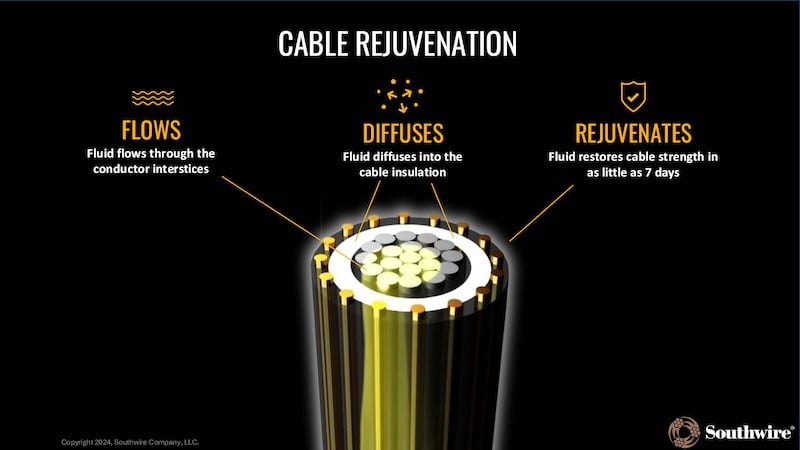
An overview of the electrical cable rejuvenation process. Image used courtesy of Southwire
Enemies Below: The Causes of Common Cable Failures
Underground cables face several hidden threats that degrade insulation and reduce their lifespan. The most common culprit is water trees– tree-like formations within the cable’s insulation caused by underground moisture, alternating current fields, and ions in the soil. Over time, these formations weaken the insulation’s ability to block electrons from straying to ground, ultimately leading to the cable’s failure.
Additionally, some cables may have pre-existing defects such as voids, electrical trees (carbon trees), or manufacturing defects. These defects shorten the life of the segment by facilitating electron movement from the conductor to ground.
Diagnosing Before You Inject
To determine if cable rejuvenation is a viable option, it’s important to determine if any potential defects are present within the cable. Partial discharge (PD) testing identifies cable defects while the cable is in service, helping prevent unplanned outages. This helps determine whether issues can be mitigated before rejuvenation or if a full replacement may be necessary.
For example, Southwire Field Services may conduct a PD test for the utility and discover that the original cable has a jagged cut at a termination or joint. By identifying this defect beforehand, the team can mitigate the existing cable and then follow through with the cable rejuvenation process, reducing the chances of cable failure while simultaneously extending the life of the cable.
Breaking Down the Rejuvenation Process
The rejuvenation process starts by isolating and grounding the cable. Once the cable is safe to work with, a Time Domain Reflectometer (TDR) is used to determine the length of the cable, locate the joints, and assess the condition of the neutrals.
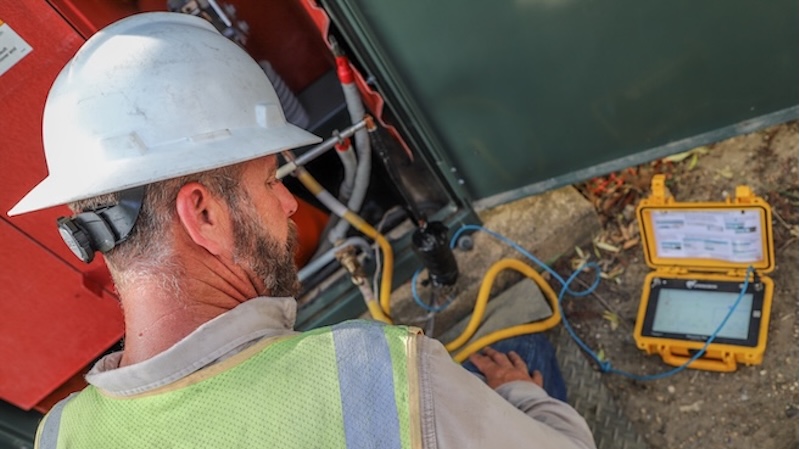
The cable rejuvenation process begins with diagnostic testing and characterization. Image used courtesy of Southwire
The terminations are then changed to injection terminations to allow Siloxane fluid into the conductor’s interstitial region. Airflow is introduced to confirm that a clear path exists from one end of the cable to the other end.
Once confirmed, a special tank and hose are attached to the new injection termination, and a slight pressure is applied. At the far end of the cable, a receiving tank is attached to the new termination. Once the fluid traverses the length of the cable, from one tank to the receiving tank, the cable is treated.
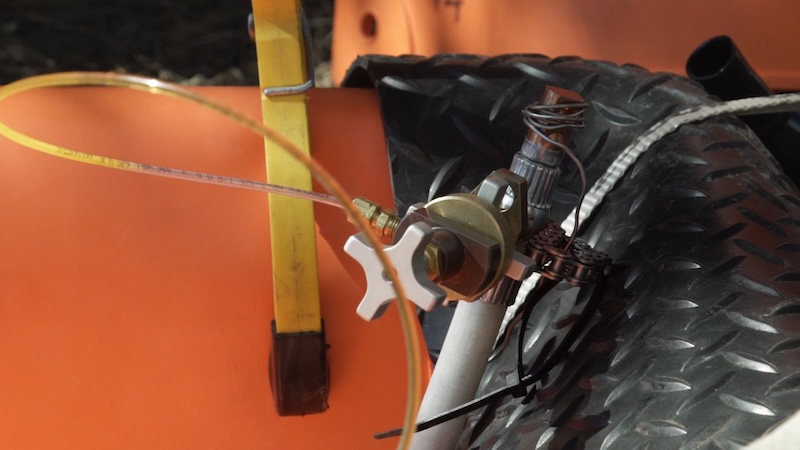
Special tanks are connected at the two ends of the cable being treated. Image used courtesy of Southwire
The tanks are then removed, and the cable is put back in service. Typically, a crew can rejuvenate three to six cables in a single day– significantly faster and safer than a cable replacement program.
Rejuvenation vs. Replacement
Total cable replacement is costly, labor-intensive, and may be environmentally disruptive. While cable replacements have a time and place, cable rejuvenation is a more sustainable, cost-effective alternative. It can extend the life of a cable by up to 40+ years and restore it to a better-than-new condition at roughly one-third the cost of replacement.
Rejuvenation is also environmentally friendly, reducing landscape disruption while mitigating approximately 660K metric tons of CO2. Rejuvenating a 350-foot cable is roughly the equivalent of driving a typical car 5.9 miles, compared to over 3,000 miles for a full replacement.
As utilities face increasing pressure to modernize aging infrastructure, cable rejuvenation offers a smart, sustainable option for utilities looking to extend the life of their assets, reduce outages, and avoid the time and expense of full cable replacements. In conjunction with PD testing, cable rejuvenation can help utilities stay ahead of failures and extend the life of their existing assets. With decades of field use and continued innovation, rejuvenation is more than a short-term strategy—it’s an investment in long-term grid performance.