Facebook
 Google
 GitHub
 Linkedin
DC-Link Capacitors: The Component That Will Make or Break AI Power
Discover why next-gen film technology is crucial to meeting modern efficiency and reliability targets for 800 VDC AI data centers.
The data center power industry is undergoing its most consequential architectural shift in 30 years. AI workloads have outgrown traditional AC power distribution, demanding a new power paradigm. 800 VDC is becoming the industry standard:
- Vertiv’s 800 VDC ecosystem ships commercially in 2H 2026.
- Delta has an 800 VDC busway in production.
- Texas Instruments recently unveiled a complete 800 VDC power architecture with NVIDIA.
Inside every one of these systems, doing work that almost no one talks about, sits the same component: the DC‑link capacitor.
800 VDC places unprecedented stress on this integral component. If you design or specify power conversion hardware and haven’t revisited your capacitor assumptions since the IGBT era, now is the time to do so.
What a DC-Link Capacitor Does When It’s Doing Its Job
The DC‑link sits between the rectifier output and the switching inverter or DC‑DC converter. It does four things:
- Absorbs transient energy
- Smooths the DC bus voltage
- Suppresses ripple
- Buffers fast load changes before they slam into the grid or downstream converters
In the legacy world of industrial motor drives and UPS systems, aluminum electrolytics handled this job. They’re cheap, big, and well understood. But you can’t run electrolytic banks above 600 VDC at the capacitance and reliability levels modern systems need.
At 800 VDC, electrolytics are out of the conversation. Film capacitors are the only serious option.
800 VDC Turns Wasted Watts Into Working GPUs
A single GPU rack in a modern AI training cluster exceeds 100 kW. NVIDIA’s Vera Rubin DSX reference architecture specifies roughly 400 joules per GPU of rack‑level capacitor energy storage for NVL72 systems, setting a baseline for these platforms.
Scale that across a 1 GW AI facility with roughly 10,000 racks, and you need on the order of 4 megajoules of total capacitor energy storage spread across rectifiers, busway protection modules, remote power panels, rack power units, and energy storage shelves.
Traditional AC distribution moves that power through five or more conversion stages, each introducing losses and failure points that erode efficiency and complicate reliability. 800 VDC distribution replaces that with a single rectification event at the building perimeter and a direct busway to the rack. Deployments and vendor data show that this shift delivers roughly 8–12% end‑to‑end efficiency gains, 45% less copper usage, and up to 70% lower maintenance costs.
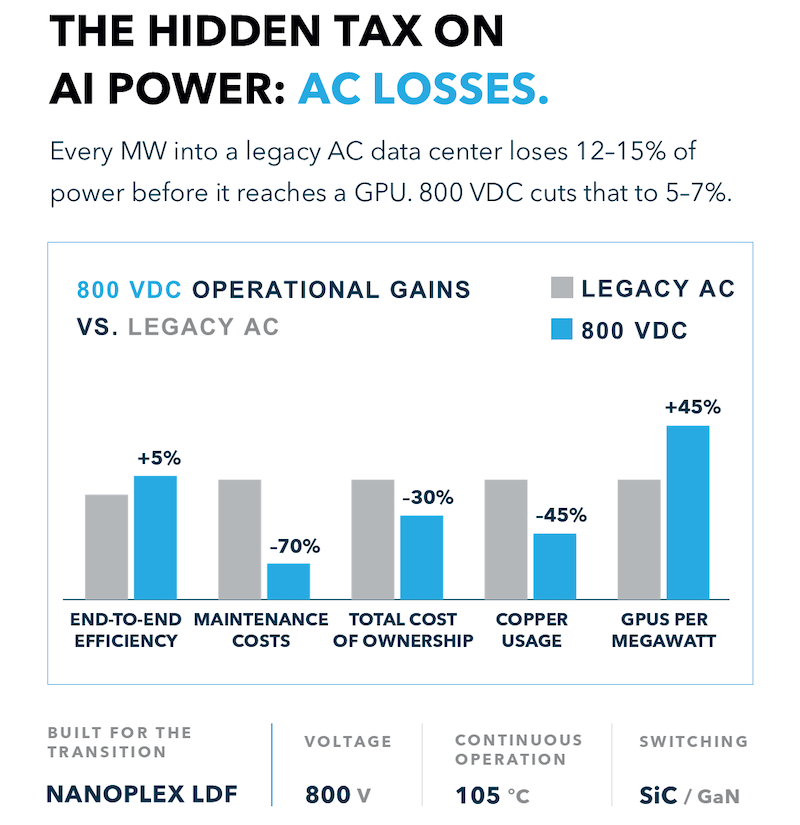
800 VDC provides numerous advantages over legacy VAC systems for AI data centers. [click to enlarge]
Efficiency matters. But the real change is deeper in the stack: 800 VDC makes film capacitors ubiquitous.
Every major function in the 800 VDC chain leans on capacitors:
- Rectifier DC‑bus output filters
- Busway protection and surge‑suppression modules
- Rack‑level LLC resonant tanks and snubbers
- Energy‑storage shelves that absorb millisecond‑scale GPU power spikes
Film capacitors are the connective tissue of the 800 VDC ecosystem, determining whether AI power architectures actually deliver what they promise.
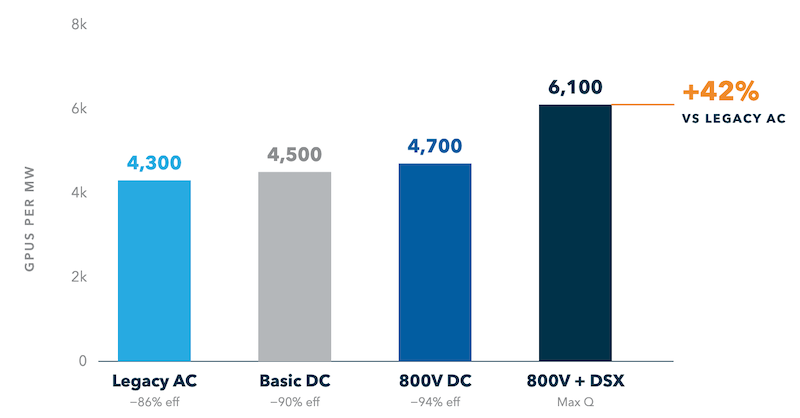
A comparison of GPUs per MW for different voltage supply systems.
When Temperature Breaks Your Design
This is where materials are either a constraint or an enabler.
Most legacy capacitor designs are rated to 85 to 105 °C. In 800 VDC AI environments, busways, racks, and power stages routinely push toward 125–135 °C. Wide‑bandgap stages drive higher ripple current density into the DC link, and power distribution runs hot.
Capacitors designed for yesterday’s temperature envelope start to struggle. To cope, you end up derating capacitors, stacking more of them in parallel or series, or wrapping them in extra cooling hardware. This adds cost, complexity, and failure points.
Next‑generation data center architectures built around SiC and GaN devices and solid‑state transformers and switches are already optimized for these higher temperatures and switching frequencies. The capacitor bank has to follow suit. Without a design upgrade, the DC link becomes a constraint dictating capacitor bank size, cooling requirements, and maintenance schedules.
To hit AI power‑density and efficiency targets, you need next-generation capacitor designs and high-temperature dielectrics engineered for 800 VDC’s wide‑bandgap frequencies and real‑world thermal conditions. Not devices you have to nurse along with derating curves and fans.
A Utility‑Scale Question
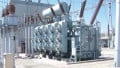
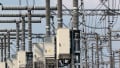
The importance of DC-link film capacitors doesn't stop at the rack. Utilities are up against the same physics. Reactive compensation banks, harmonic filters, and power factor correction equipment for AI campuses face rapid, high‑magnitude load swings from AI training cycles, tight grid‑code requirements on power quality, and multi‑decade service life expectations.
Substation‑level capacitor banks need the same traits as the DC‑link banks inside the racks, including low loss, high current capability, and high‑temperature endurance. For utilities planning substation upgrades for AI loads, capacitor film selection now impacts 15-year reliability, maintenance, and performance.
The Qualification Window Is Closing
DC‑link film capacitors have always mattered. The 800 VDC transition elevated the requirements for their capabilities and made them essential infrastructure.
Architectures for 2027–2028 AI factory deployments are being locked now. And the decisions around film technology and capacitor vendors will determine field reliability and operating cost as AI capacity ramps through the end of this decade.
When you upgrade one major element of a system, you have to look at the impact on the entire power chain. Capacitors can either upgrade or limit system performance and reliability. If you modernize everything except the DC link, you risk baking in thermal, lifetime, and efficiency penalties for the next decade. These only become visible once it’s hard and expensive to change.
AI has forced power electronics into a new operating regime. Capacitors, and the films inside them, need to catch up. And the teams that act now will build power systems that can actually keep pace with AI compute.
If you are interested in learning more about this topic, check out this webinar on The Race to Win AI from Peak Nano.