Facebook
 Google
 GitHub
 Linkedin
Tesla-Type Turbine Generates Electricity Using Air and Static
South Korean researchers have developed a Tesla-inspired turbine that uses triboelectric nanogenerators and the electrostatic potential of particulate matter from the air.
In 1913, Nikola Tesla patented a bladeless turbine design that could run on water, steam, or air. It was small—only six inches long and weighing just 10 pounds—but it could generate up to 30 hp. The design was simple: it didn’t rely on blades like conventional turbines but instead contained a series of closely packed parallel disks attached to a shaft. Most turbines used today use blades, but electronics still have a place for a bladeless turbine, especially one that can use renewable energy.
Building on the Tesla turbine structure, South Korean researchers have developed a Tesla turbine-inspired structure that uses triboelectric nanogenerators (TENGs) and the electrostatic potential of particulate matter to drive disk motion. The turbine generates an electrostatic discharge (ESD)-based electrical output using high-pressure air.
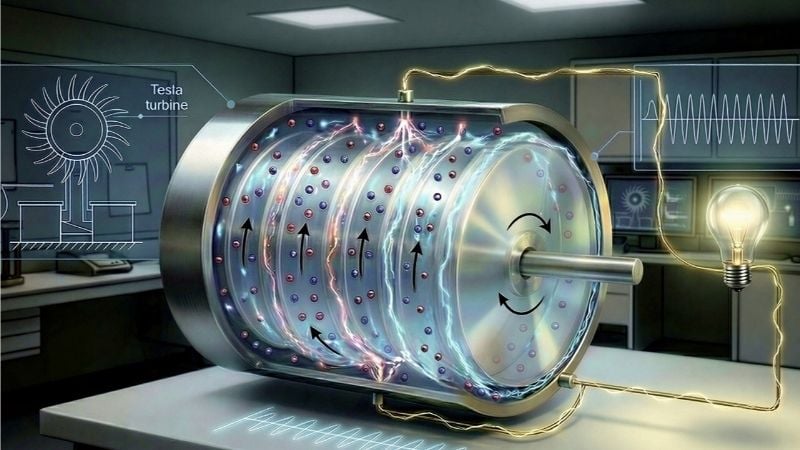
The researchers’ concept of a Tesla-type turbine powered by a particulate static effect. Image used courtesy of Chung-Ang University
The Tesla Turbine Structure
Tesla wasn’t the first person to invent a bladeless turbine. A European patent had existed since 1832, but in 1906, Tesla brought the concept to life through multiple design iterations and improved prototypes.
In the Tesla Turbine, a current of fluid—water, steam, or air—is subjected to pressure, which actuates the disks. This causes them to rotate and generate mechanical power.
The energy generation process starts when pressurized fluid (gas or liquid) enters the turbine chamber. The fluid passes between the disks via exhaust ports, making them rotate as the fluid hits the edges of each disk before passing over the disk’s center. The disks connect to a rotating shaft that generates electricity.
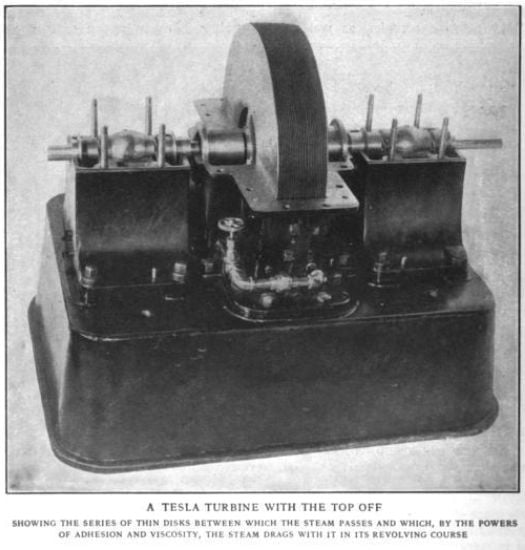
A Tesla Turbine from 1912. Image used courtesy of Wikimedia Commons
In theory, the turbine could use any number of disks, so the size could be tailored to the application’s power needs. More disks provide more power, but they require a larger fluid flow to spin.
Despite the potential of Tesla turbines, conflicts with Thomas Edison, mechanical degradation concerns, and engineers’ inability to replicate Tesla’s results hampered the adoption of the bladeless design.
The Turbine Inspired by Tesla
Building on the Tesla turbine structure, a research team led by Chung Ang University has developed a Tesla turbine-inspired structure (a turbine with disks) that uses TENGs and the electrostatic potential of particulate matter to drive the movement of the disks. The turbine generates an electrostatic discharge (ESD)-based electrical output using high-pressure air.
While an ESD-based mechanism has shown promise, uncontrolled electrical discharge can cause fires and damage in industrial applications. Other efforts in similar turbines have required adding other particles or water to dampen these effects.
However, scientists have not directly addressed the challenges and hazards posed by high electric potentials. This time, the researchers wanted to tackle these problems by using TENGs.
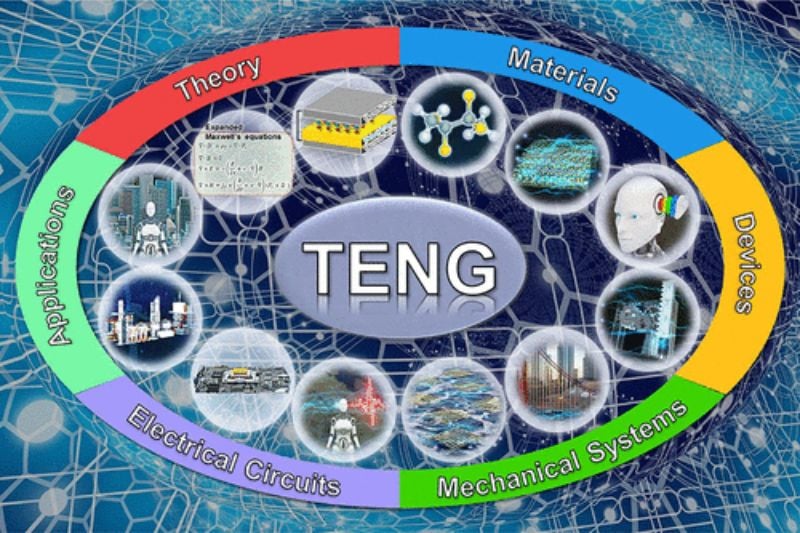
TENG applications. Image used courtesy of Choi et al.
Generating an electrostatic potential in particulate matter and converting it into electricity has been a common energy-harvesting route for TENGs in small-scale devices. But while TENGs have shown potential for small-scale applications, they may be able to generate large-scale energy using a Tesla-inspired turbine.
In their initial studies, the researchers found that TENGs can generate electricity via the particulate static effect—an effect in which fine particulate matter generates surface charges when it passes over a surface under high-pressure air. Researchers found that this structure could generate surface changes on the triboelectric layer of the TENG. They designed the turbine system to work using compressed air that generates both electrostatic charges and viscous force on the turbine disks.
How the Turbine Works
In a conventional Tesla turbine, the fluid moves across a disk’s surface towards the exit of the turbine casing, rotating the disks in the process. Fluid flows through the path of least resistance, causing gradual changes in velocity that turn the turbine shaft.
This new turbine works on a similar principle with significant differences. The compressed air introduced into the turbine provides the viscous force that induces rotational motion of the disks. The TENGs contain tribo-positive and tribo-negative layers that accumulate surface charges through the particulate static effect, without any frictional sliding. This enables the turbine disks to behave like non-contact TENGs, which generate electricity by electrostatic induction from the rotating electrodes.
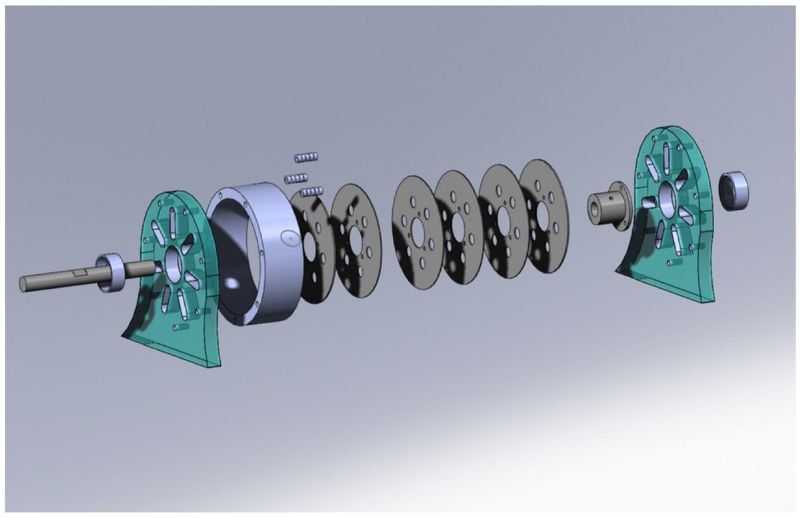
Illustration of a Tesla turbine. Image used courtesy of Capata and Calabria
To determine the turbine’s effectiveness, the researchers measured the charge transferred from compressed air by mapping the triboelectric layer. This analytical method showed that this turbine could generate up to 800 V and 2.5 A of ESD output at 325 Hz and a rotational speed of 8,472 rpm.
This non-contact approach uses electrostatic charges and viscous force of compressed air to move the turbines, while the high-voltage output prevents dust and moisture from collecting on the turbine disks. While not exactly the same as Tesla’s designs, this new turbine utilizes the basic disk structure as a fundamental principle while taking advantage of triboelectric technology.
Where the Turbine Could Be Used
The study showed that the Tesla-inspired generator could power a range of electronic systems while regulating humidity by collecting moisture from the air and removing airborne dust within the turbine. These characteristics could be harnessed and applied to power a range of industrial applications with compressed air and wasted airflow, such as manufacturing, food processing, and automotive machinery.