Facebook
 Google
 GitHub
 Linkedin
Sticky Solution: Mussels Inspire Lithium-Metal Battery Electrolyte
Researchers developed a mussel-inspired solid electrolyte that suppresses dendrites and improves safety in lithium-metal batteries.
Could a battery material inspired by mussels help prevent dendrites and thermal runaway? South Korean researchers think it might be possible.
The team at Chonnam National University (CNU) developed a tri-layer composite solid electrolyte modeled after the adhesive proteins mussels use to stick to rocks. The result was a longer-lasting battery with no dendrite growth after 1,000 charging cycles.
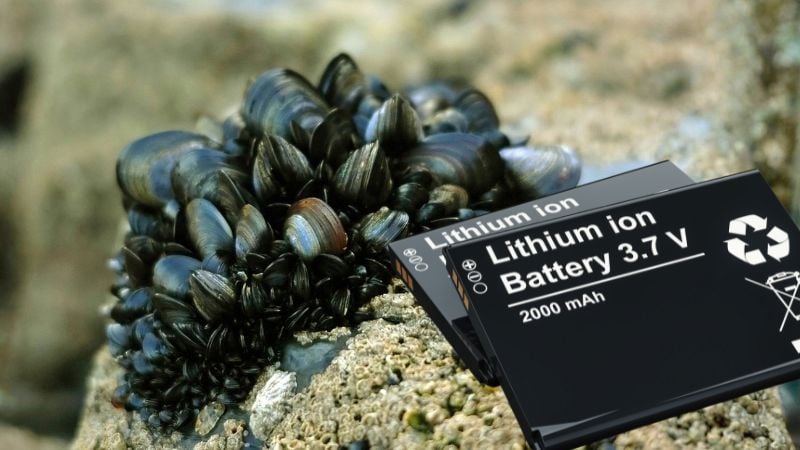
A mussel-like adhesive might make batteries safer. Image adapted from image used courtesy of Wikimedia Commons
Lithium-Metal Batteries: The Challenge
Lithium-metal batteries use pure lithium metal as the anode, whereas Li-ion batteries use graphite. While graphite has become a staple, lithium metal significantly improves a battery's theoretical energy density because it has a theoretical specific capacity roughly 10 times that of graphite. Lithium-metal batteries also have a low redox potential, which, combined with the high specific capacity, gives them a much higher theoretical energy density.
However, dendrite formation limits their practicality by reducing cycling stability and causing safety issues such as electrolyte breakdown, reduced Coulombic efficiency, and uneven solid-electrolyte interface formation. Therefore, the usable lifetime of current lithium-metal batteries is limited, making them unsuitable for commercial high-performance technologies such as electric vehicles.
Using solid-state electrolytes instead of flammable liquid electrolytes, especially solid polymer electrolytes with good electrochemical stability and mechanical flexibility, is attracting significant attention to make lithium-metal batteries last longer and be safer.
Mussel-Inspired, Three-Layer Electrolyte
The team designed a three-layer composite electrolyte with two softer outer layers and a more mechanically robust inner layer. They used PEO (polyethylene oxide) and a lithium salt called LiTFSI, or lithium bis(trifluoromethanesulfonyl)imide, to form a PEO/LiTFSI matrix on the outer layer.
For the central layer, they used a PEO/LiTFSI matrix reinforced with LLZO (lithium lanthanum zirconium oxide) ceramic particles coated with PDA (polydopamine), and PPP (poly(ethylene glycol)-block-poly(propylene glycol)-block-poly(ethylene glycol)—a flexible triblock copolymer. This was referred to as PDA@LLZO-PPP and designed as 10-40% of the layer’s weight. They fabricated the three-layer composite using solvent-assisted dispersion, tape casting, thermal lamination, and hot-pressing methods.
The PDA in the central layer was inspired by the chemistry behind mussel adhesion, which uses the molecule “DOPA” (3,4-Dihydroxy-L-phenylalanine) in its foot proteins. This amino acid has exceptional wet and dry adhesive properties. Mussels use DOPA in their proteins to stick to a wide range of dry and wet surfaces.
Learn more about the three-layer electrolyte. Video used courtesy of CNU
The three-layered composite leverages similar adhesive properties using PDA-functionalized LLZO. Instead of using adhesive properties to stick to an external surface, the researchers used PDA@LLZO’s adhesive properties to improve interfacial adhesion and chemical compatibility between the internal layer and the PEO in the outer layers.
PDA forms hydrogen bonds with PEO polymer chains, passivates reactive surface sites, and creates a flexible interface that promotes lithium-ion transport through percolating conduction networks and continuous ion pathways—especially as PDA increases Li+ concentration by selectively interacting with TFSI- ions.
The hydrogen-bond network also provides uniform particle dispersion at the interface and reduces interfacial resistance by separating the ceramic-rich layer from the cathode. This boosts the electrolyte’s ionic conductivity and mechanical strength inside the lithium-metal battery.
The flexible PPP in the central layer reinforces the electrolyte structure, improves its mechanical flexibility, and redistributes localized stress. These properties help deflect dendritic intrusion and suppress dendrite growth by reducing the rigid material they can penetrate and propagate through (which usually causes cracking in more rigid solid materials once a nucleation site has been established inside voids). The composite’s outer layers provide intimate contact with the electrodes and lithium transport channels, improving lithium transport.
The research team also found that during operation, a conformal, chemically uniform solid electrolyte interphase layer forms, enriched with LiF and polymer-derived organic species. This helped to ensure interfacial continuity and electrochemical stability during operation.
The ‘Mussel Battery’ Performance
Although the battery is not anything like a mussel, PDA's adhesive properties offer many benefits, much like DOPA does for mussels sticking to rocks. In the formal cell tests, the three-layer electrolyte contained 30% by weight of PDA-coated LLZO, with layers of equal thickness.
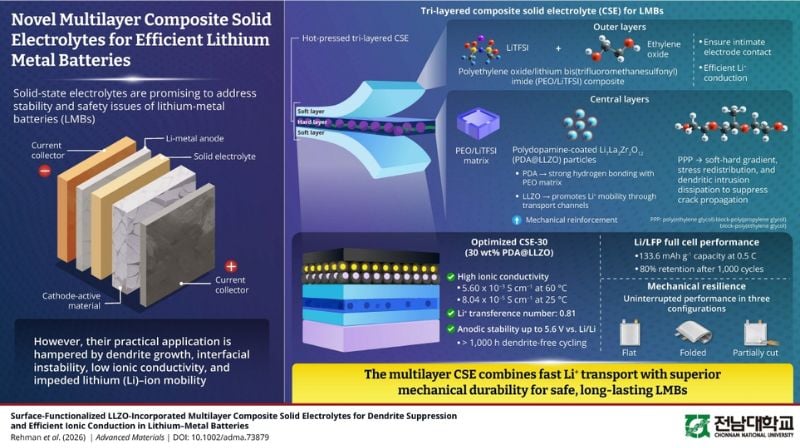
Graphical abstract of the solid electrolyte. Image used courtesy of CNU
The triple-layer electrolyte achieved an ionic conductivity almost four times that of a PEO electrolyte. Specifically, the electrolyte exhibited an ionic conductivity of 5.60×10⁻³ S cm−1 at 60°C and 8.04 × 10⁻⁵ S cm−1 at 25°C. The triple-layer electrolyte also had a lithium transference number (a measure of Li-ion transport efficiency) of 0.81, meaning the Li+ carried most of the ionic current.
In a full-cell configuration, the mussel-inspired electrolyte delivered 133.6 mAh/g at 0.5C with 99% Coulombic efficiency. It retained at least 80% capacity after 1,000 cycles without short-circuiting, offering over 1,000 hours of dendrite-free cycling at 0.2 mA cm−2.
The researchers subjected the cell with the flexible electrolyte to physical tests to assess its mechanical durability. When fabricated into a flexible pouch cell, the cell continued to power an LED when folded and partially cut.
Anticipated Applications
Because the electrolyte has been integrated into a lithium-metal battery, it could be used in higher power applications, such as EVs. The researchers said this type of electrolyte could enable longer-range, safer EVs and long-duration energy storage systems.
The study appeared in Advanced Materials.