Facebook
 Google
 GitHub
 Linkedin
Law Bending: More Ion Flow, Faster Charging Supercapacitors
Research yields insights on ion flow dynamics and pore connectivity, charting a path toward faster charging in supercapacitors.
Controlling the efficient flow of ions is essential in designing advanced supercapacitors that can charge electric vehicles in minutes. University of Colorado (CU) Boulder researchers reimagined long-established Kirchhoff’s circuit laws to model a network of nanoscale pores with enhanced ion transport, enabling faster charging for supercapacitors.
By tweaking Kirchhoff’s laws to apply to ionic diffusion, the team discovered ions could flow through large interconnected networks rather than single pores individually. Using the new framework, they developed a model to simulate a network of 5,000 pores in six minutes.
The findings can be used to optimize pore networks and materials in supercapacitors, which store and release energy by accumulating positive and negative ions at an electrode surface (pore). Arranging transport through an interconnected system could allow ions to flow more efficiently.
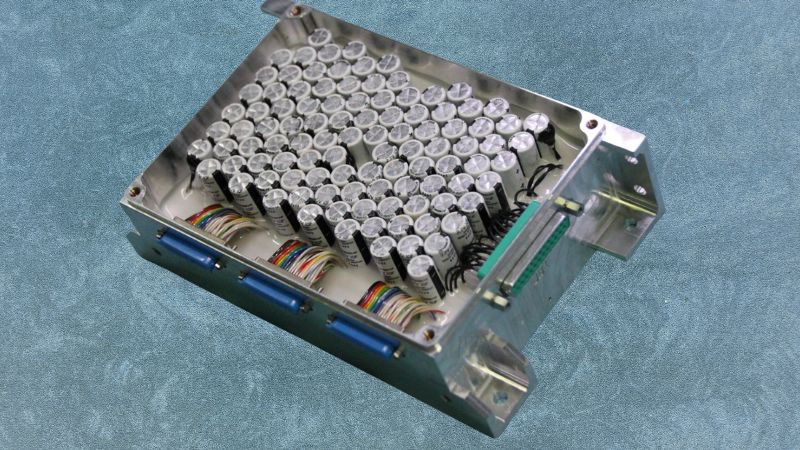
This bank of 34 supercapacitors provides quick bursts of power for space missions. Image used courtesy of the European Space Agency
Supercapacitors
Supercapacitors are gaining traction for their competitive charging time and lifespan. With triple the power density of lithium-ion batteries, they offer a significantly higher charge rate and discharge within seconds or minutes, beating the hours-long standard of most batteries today. They also last 10 to 15 years—up to 1 million charging cycles—whereas lithium-ion batteries wear out in about five years.
However, since supercapacitors store less energy, they’re limited to applications demanding immediate bursts of power, such as medical defibrillators or onboard equipment in space missions. They can also help balance loads in electric grids, mitigating the impact of intermittent energy supply from solar and wind resources.
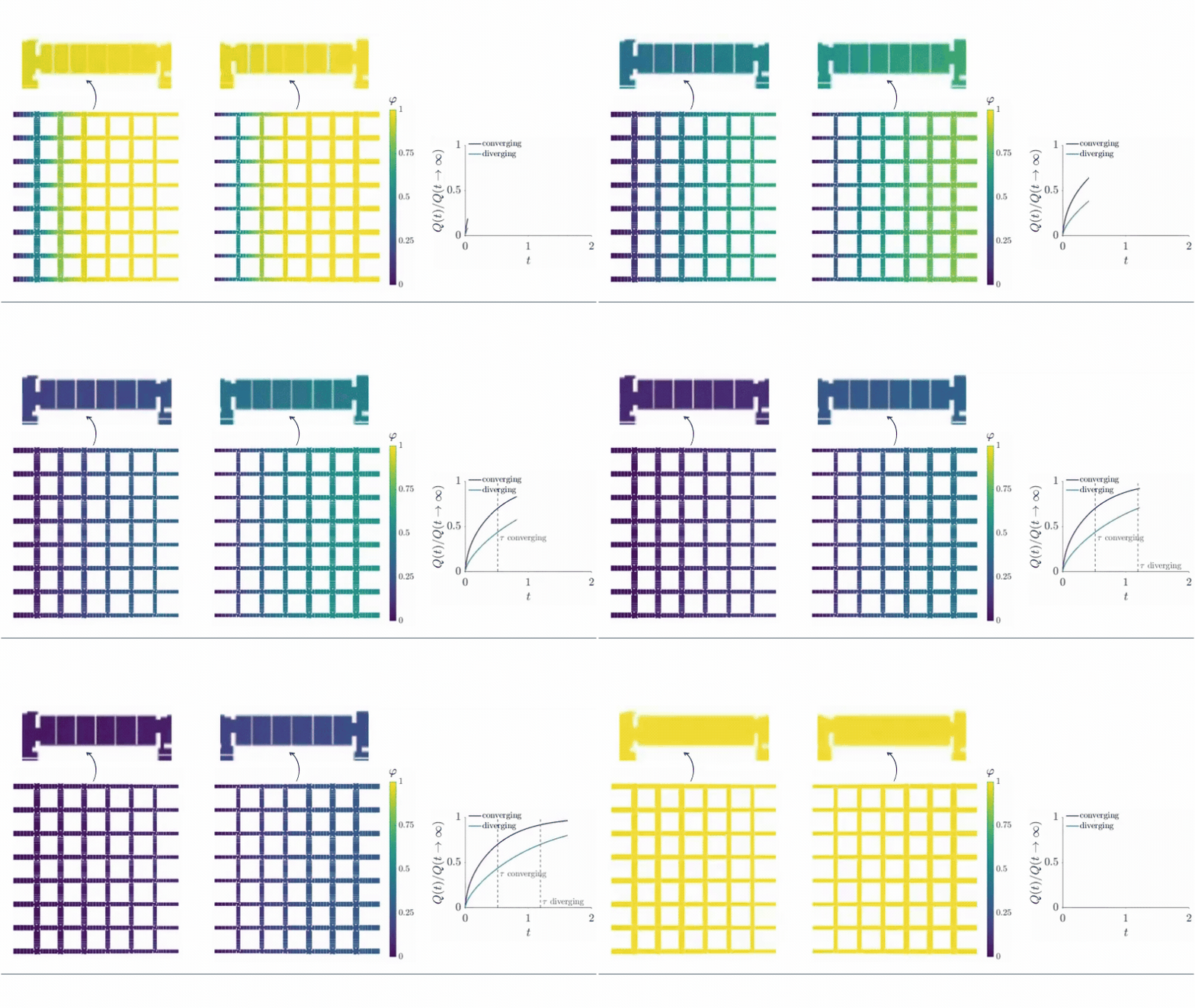
A visual of the simulation model developed by CU Boulder researchers. Video (adapted to GIF) used courtesy of Filipe Henrique
Rethinking Kirchhoff’s Law for Ionic Currents
Kirchhoff’s circuit laws, the eponymous work of German physicist Gustav Kirchhoff in 1845, cover the current and voltage of electrical circuit junctions. Two principles are at play. Kirchhoff’s current law explains that the sum of currents entering a circuit’s junction or node equals that flowing out of it. In Kirchhoff’s voltage law, the sum of voltages across a circuit junction must be zero to avoid disruption.
The CU Boulder researchers noted that Kirchhoff’s laws describe electrolyte transport as the charge’s electrochemical potential rather than its electric potential. The concept could be modified to govern ion diffusion, not just electron transport.
In their study, the team adjusted Kirchhoff’s laws to swap out voltage (V) with an electrochemical voltage (φ) that combines diffusion and voltage.
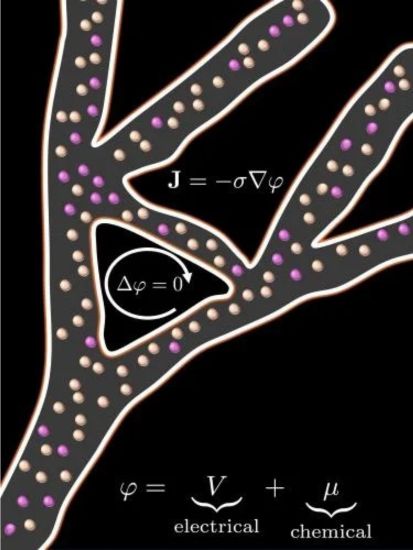
Modifications to Kirchhoff’s laws. Image used courtesy of the University of Colorado Boulder
Ion movements have historically been understood to move through diffusion in one straight pore rather than a series. However, with the modified Kirchhoff’s laws, the researchers found that narrow pores and junctions were possible by combining the charge density and electric potential into one concept—the electrochemical potential of charge. As such, the framework expands ion movement to large networks of thousands of interconnected nanopores.
Simulating Charging Dynamics
Supercapacitors employ electric double-layer (EDL) capacitance at the contact surface of porous nanoscale electrodes. Due to the computational intensity of direct numerical simulations, EDL charging research has been limited to simple geometries.
To address this gap, the CU Boulder team developed a network model to accurately predict EDL charging in long pore networks without restricting the pore radii and EDL thickness. The results found that the new framework sped up numerical computations by six orders of magnitude, simulating a triangular lattice of thousands of pores in under 10 minutes.
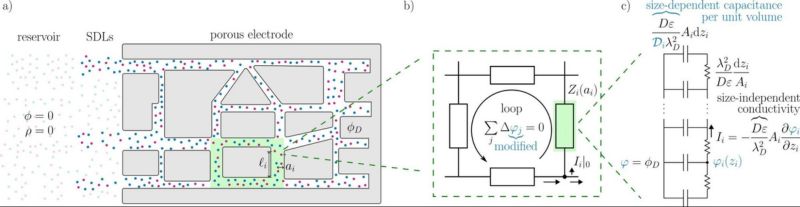
A transmission-line model for EDL charging in long pore networks shows a modified circuit representation where pores of varying sizes intersect. Image used courtesy of Filipe Henrique
The team also investigated the relationship between charging time, pore size distribution, and connections. A pore network can be arranged to split a current from a narrow pore into junctions to optimize materials for faster charging.
These results could inform 3D printing designs to customize supercapacitor ion flow for microscale electrodes in IoT energy storage devices.