Facebook
 Google
 GitHub
 Linkedin
Introducing an Efficient, Low-Cost Photoreactor for Solar-Driven Synthesis
German and Canadian researchers demonstrate a low-cost photoreactor concept supplying high photon/energy efficiency without sun tracking.
A new photoreactor module developed by German and Canadian researchers brings a low-cost and highly efficient array of reaction channels for solar-driven synthesis. Teams from the Karlsruhe Institute of Technology and the University of Toronto say the concept could produce hydrogen on rooftops or solar farms.
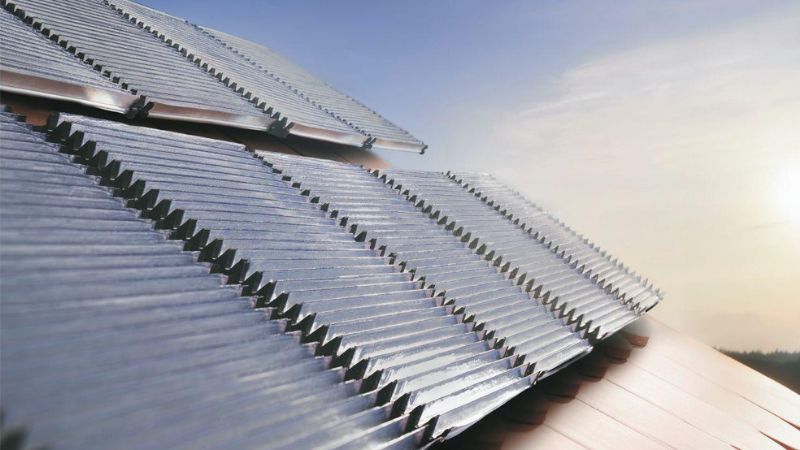
A new study details a photoreactor panel design that can be inserted into inexpensive solar modules. Image used courtesy of the Karlsruhe Institute of Technology by Amadeus Bramsiepe
The researchers used artificial photosynthesis with photocatalysts, which could be applied to decompose water into hydrogen and oxygen or produce clean fuels from water and carbon dioxide (CO2). Such technologies have mostly been limited to laboratory research due to the high cost of solar-hydrogen production. However, the team’s concept bypasses these barriers with highly efficient photoreactor panels inserted into inexpensive modules.
The photoreactors are easily manufacturable through mass fabrication techniques in polymers. In the study—published recently in Joule—the researchers said their photoreactor addresses two major engineering challenges: creating the right operating conditions for the quantum yield of the photocatalyst to peak and ensuring high-efficiency transport of radiation from the photoreactor aperture to the photocatalyst. The result is high photon/energy efficiency throughout the day/year without requiring sun tracking.
The concept features microstructured polymer panels coated with aluminum for high reflectivity. The researchers used computer-aided geometry optimization techniques and a photocatalytic model to demonstrate the design.
The researchers said future modules could be designed with high chemical reaction efficiency via artificial photosynthesis to reach maximum efficiency in several applications. However, the photoreactor panels must be spread across large surfaces to produce the necessary product quantities. This could be achieved with inexpensive materials and geometries already capable of production in a series. The study estimated that a photoreactor module of 1 square meter would cost $22.

A laboratory demo of the photoreactor. Image used courtesy of the Karlsruhe Institute of Technology by Amadeus Bramsiepe
After publishing their study, the researchers are now developing a photocatalyst that can efficiently decompose water into hydrogen and oxygen, to be integrated into the photoreactors. They’re also exploring the potential to mass-produce the panels. The study mentions the microchannel arrays, which operate with a low-temperature-active photocatalyst, can be mass-manufactured with materials that ensure the concentrator and cavity walls retain high reflectivity at a low cost of the overall channel array.
How the Photoreactor Concept Works
While photocatalytic processes that use water and CO2 as feedstocks bring promise in the global transition to renewable energy, a record of low photocatalytic efficiencies and high costs are significant barriers to scaling the emerging technology.
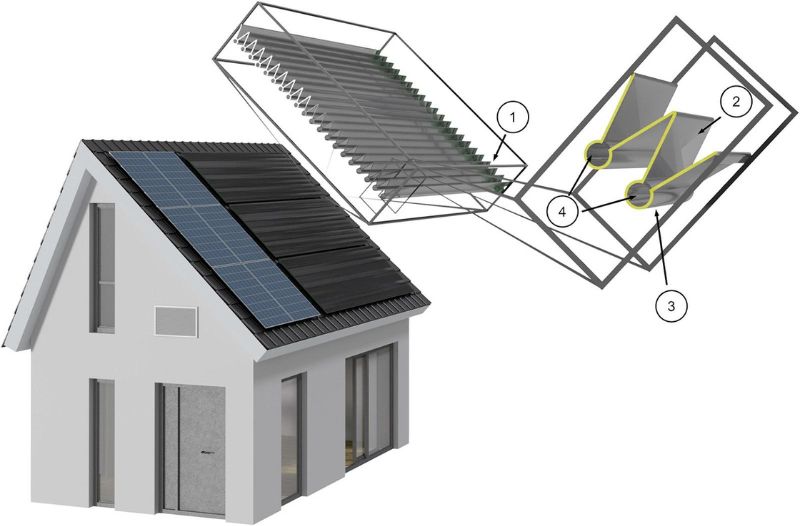
The photoreactors on a house’s rooftop. 1) points to the fluid connectors distributing reactor feed and collecting products, 2) shows the transparent polymer optics module with reaction channels, 3) is the outer reflective coating, and 4) shows individual reaction volumes. Image used courtesy of the authors (Creative Commons)
The researchers wanted to address these challenges with a low-cost, milli-to-micro structured photoreactor concept suitable for small-scale decentralized and large-scale solar farm applications. The panel-like photoreactor hosts hundreds of parallel reaction channels, each featuring a V-shaped concentrator and a tube-like cavity holding the reaction volume.
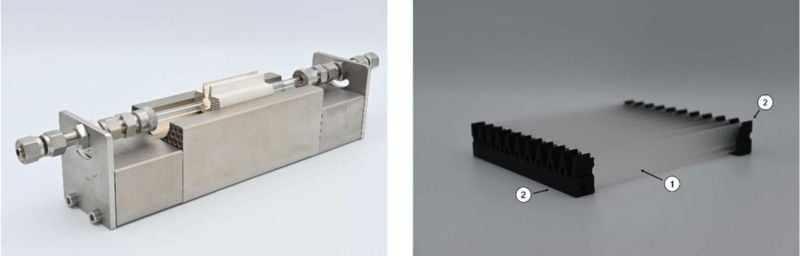
The left photo shows the lab-scale demonstrator, while the right shows a 3D-printed polymer prototype with a 10- by 10-centimeter aperture area. 1) references the optics module and 2) shows the two fluid connectors. Image used courtesy of the authors, page 18 (Creative Commons)
The team developed a design guideline for facile photoreactor dimensioning to connect the design parameters and performance metrics that could be adapted and enhanced for future solar-driven photosynthesis applications. Further work could extend the guideline to photocatalysts that don’t just absorb light but scatter it.
The paper discloses that the authors have a pending patent application by the Karlsruhe Institute of Technology for the photoreactor design concept.