Facebook
 Google
 GitHub
 Linkedin
Faster Ion Movement Could Speed Up Advances in Battery Charging
Enhanced ion speed in organic materials could improve battery charging, soft robotics, and neuromorphic computing.
Enhanced ion speed in organic materials could improve battery charging, soft robotics, and neuromorphic computing.
Researchers have long sought materials to bridge the gap between biological systems and electronic technologies. Organic conductors have opened frontiers in fields ranging from biosensing to neuromorphic computing, but researchers have faced challenges in creating materials that can manage both ionic and electronic transport.
Washington State University and Lawrence Berkeley National Laboratory research could transform this technological landscape.
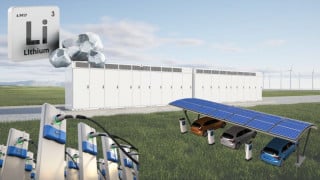
Ionic-electronic conductors could enhance battery charging technology. Adapted from images used courtesy of Canva
Organic Background
Organic mixed ionic-electronic conductors (OMIECs) are made of polymeric materials uniquely designed to simultaneously facilitate ion movement and electron transmission through their molecular architecture. Compared to inorganic materials, OMIECs offer significant advantages, including high volumetric capacitance that allows efficient ion injection and swelling of the material. In addition, OMIECs lack surface dangling bonds, which hinder ion transport and affect material properties.
OMIEC-based devices have demonstrated superior performance in converting electrophysiological signals within the body and brain compared to their inorganic equivalents. These materials leverage ion movement, similar to biological signaling in the human body, while also conducting electrons. Blending these two transport forms allows OMIECs to interface efficiently with biological systems and electronic circuits. However, the primary challenge with OMIECs is the inherently slow ion transport compared to electron transport.
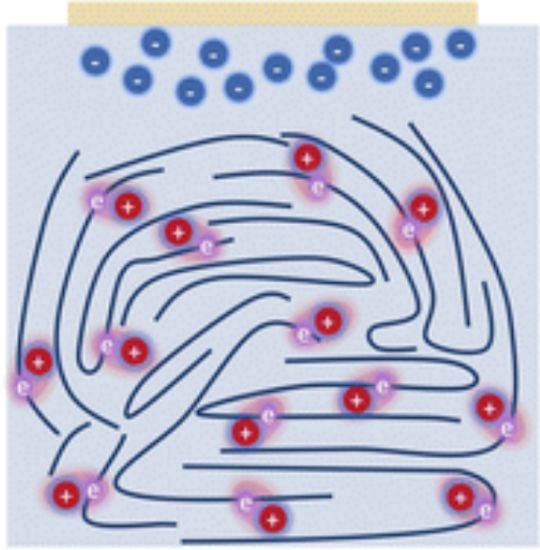
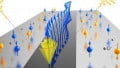
Portraying electron and ion movements. Image used courtesy of Fabiano et al.
Ions must navigate complex, disordered pathways, similar to a “rat’s nest” of pipelines. This significantly hampers their speed and reduces the overall efficiency of devices. This slow ion movement constrains the speed of electrical signaling, impeding the performance of applications like rapid biosensors or fast-charging batteries. Furthermore, the mechanisms governing the coordination between ionic and electronic movement remain poorly understood, making it difficult to optimize these materials.
Achieving faster ion transport is essential for OMIECs to reach their full potential.
Breakthrough in OMIECs
Scientists at Washington State University and Lawrence Berkeley National Laboratory have advanced the performance of OMIECs by significantly improving ion transport speeds.
Specifically, this breakthrough involves creating a nanoscale architecture that enhances ionic mobility by more than tenfold. The researchers engineered dedicated nanometer-sized channels within the OMIEC matrix to streamline ion flow. In contrast to traditional “rat’s nest” flows, the new channels were lined with hydrophilic molecules that attract ions from an electrolyte solution, forming an efficient “ion superhighway.” The system allows ions to travel swiftly along these channels while electronic charges flow through the conductive matrix.
The result was ion movement at record speeds that surpassed water transport.
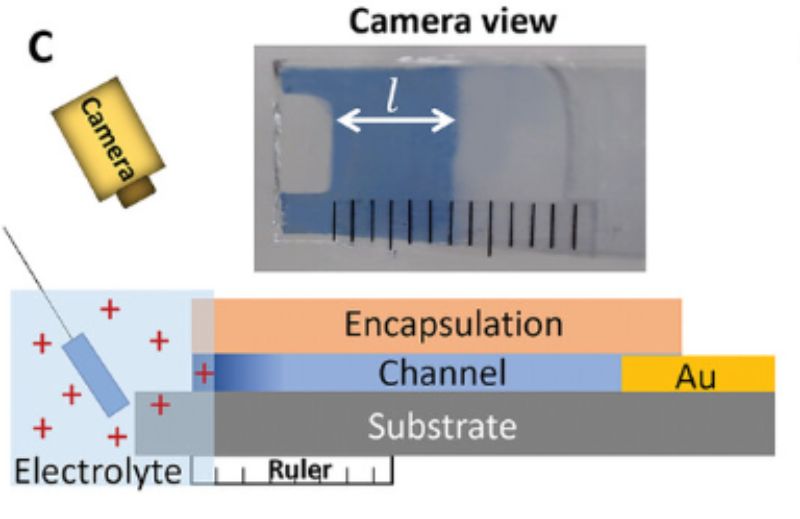
Schematic of the experimental setup. Image used courtesy of Khan et al.
The invention also includes dynamically controlling ion movement using surface chemistry. Hydrophobic molecules can repel ions, forcing them back into the slower matrix pathways, while hydrophilic molecules can attract and facilitate rapid ion flow. This mechanism enables a reversible switch that can open and close the ion pathways in response to specific chemical triggers, mimicking biological ion channels. The tunable feature allows for enhanced sensitivity in biosensing applications and rapid signal transduction, particularly in detecting chemical reactions on the nanoscale.
New Horizons
According to the researchers, these advances could change how we build batteries, medical sensors, and even brain-like computer systems. Scientists are bringing us closer to devices that work more like living systems by creating faster movement pathways for ions.