 Facebook
 Google
 GitHub
 Linkedin
Exclusive Interview: Aerospace Quality at Automotive Volumes to Power AI Racks
Eaton VP Peter de Bock explains why 800 VDC and solid-state transformers matter for dense AI racks, and why those racks need aerospace-grade engineering.
At this year's Open Compute Project (OCP) Global Summit, the conversation shifted from coolant distribution units to 800 VDC power and solid-state transformers (SSTs). For engineers, that raises practical questions about standards, supply, reliability, and retrofits.
Peter de Bock is Vice President of Data Center Energy and Cooling at Eaton, where he works across the company's divisions as a systems thinker. He previously led electrified aviation and data center cooling programs at ARPA-E and has a background at GE Aerospace. At OCP, he co-presented a keynote on 800 VDC with ABB entitled Shifting to DC Power Distribution in Data Centers: A Collaborative Journey.
Eaton’s Peter de Bock spoke at the 2026 OCP Global Summit with ABB’s Paolo Catapane. Video used courtesy of the Open Compute Project
EEPower spoke with de Bock after the show. The conversation has been edited for length and clarity.
800 VDC Is an Architecture, Not a Product
EEPower: What was the most interesting or encouraging development you saw at OCP?
Peter de Bock: Last year, OCP was all about the CDUs (Cooling Distribution Units). This year, it was all about 800 VDC and solid-state transformers. That message came from multiple speakers, and I think the discussion will continue into 2027.
EEPower: In your keynote, you described 800 VDC as an architecture, not a product. What technical challenges remain?
de Bock: The technical parts are relatively solved, or at least doable. The work now is getting everything standardized and certified so it can be sold as a system. The industry can only adopt something that is carried by an ecosystem, interoperable, and safe.
That is why the OCP white paper on low-voltage DC power distribution matters. Current/OS and the Open DC Alliance (ODCA), the foundational electrical communities, have strong technical depth, and the white paper brings it to the data center community. Eaton showed a 1,500 A, 800 V solid-state circuit breaker on the show floor, and our solid-state transformer is in development. I expect to see all of it deployed and certified in 2027.
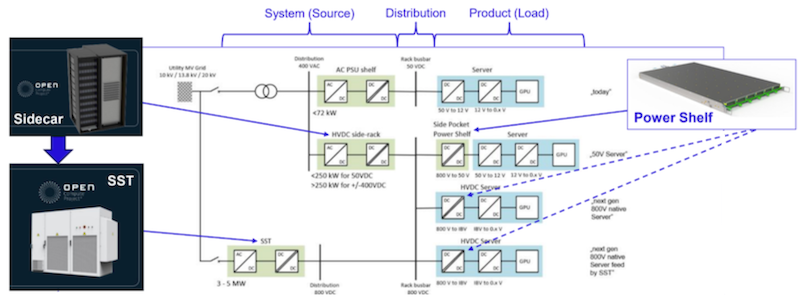
The Current/OS community has been instrumental in helping the Open Compute Project develop the framework for 800 VDC in AI data centers. Image used courtesy of Current/OS
EEPower: Do you expect full 800 VDC systems in 2027?
de Bock: You're asking me to speculate, but we will see a few 800 VDC deployments next year.
EEPower: Why is 800 VDC so important?
de Bock: It is almost a necessity for high-density racks. You do not want to deliver that much power at 480 AC, for efficiency and for dynamics.
A solid-state transformer switches at multiple hundred kilohertz, which gives you much better control of the bidirectional dynamics of a large load on the grid, plus stability, isolation, and programmability.
It is also a fungible device. You can install it today to produce 480 VAC, and later press a button to produce 800 VDC. With a traditional transformer, you have to rip it out and replace it.
Scaling Supply: Automotive DNA and Automated Manufacturing
EEPower: Are there economic challenges, from scaling or supply chains, that could slow adoption?
de Bock: It is always chicken and egg: how much do you invest up front? We have to match the ramp in demand with the ramp in our capabilities, and supply will probably be limited at first.
This industry has traditionally served utilities, which move at a different speed. Now we have to deliver gigawatt data centers at an increased pace, so we are moving many components to advanced automated manufacturing. For example, we have a fully automated electrical-gear facility in Vienna, Austria. I think the manufacturing giants will lead this space.
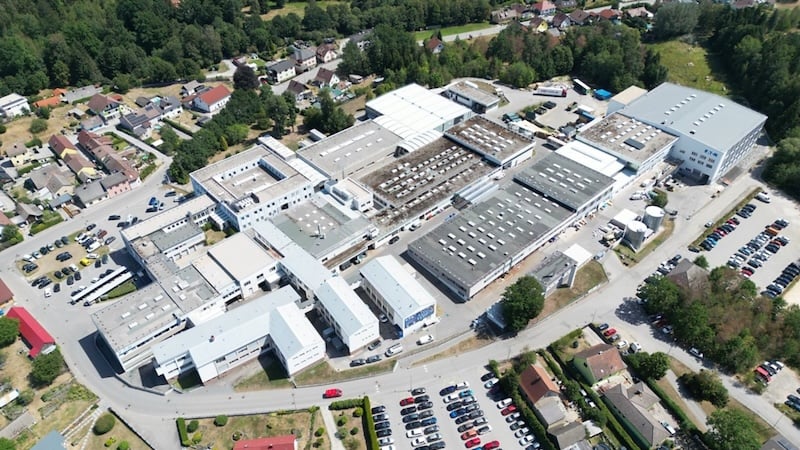
Eaton’s 2026 facility expansion in Austria adds 5,000 m² with advanced automation, digital integration, and end-to-end product traceability. Image used courtesy of Eaton
EEPower: So the technology that builds the components matters as much as the components themselves.
de Bock: Very much so. We are bringing Eaton's automotive DNA and long mass-manufacturing background to this. It also helps that 800 VDC is already standard in some vehicles. A customer asked whether we could design an 800 V connector, and we already had one from our automotive business. I think that availability is part of why the industry chose 800 VDC.
EEPower: Beyond automotive, what advantages does Eaton bring?
de Bock: Eaton is not afraid to invest in this space. We acquired Resilient Power for solid-state transformer technology, and we can take what was a startup to massive scale.
The second advantage is aerospace quality. Eaton makes the hose and quick disconnect used for in-air refueling of the Joint Strike Fighter. If you trust us with that, I think we can cool your server rack. If I need to go deeper technically, I can call the aerospace division, which can certify systems up to nine nines of reliability. My pitch to leadership is aerospace quality at automotive volumes. That is what the data center industry needs.
The Rack as a Factory: Reliability Beyond the Uptime Tiers
EEPower: Several people at OCP told me uptime and quality were a surprising theme. How do you see reliability requirements changing?
de Bock: I expect uptime requirements to go higher. Uptime Institute Tier III is 99.982 percent, and I would not fly a person on 99.982 percent. As data centers get denser and the investments larger, reliability needs to go much higher.
At GE Aerospace, we calculated for every circuit board how long it would run before failing in the worst environment, testing all the corner points. That gets you to nine nines. Military aircraft are around six nines, so we can move up and down that reliability chain.
There is also a divergence in data centers. Enterprise racks are 50 kilowatts and below. The extreme racks at 100, 200, or 300 kilowatts are multimillion-dollar investments that are basically factory outputs. If one goes down, that factory loses revenue.
I think that will drive the need for higher tiers and better ways of validating them, including HALT testing, which both Eaton and Boyd Thermal bring from aerospace and space work.
EEPower: Thinking of the rack as a factory helps me understand the investment.
de Bock: At roughly 500 kilowatts per cubic meter, a rack has about the same energy density as a Honda four-cylinder engine, so you should do the numbers yourself. This is no longer telecom. It requires strong engineering companies to design power and cooling as a single system. A car company does not buy the fuel system from one vendor and the cooling from another.
Power and Cooling as One System
EEPower: How do you use your expertise in both areas to improve efficiency and reliability, compared with treating them separately?
de Bock: I report to Eaton's CTO as the system thinker across the component divisions. Eaton now has a data center segment, formed earlier this year, and it reflects Eaton going from component supplier to full subsystem supplier. Can we sell an entire pod, designed as a pod? I was also involved in the acquisition of Boyd Thermal.
EEPower: What does a pod include?
de Bock: A pod, also called an L12, combines the racks, power architecture, cooling architecture, busway, and connectivity into one modular system. It looks a little like an engine block. That is why Eaton has broadened its portfolio to go from grid to chip.
The $9.5 billion Boyd Thermal acquisition means we own the cooling architecture too, including the cold plates and CDUs. To me, it is one energy flow: electricity comes in, goes through the chip, and comes out as heat.
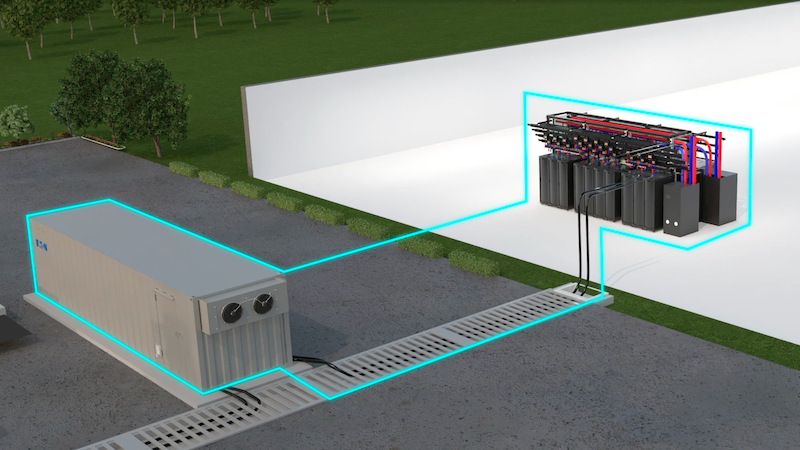
Eaton is collaborating with NVIDIA to develop modular solutions for AI data centers like the Beam Rubin DSX to maximize system performance across both power and cooling. Image used courtesy of Eaton
Retrofits, Sidecars, and Compute Density
EEPower: Is there a reasonable retrofit path for existing data centers?
de Bock: I think there is, especially with solid-state transformers that can also output 480 AC. Some cells in your data center could stay at 480 while others move to 800. The other path is the sidecar: you keep 480 through the facility and convert to 800 close to the rack. Eaton demonstrated an air-cooled 800-kilowatt sidecar at last year's OCP, and a liquid-cooled next generation is coming.
EEPower: What is the biggest benefit of the sidecar?
de Bock: When you switch faster, the magnetics and capacitors shrink, so the topology gets simpler and you keep compute density in the rack. AI computing is about getting as many transistors as possible to work together as one unit, so you make the processors as big as you can and place them close together.
If a power supply takes up a couple of rack units, you have wasted density. Shrinking it into DC-to-DC converters, or moving it to a sidecar, keeps that density with higher performance.
Skills, AI, and the Next Generation of Engineers
EEPower: What would you tell students interested in working on these problems at companies like Eaton?
de Bock: The data center industry is one of the biggest engineering efforts humanity has taken on, and it is our duty to design it economically and sustainably. Three technical pivots need deep technical minds:
- 800 VDC
- Solid-state transformers
- Liquid cooling
These areas span aerospace, automotive, electrical, and mechanical engineering. I have even thought about writing a university curriculum. My aerospace degree taught me to think in systems, and I feel blessed to have it in data centers.
EEPower: Engineering education tends to be narrow. Is it hard to find people with cross-disciplinary training?
de Bock: People come in with a skill set, and if they do well in one area, we can help them broaden it. Your entire career is a learning journey.
EEPower: How is AI helping you in your work today?
de Bock: We have put AI into our engineering practices already, and we will accelerate that, along with more automated manufacturing. Eaton gives employees access to AI tools within our private clouds. After one long meeting, I pressed a button and got a SWOT analysis of the discussion.
The second tier is accelerating engineering. When we start a new design, we can check our database for anything similar we have already designed. For a company with millions of SKUs, that saves a great deal of redesign work. We also work closely with NVIDIA and Autodesk. NVIDIA recently announced Eaton as a DSX partner.
EEPower: Is there any other message you want to get out to the industry?
de Bock: The next stage of AI needs more than processors. It needs power, cooling, and chips working together, and the chipmakers need us as much as we need them. I also hope people recognize the foundational work from Current/OS and ODCA. My OCP presentation (Shifting to DC Power Distribution in Data Centers: A Collaborative Journey) was not just about Eaton and ABB. We were showcasing the collaboration of an entire industry.