Facebook
 Google
 GitHub
 Linkedin
EV Charging on the Move: How the Wireless Technology Works
What if electric vehicle drivers could charge their cars while driving down the highway?
Advancements in electric vehicle charging are poised to address EV driver challenges and enhance the convenience of EV ownership. Research in wireless charging has usually focused on charging vehicles while parked, though some research has posited installing wireless chargers within roadways.
Researchers from the Ulsan National Institute of Science and Technology (UNIST), led by Franklin Bien, are working on a wireless charging track system for electric vehicles. This system will enable electric cars to charge while in motion, addressing the challenge of finding charging stations.
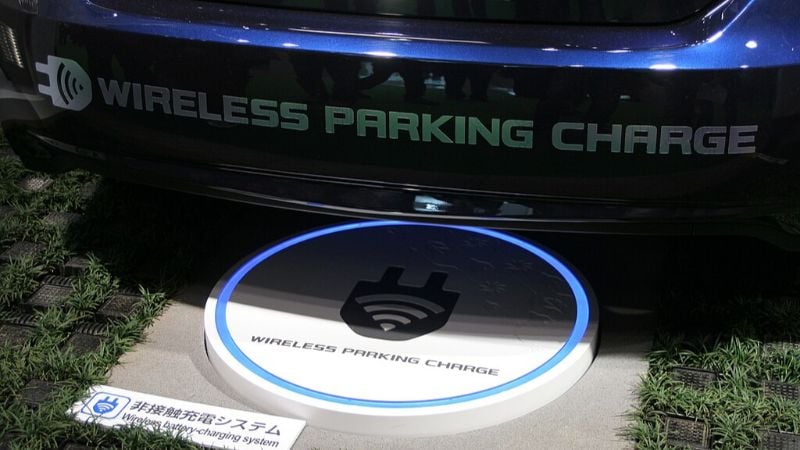
Parked wireless EV charging. Image used courtesy of Wikimedia Commons
How Does the Wireless Charging Track Work?
This innovative charging system creates a large magnetic field using wires arranged specifically to allow electric vehicles to charge without stopping. When an electric current flows through these wires, it generates a magnetic field around them, spreading over a wide area.
This magnetic field transfers power to the vehicle wirelessly as it moves along the track. The system is designed so cars can move freely in both forward and backward directions without staying precisely on the wires or using costly magnetic materials. As a result, the electric vehicle can charge while driving, offering a flexible and efficient way to stay powered without the hassle of stopping at a traditional charging station.
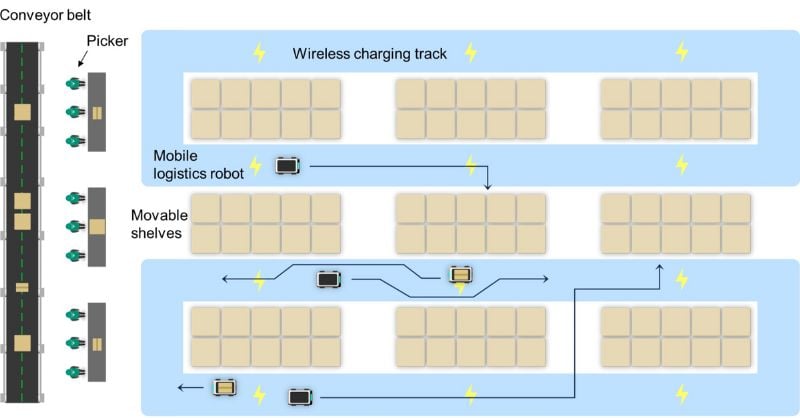
Wireless charging schematic. Image used courtesy of UNIST
The research team drastically improved the prior design. Rather than using costly magnetic materials, they developed algorithms to optimize the system. The algorithms resulted in a 90% increase in the power transfer efficiency for electric vehicles and enabled 100 MW. This approach is deemed more effective, as it involves less cost and has higher durability.
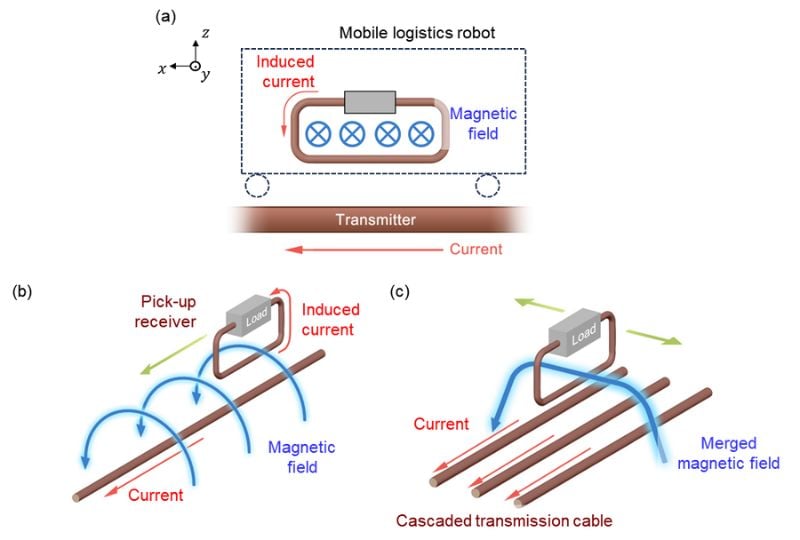
How the wireless charging track system works. Image used courtesy of UNIST
"Transportation, including electric vehicles, should be able to move flexibly not only in parallel but also vertically,” Bien stated, “However, existing dynamic wireless charging technologies have yet to achieve this."
While the UNIST team’s experiments used mobile robot electric vehicles, the technology could be scalable to full-size vehicles. This technology could reduce EV drivers’ worries about long charging times and short driving ranges, added researcher Hyunkyeong Jo.
“Furthermore, by reducing battery size, we can decrease air pollution stemming from resource extraction, such as lithium, promoting sustainable use of natural resources," he said.
Addressing Safety Concerns
The research team conducted a series of thorough safety checks to meet IEEE guidelines. The team ensured the technology would run safely and efficiently, guaranteeing reliable wireless charging without causing any harm to people or devices.
Additionally, they followed the International Commission on Non-Ionizing Radiation Protection (ICNIRP) safety standards. Since the wireless charging system uses electromagnetic fields to transfer power, it’s crucial to ensure those fields don’t harm anyone nearby. ICNIRP sets safe exposure limits to protect people from possible risks. By meeting these standards, the team demonstrated their technology is innovative and safe for everyday use in real-world environments.
The team plans to test their wireless charging system on larger vehicles in future research.