Facebook
 Google
 GitHub
 Linkedin
Engineering Jobs Expected to Grow in All Sectors in 2025
Power engineers remain in high demand in 2025, with openings in conventional and cutting-edge technologies.
The electronics market is projected to maintain its decades-long growth trend, creating a strong demand for engineers across various sectors. Opportunities abound in power systems, energy services, research and development, telecommunications, manufacturing, and government projects, including military aircraft, satellites, and radar and sonar systems.
According to the Bureau of Labor Statistics (BLS), 287,800 electrical and electronics engineers are employed in the U.S. today. California has more electronic engineers than any other state, followed by Texas, Colorado, and Florida.
The BLS projects a 9% increase in employment for these roles from 2023 to 2033—more than double the average growth rate of 4% across all occupations. This growth amounts to about 19,000 job openings annually over the next decade, driven by retirements and career transitions. Overall, the field is expected to add more than 26,200 employees by 2033.

Power engineer. Image used courtesy of Adobe Stock
Power Electronics Engineering Job Market
Power electronics design and development remains a highly sought-after engineering sub-field, with thousands of related positions listed on popular job boards:
- ZipRecruiter: 53,752
- Adzuna: 12,006
- Indeed: 8,000+
- Glassdoor: 3,966
- SimplyHired: 3,464
- LinkedIn: 2,737
- Dice: 2,173
Engineers specializing in electric vehicles, energy technology, batteries, aerospace, and power devices are in high demand. Tesla, GE, Boeing, Texas Instruments, ABB, and other industry giants are actively recruiting candidates skilled in hardware controls, materials, vehicle electronics, jet engines, GaN devices, and embedded systems.

Top tech skills among electrical engineering professionals. Image used courtesy of O*NET
According to O*NET, employer job postings frequently mention that electrical engineers should be experienced in standard software, such as AutoCAD, MATLAB, Revit, and Python and C++ programming.
Salary Trends and Highest-Paying Industries
Technical engineering salaries are growing ahead of inflation, especially for employees with Ph.D and management degrees, according to IEEE-USA's 2024 Salary and Benefits Report. The base salary rose by 5% from 2023 to 2024.
According to the BLS, the median salary for electronics engineers was $119,200 in mid-2023, slightly higher than the $106,950 estimate for electrical engineers. Employers typically value candidates with a bachelor’s degree and practical experience gained through cooperative engineering programs and internships.
R&D and aerospace engineers earn some of the highest salaries in the field, surpassing $130,000 annually. Among industries, semiconductor and component manufacturing offers the highest median pay at $144,960, followed by the federal government at $126,610, and navigational, measuring, control instruments, and electromedical manufacturing at $125,930.
Energy Engineers in High Demand
The energy sector is experiencing steady employment growth as grid operators and utilities ramp up power generation to meet increasing demand from energy-intensive data centers and artificial intelligence applications. According to the Energy Information Administration, much of the growth in commercial electricity demand is concentrated in states like Virginia and Texas. Virginia’s status as a data center hub stems from its access to subsea fiber cables. At the same time, Texas attracts large-scale computing and cryptocurrency mining facilities with its low electricity costs and ample land availability.
The clean energy transition is pushing fossil fuel-related jobs towards renewables. The clean energy workforce is among the fastest-growing fields in the U.S., and projections from CareerOneStop indicate this dominance will continue through the next decade. Solar power generation leads the way, projected to grow 276% from 12,900 jobs in 2023 to over 48,600 in 2033. Wind energy follows with a 115% jump to 20,000 jobs, geothermal (+42% to 1,800 jobs), and other electrical equipment and component manufacturing (+38% to 227,000 jobs).
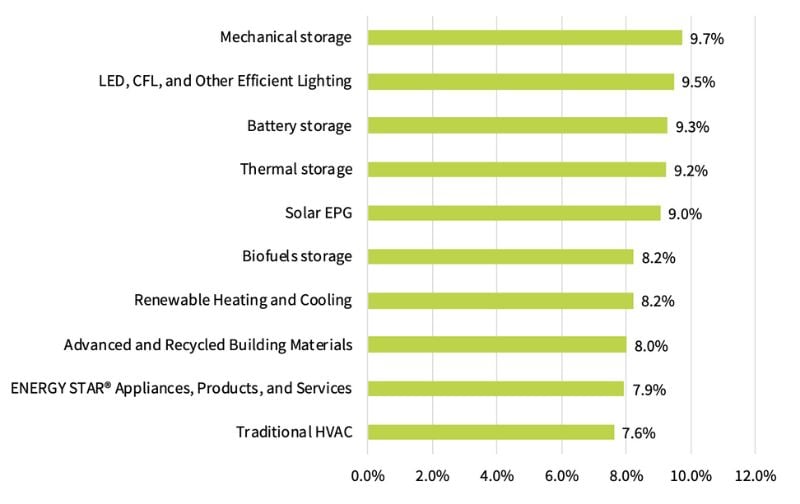
Areas with the highest anticipated job growth. Image used courtesy of Department of Energy
However, CareerOneStop expects that conventional energy jobs in coal, fossil fuels, and nuclear power generation will decline by 44%, 33%, and 16%, respectively, as the energy sector continues shifting toward renewables.
Despite these declines, fossil fuel jobs remain a sizable component of the American workforce, employing hundreds of thousands of workers across several states. According to the Energy Workforce and Technology Council, a member organization primarily comprising oil and gas companies, the oilfield services sector is seeing steady employment growth for positions like field engineers, equipment technicians, machinists and welders, safety inspectors, and other support roles.
Energy services reached 655,801 jobs in September, a monthly increase of 3,667 people. The workforce is 76% dominated by the top six energy-producing states—Texas, Louisiana, Oklahoma, Colorado, New Mexico, and California, which total 495,685 jobs.