Facebook
 Google
 GitHub
 Linkedin
Can This Battery Tech Help EVs Travel 3,000 Miles per Charge?
South Korean researchers have developed a battery tech that dramatically improves energy density and could enable electric vehicles to travel up to 3,000 miles on a single charge.
A breakthrough in battery chemistry suggests that electric vehicles traveling up to 3,000 miles on a single charge may no longer be a distant dream.
Researchers at POSTECH and Sogang University in South Korea have developed a lithium-ion battery design that addresses one of the most stubborn limitations in next-generation battery systems: silicon's expansion problem.
EV charging for a long trip. Image used courtesy of Adobe Stock
The Silicon Dilemma
Silicon has long been considered a highly promising anode material due to its exceptional lithium-ion storage capacity, which is nearly 10 times that of conventional graphite. But its adoption has been hindered by a critical flaw: Silicon expands up to 300% during charging, leading to structural damage, contact loss at the electrode–electrolyte interface, and rapid capacity degradation.
To counter this, researchers have traditionally turned to quasi-solid-state electrolytes (QSSEs), which offer greater mechanical integrity than liquid electrolytes. However, even these advanced electrolytes have struggled to maintain stable contact with the active silicon material during cycling.
The Interlocked Electrode-Electrolyte System
The South Korean research team has developed an in situ interlocking electrode–electrolyte (IEE) system designed to overcome these challenges. By forming covalent bonds between an acrylate-functionalized binder on the electrode and a crosslinking agent in the QSSE, the IEE system creates a chemically entangled interface that remains intact even under extreme volume changes.
The interlocking mechanism delivers a range of performance benefits. In half-cell tests, silicon microparticle anodes retained 81.3% of their initial capacity after 200 cycles, compared to just 18.7% in conventional QSSE systems. Full cells using the IEE configuration achieved rapid Coulombic efficiency stabilization at 99.5% within just three cycles.
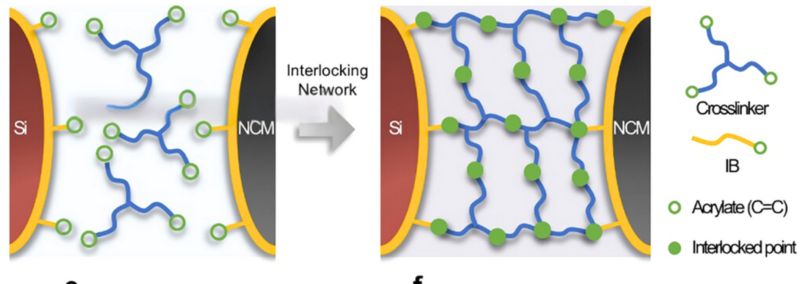
Schematic illustration of the interlocking process between electrodes and electrolytes. Image used courtesy of Han et al.
Energy Density for Long-Range EVs
Perhaps the most compelling metric is energy density. The IEE-based bi-layer pouch cell demonstrated a gravimetric energy density of 403.7 Wh/kg and a volumetric density of 1,300 Wh/L, more than 60% and nearly 100% higher than commercial lithium-ion batteries, respectively. These figures suggest that EVs equipped with such batteries could theoretically reach ranges of 3,000 miles on a single charge.
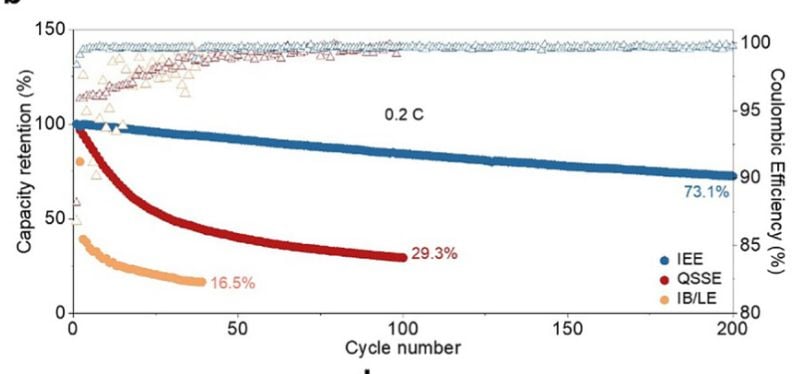
Capacity retention and Coulombic efficiency. Image used courtesy of Han et al.
Crucially, the team’s approach also favors scalability. Unlike nano-silicon designs, which are costly and difficult to produce, the IEE system uses micro-silicon particles, reducing both complexity and cost. The covalently bonded QSSE system is also designed for room-temperature operation and does not require high-pressure cell assembly, further improving manufacturability.
Beyond performance and scalability, the batteries demonstrated mechanical resilience in abuse tests, with pouch cells continuing to operate after folding and cutting. They also offered enhanced fire safety, self-extinguishing within seconds in open flame tests due to the immobilized liquid electrolyte in the QSSE matrix.
Toward the Future of EV Range
While EVs capable of traveling 3,000 miles are not yet commercially available, the IEE architecture presents a significant step toward that future. By solving the silicon interface problem and pushing the boundaries of energy density and mechanical durability, this research could unlock a new era of ultra-long-range electric transportation.
The findings were published in the journal Advanced Science and continue to generate interest among automakers and energy storage companies aiming to eliminate range anxiety as a barrier to EV adoption.