Facebook
 Google
 GitHub
 Linkedin
Waving From Hawaii: World’s Largest Ocean Generator Debuts
An 826-ton wave energy buoy has been deployed off Hawaii’s coast to capture wave energy at a scale large enough to help power the grid.
Renewable energy innovations can capitalize on extreme environments and severe weather conditions. Ultra-high-altitude wind farms capture wind currents in harsh, mountainous regions, and a gigantic twin-rotor wind turbine was deployed to capture hurricane-force winds out to sea. However, it is also possible to capture renewable energy from more subtle yet constant movements in the environment—like ocean waves.
This time-lapse video shows the construction of a wave energy buoy. Video used courtesy of OceanEnergy
Engineers are pushing the envelope of wave energy devices that can capture ocean movement to power the grid. OceanEnergy has deployed its OE-35 buoy wave energy converter off the coast of Hawaii. It’s touted as the world’s biggest wave energy converter.
The wave generator uses an oscillating water column design to convert ocean waves into a renewable electricity source. Turbine efficiency and structural corrosion have hampered the development of wave energy devices, but OE-35 has the durability needed to make a long-term contribution to sustainable energy.
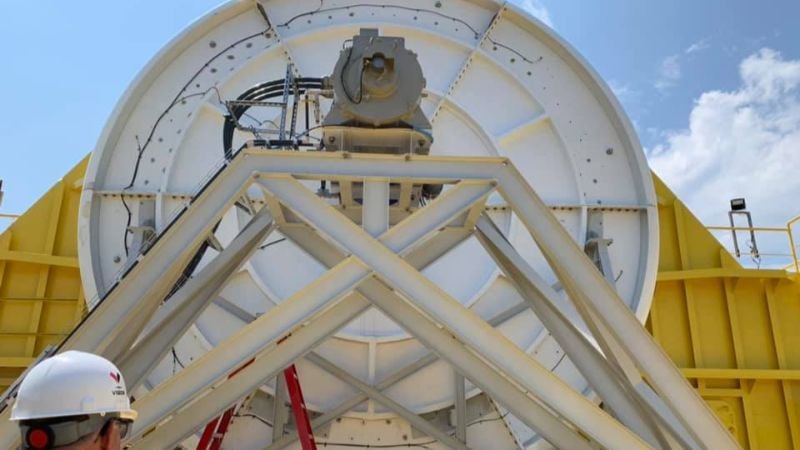
Air turbine used to harvest energy from ocean waves. Image used courtesy of OceanEnergy
Wave Energy Faces Efficiency and Durability Challenges
Wave energy devices appear in different forms, such as oscillating water columns, point absorbers, and attenuators. Each model is designed to capture the wave motion in unique ways. One main technical challenge in developing oscillating water column (OWC) wave energy devices is optimizing turbine efficiency. OWCs use bidirectional airflow, where air flows in and out depending on wave motion. This system requires turbines that can handle frequent changes in flow direction. Wells turbines, commonly used in OWCs, are designed to rotate in the same direction regardless of airflow direction.
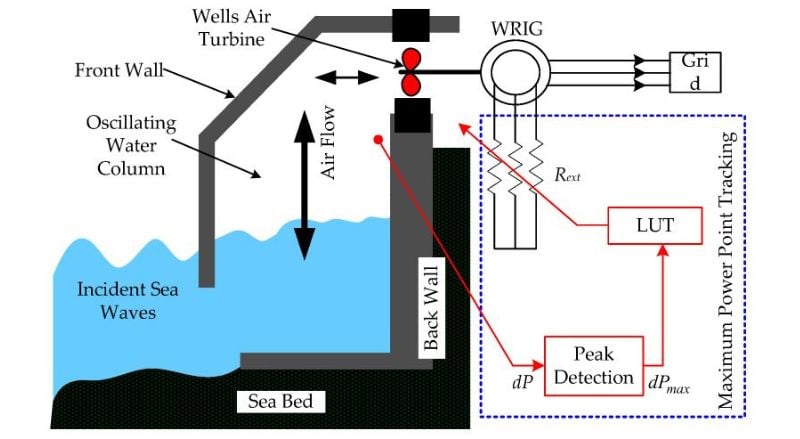
Diagram of an oscillating water column wave energy device. Image used courtesy of Mishra et al.
However, OWCs suffer from performance limitations at high air velocities, leading to reduced efficiency. Research suggests that Wells turbines plateau at lower efficiencies (60%-70%) than traditional unidirectional turbines surpassing that threshold. This inefficiency limits OWCs’ overall power output and remains a focus of ongoing research.
Another significant challenge is the OWCs’ structural durability in the harsh marine environment. The devices must withstand constant exposure to saltwater, extreme weather, and the mechanical stress of waves, which leads to high maintenance costs and shortened lifespans. Costs for the structural components often dominate the total costs of OWC wave energy devices because the hull, electrical infrastructure, and the mooring elements for floating installations all create considerable expenses. Maintaining these structural elements is complex due to corrosion and biofouling, which are major issues that require durable materials and coatings that can resist degradation. Corrosion can reduce a structure's life, and repairs in marine settings are costly and logistically difficult. Improving materials and designs to enhance durability while controlling costs is crucial for making wave energy devices economically viable.
Scaling Up the OE-35 for Grid Support and Structural Longevity
OceanEnergy, a team of specialists in marine hydrokinetics, created an enormous, state-of-the-art wave energy buoy after 15 years of research, design, and testing. The OE-35 weighs over 800 tons and is more than five stories tall. The company has mitigated cost obstacles because the OE-35 has scaled up in size, and the structure is robust.
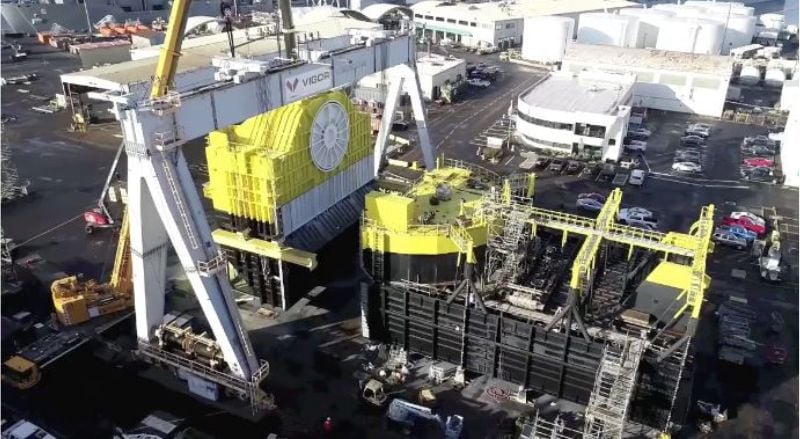
OE-35 under construction. Image used courtesy of OceanEnergy
Subsea cables will connect the buoy to Hawaii’s power grid, thus creating a direct impact on local energy stability. OE-35 can produce 1.25 megawatts in electrical power and will be among the first wave generators connected directly to a power grid.
The wave generator’s size enables it to contribute substantially to renewable energy.
All the OE-35’s moving parts sit well above the water, thus obviating many problems with structural corrosion and minimizing maintenance.
The Future of Wave Energy
Currently installed off the Hawaiian Island of Oahu, OE-35 represents a season of growth in the wave energy sector. OceanEnergy has substantially contributed to wave energy technology by developing OE-35. As other engineers expand upon its potential, wave energy will likely play an increasingly significant role in supporting the grid through renewable energy sources like the vast ocean waves that will never lose their potential to turn a turbine.
The U.S. Department of Energy has been funding this project, given the unrealized potential of functional OWC devices. However, it is still not reaching the optimization level of other renewable energy tech currently available.