Facebook
 Google
 GitHub
 Linkedin
Tiny Spheres, Big Energy: PV ‘Balls’ Challenge Solar Panel Tech
The company claims these spheres could achieve 60 times more energy output than solar panels in natural or artificial light.
The widespread adoption of solar panels still faces myriad challenges. Urban areas struggle with space constraints for large panels. Efficiency remains a concern. Costs are still not low enough.
In response to these challenges, Wavja developed photon energy systems (PES), which the company claims exceed traditional panels' performance by orders of magnitude. This alternative to photovoltaics for solar energy harvesting could provide a solution.
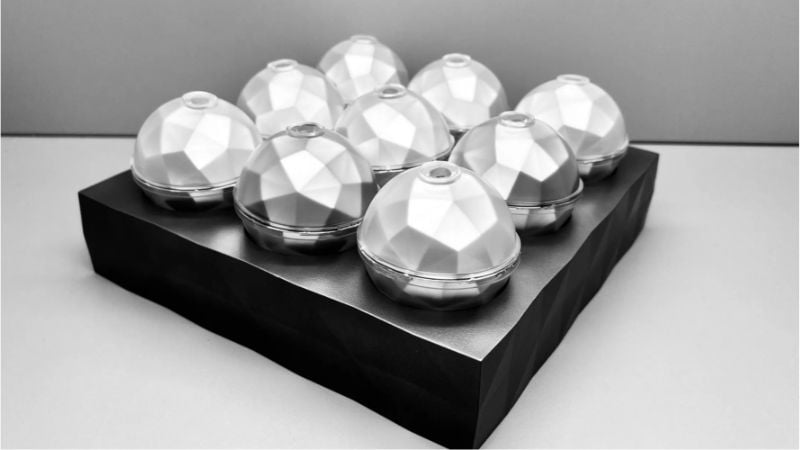
Photo energy system. Image used courtesy of Wavja
Highlighting Solar Challenges
Solar panels are fundamental to renewable energy systems, harnessing solar radiation to generate electricity through photovoltaic technology. Yet, despite their significance, several technical challenges persist.
Space efficiency is a concern, as traditional silicon-based PV panels require a substantial area for installation relative to their power output. This spatial demand complicates urban integration and limits deployment in densely populated areas.
Energy efficiency is another notable issue. Current PV panels typically convert only 15-20% of incident sunlight into electrical energy, with the remainder lost as heat or reflection. This contrasts with a 45% efficiency in energy generation from burning natural gas. Improving PV efficiency involves enhancing material properties, optimizing cell design, and reducing internal losses.
Durability is another issue, particularly in harsh climates. Solar panels must withstand various environmental stressors, including extreme temperatures, humidity, and physical impacts from hail or debris. Over time, these factors can degrade panel performance, reducing their lifespan and overall energy output. Developing more robust materials and protective coatings is an ongoing area of research to enhance longevity and maintain efficiency over extended periods.
Tiny Spheres, Big Impact
Wavja’s photon energy system comprises spherical devices designed to surpass traditional solar panels in efficiency and versatility.

Testing light-catching spheres under artificial light. Image used courtesy of Wavja
Ranging from just over an inch to almost four inches in size, these spheres utilize multiple layers of advanced materials to capture both natural and artificial light for electricity generation. According to Wavja, each sphere achieves outputs 7.5 times greater than solar panels while being 200 times more efficient. Moreover, they are 30 times smaller than conventional solar panels.
To contrast performance, the third iteration of the PES system purportedly boasts 60 times the power output of a solar panel of comparable size. In a demonstration, the device operated independently with an integrated battery system and powered various devices, including tablets and phones, through LED-illuminated setups.
Beyond Solar Panels
If the efficiency gains prove accurate and scalable, this technology could transform how we integrate renewable energy into urban environments and everyday devices. Harnessing natural and artificial light efficiently opens up new possibilities for energy generation in indoor spaces and during low-light conditions. Greater efficiencies and space effectiveness could be game changers for applications in all environments.
Overall, this innovation could lead to a reimagining of energy-independent devices and buildings, and the potential ripple effects on energy infrastructure, urban planning, and consumer electronics could be far-reaching and transformative.