Facebook
 Google
 GitHub
 Linkedin
Smart Meter Data Analyzer Tracks EV Charging at the Grid Edge
Sense has launched the EV Analytics system to help utilities improve grid reliability by providing real-time insights into electric vehicle charging patterns.
As electric vehicles continue to rise rapidly, utility companies are scrambling to manage the unpredictable strain they place on the power grid. The challenge? Most charging happens at home, hidden from direct utility oversight, especially when homeowners use basic Level 1 chargers. Without visibility into when and how these vehicles draw power, utilities are left to plan blindly, risking overloads and inefficiencies during peak demand.
Learn how EV Analytics can assist utilities. Video used courtesy of Sense
To tackle this growing blind spot, Sense has introduced EV Analytics, a software tool embedded directly in AMI 2.0 smart meters. This solution leverages high-resolution waveform data and edge-based AI to detect electric vehicle charging in real time, regardless of vehicle brand or charger type. By identifying charge events down to the minute, Sense offers utilities the kind of clarity and precision needed to forecast loads, engage customers, and manage energy distribution more effectively.

EV Analytics can monitor charging throughout the utility service area. Image used courtesy of Adobe Stock
Why Real-Time, Local Data Changes the Game
EV Analytics marks a shift from outdated, cloud-reliant models to a more responsive, localized approach. Rather than waiting for delayed or generalized interval data, utilities now gain access to granular, meter-level insights, such as charging durations and energy usage. This is especially crucial for detecting vehicles charging with basic equipment that can evade traditional detection systems.
Another key advantage lies in its compatibility. EV Analytics doesn’t require automakers to share telematics or users to install special hardware. It works across all makes and models, and with both Level 1 and Level 2 chargers. That universality removes enrollment barriers and makes it easier for utilities to offer managed charging programs to a broader range of customers. This can help reduce program costs, increase adoption, and ensure that energy usage aligns better with off-peak hours or cleaner generation times.
Scalable Technology and Future-Proof Infrastructure
Sense’s platform also stands out for its flexibility and scalability. Built into Landis+Gyr Revelo smart meters, EV Analytics combines communication protocols, such as cellular, mesh, and Wi-Fi, to integrate with existing utility infrastructure. The company also plans to roll out a full suite of grid-edge intelligence tools over the coming months, expanding its capabilities to support other forms of distributed energy and demand response strategies.
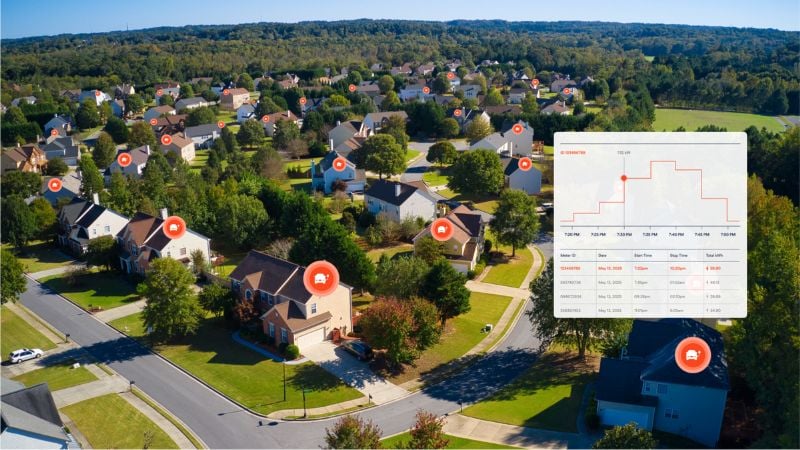
EV Analytics can detect where, when, and how charging is taking place. Image used courtesy of Sense
At the customer level, this system opens up a new kind of engagement. By pairing with the Sense Home app, users can receive real-time alerts about their EV’s charging behavior, how much power they’re using, and when energy is cheapest or cleanest. That’s important because current time-of-use pricing models often fail to align with grid conditions. With better tools and information, customers can shift charging habits to reduce emissions, save money, and support grid stability.
A Smarter Response to Surging EV Demand
Looking ahead, the stakes are high. EVs made up approximately 10% of new car sales in the U.S. in 2024, and this number is expected to increase. By 2030, experts forecast they could represent up to half of all new vehicles. That growth level could add nearly 200 terawatt-hours of demand to the grid, presenting a huge opportunity but also a potential liability if left unmanaged. EV Analytics helps close that gap, giving utilities the visibility they need to stay ahead of demand, rather than scrambling to react to it.
With home EV charging quietly transforming residential energy use, utilities face mounting pressure to adapt. Sense’s EV Analytics steps in as a timely solution, bringing transparency to the grid edge, enhancing planning, and giving both utilities and customers the tools to make smarter, cleaner choices about when and how they use electricity.