Facebook
 Google
 GitHub
 Linkedin
Si Solution: Doubling EV Driving Range
Could silicon anodes increase electric vehicle range?
Electric vehicle manufacturers are seeking alternatives to lithium-ion batteries to increase power, driving range, and safety demands. Lithium iron phosphate (LFP) batteries are longer-lasting and safer than lithium-ion batteries for EVs, and commercialization is starting to advance.
Paraclete Energy created a silicon anode technology that shows higher energy density and lower costs than LFP batteries already on the market. According to one study, the SILO Silicon anode could reduce battery weight by half and double the EV’s driving range.
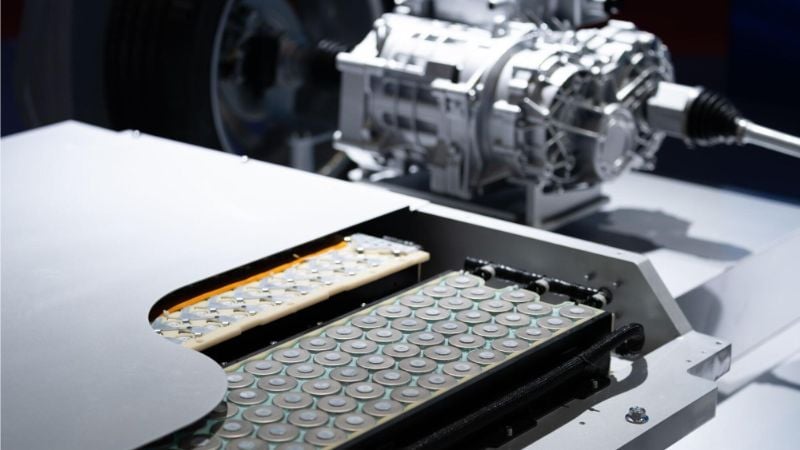
Electric vehicle battery pack. Image used courtesy of Adobe Stock
Energy Density and Cost Cuts for LFP Technology
Silicon has always had the potential for battery anodes because of its high theoretical density. However, like many anodes other than conventional lithium, silicon has had several commercialization challenges that have prevented its wider use.
Silicon can achieve high performance, but it has always been short-lived because the anode quickly degrades, causing the battery to short-circuit and become damaged. This happens long before its theoretical usable lifetime. Silicon anodes typically undergo up to 400% volume expansion during cycling, so they cannot last for long cycling periods before breaking down.
Paraclete Energy has spearheaded efforts to bring silicon anodes to commercial battery systems. To overcome the volumetric expansion issues typically seen with silicon anodes, Paraclete Energy encased the silicon in a polymer matrix. Polymers are inherently flexible materials, and this flexibility on the outside of the anode helps to prevent the anode from undergoing volumetric expansion while cycling.
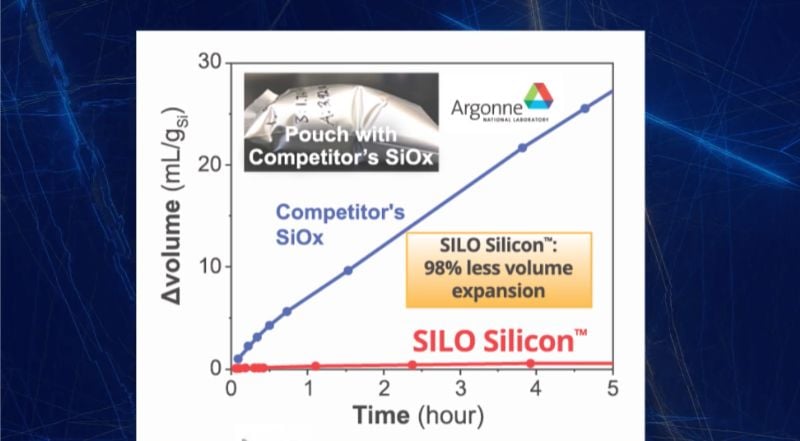
In studies, the SILO Silicon showed less volume expansion during cycling. Image used courtesy of Paraclete Energy
Batteries using the SILO Silicon were shown to be 33% less expensive per kilowatt hour (kWh) than conventional carbon-based anodes. This is primarily due to the anode’s increased energy density, which reduces the kWh cost. The silicon particle casing inside the polymer matrix means that more active silicon particles can be loaded into the anode, increasing the energy density and lowering the cost. This new anode technology has an energy density 300% greater than graphite anodes and more than 200% greater than other silicon anodes.
Improved Range and Weight for EV Batteries
Paraclete Energy has released a new study that further sheds light on the anodes’ capabilities in EV batteries.
The data shows that using the SILO Silicon™ anode in a standard 80 kWh battery pack allows the pack to be significantly downsized from around 7,000 individual batteries to under 2,000 batteries. This corresponds to a 73% weight reduction of the battery pack, reducing it from 565 kg to 150 kg―a significant weight saving for EVs, where lower weights enhance performance. These weight savings occurred with the same driving range as the original EV battery pack.
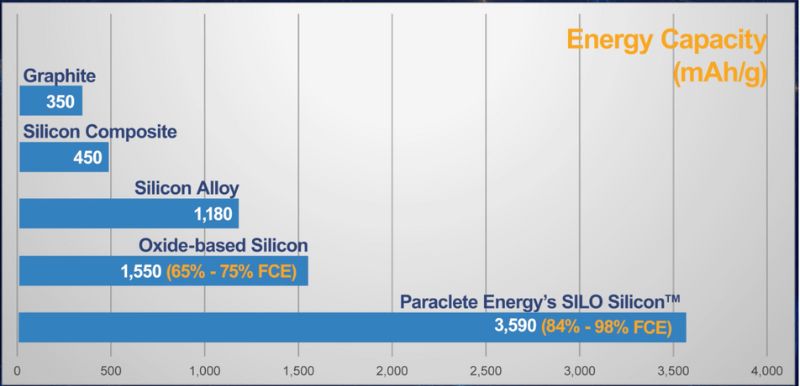
Silo Silicon compared to other materials. Image used courtesy of Paraclete Energy
With these developments, Paraclete Energy developed a 300 kg battery pack using the SILO Silicon anode. This battery pack was twice the weight of the optimized and weight-reduced battery pack, allowing twice the driving range and a fraction of the original weight. This battery pack delivered 160 kWh of power, doubling the driving range from 290 miles to over 580 miles. It potentially offers a different route for manufacturing higher-range EV batteries beyond advancements in Li-ions.
Are Silicon Anodes Finally a Feasible Commercial Option?
Could silicon anodes finally reach commercial viability after years of suffering many setbacks? It’s certainly possible because Paraclete Energy is not the only company developing advanced EV batteries. Sila Nanotechnologies has also been developing commercially feasible silicon anodes using silicon nanoparticles. Mercedes-Benz chose Sila batteries for its electric G-Class SUV vehicles.