Facebook
 Google
 GitHub
 Linkedin
Shell’s Liquid EV Cooling Could Cut Charging Times to 10 Minutes
Shell has developed an “all-in-one” thermal cooling fluid that can cool battery packs and electric vehicle powertrains.
Shell and Horiba Mira have developed a thermal cooling fluid for electric vehicle battery packs that could reduce charging times to 80% capacity to just 10 minutes. The typical battery-electric vehicle (BEV) takes 30 minutes to achieve the same results.
The ultra-low viscosity Shell EV-Plus thermal fluid is also effective in cooling the powertrain while the EV is in motion, even in extreme heat or cold. The company is touting the fluid as an “all-in-one” solution in BEV design and manufacturing.
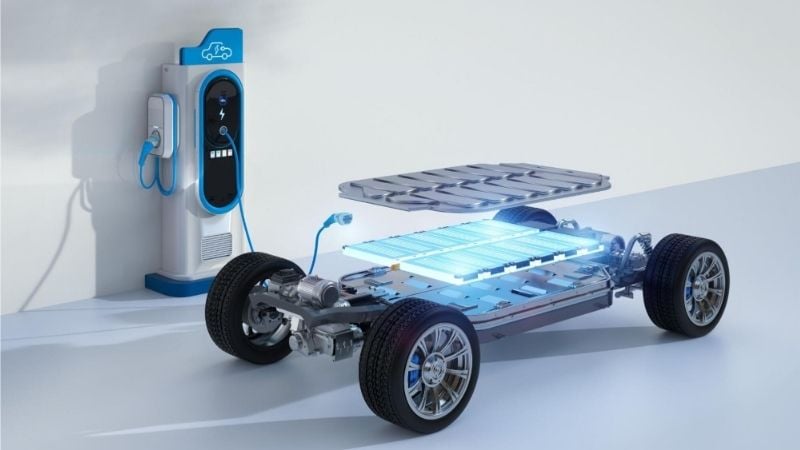
Electric vehicle battery pack when charging. Image used courtesy of Adobe Stock
Dielectric Liquids for Cooling
Cooling BEVs is challenging because they have multiple sources of lower heat distributed throughout the vehicle. A tailored solution to BEV thermal management could help improve performance and energy efficiency while reducing costs.
Cooling liquids with dielectric properties, long used in industrial applications, could be used in BEVs. Dielectric properties are essential in the fluid to avoid causing electrical shorts, as these liquids are directly in contact with the electrical systems, which often operate at high voltages, and require a high specific electrical resistivity and breakdown voltage.
Water-ethylene-glycol (WEG) is an industry-standard coolant for BEVs, but it is sub-optimal because it cannot directly touch the hot electrical components, limiting its interfacing and contacting capabilities. However, Shell has created an immersive thermal fluid that can be in direct contact with the electrical components and provide much better cooling capabilities.
Gas-to-Liquid Cooling Replaces WEG
Shell’s EV-Plus Thermal Fluid uses Shell PurePlus Gas-to-Liquid (GTL) Technology, which contains a clear 99.5% pure base oil with strong molecular bonds. The coolant’s low viscosity is similar to WEG viscosity, allowing easy pumping around cooling systems.
The dielectric liquid can perform immersive battery cooling, where the fluid intimately contacts each cell’s surface, increasing its thermal mass. This allows more efficient heat transfer from the battery cells into the fluid without significantly raising the temperature of the wider BEV battery system.
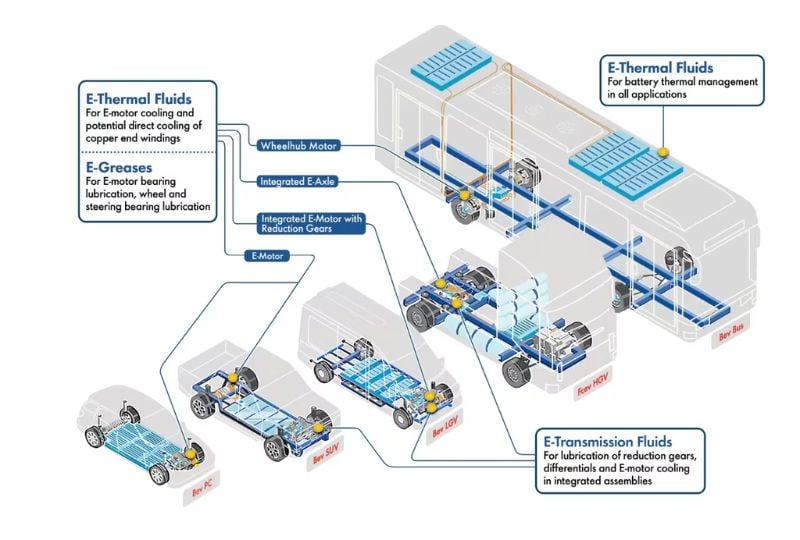
Shell’s liquid cooling in EVs. Image used courtesy of Shell
After Shell researchers achieved good thermal management during battery charging, they extended the experiments to cover all the electric components in the powertrain. They discovered that the thermal fluid could completely replace WEG coolants. They could replace the multiple patchwork cooling systems in BEVs with a single fluid to cool everything in the powertrain.
This development could help to simplify battery and powertrain design and reduce the number of components required within the powertrain―potentially leading to reduced vehicle weight, better cost efficiency, and improved performance.
Improving BEV Charging Performance
Shell’s battery tests used a VTEOS rig that mimicked the thermal loads generated by the battery, motor, and inverter when connected to a cooling circuit with pumps and a radiator.
During testing, researchers found that the immersive cooling approach with the thermal fluid charged the battery from 10% to 80% in just 10 minutes (instead of 30 minutes in new fast-charging EVs). They also found that the thermal fluid was efficient in a range of extreme driving conditions, from the extreme cold of a simulated arctic winter to the heat of a Saharan summer.
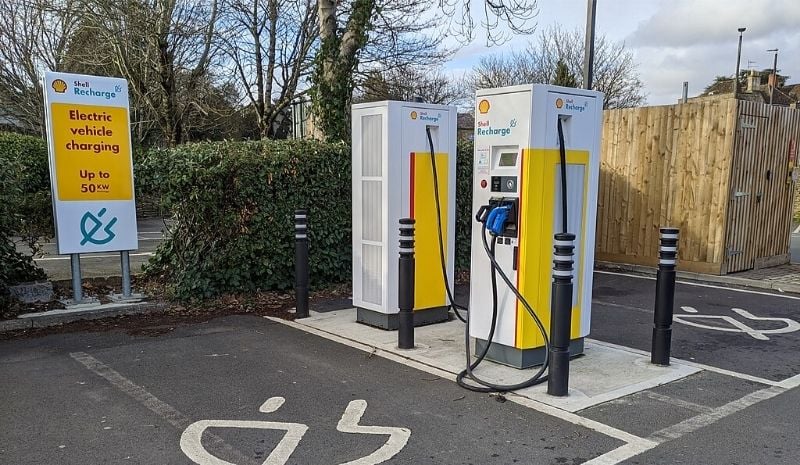
Shell EV charging. Image used courtesy of Wikimedia Commons
During the tests, the single fluid system could manage all the thermal loads from the powertrain, including in extremely fast charging scenarios. The fluid could also reject all the collected heat using a standard, off-the-shelf radiator. Engineers could develop new BEVs with these cooling systems, but could also potentially retrofit existing EVs to use them.
Potential to Replace WEG in EV Designs
Replacing the WEG cooling circuit, which contains a dedicated reservoir, pump, pipework, and heat exchangers, with the immersive single fluid cooling system could improve the performance and range of BEVs while making them cheaper and simpler to manufacture. The motors could also be reformatted to allow the fluid to flow through the rotor and stator passageways, bringing the fluid into closer proximity to the heat source and increasing the surface area to transfer heat.