Facebook
 Google
 GitHub
 Linkedin
Pitch the Plug. Mercedes-Benz Can Power EVs With Solar Paint
Are solar-powered EVs possible with nano-coated solar paint?
Scientists are working worldwide to develop electric vehicle batteries that charge faster and enable longer distances between charges. Others are experimenting with wireless charging roads. A few envision covering a vehicle with solar panels. But what if the solution to range anxiety is paint?
Mercedes-Benz is developing a photovoltaic paint that the company says can charge EVs with solar power. While the paint couldn’t replace the battery pack, it could produce enough power to extend the vehicle’s range.
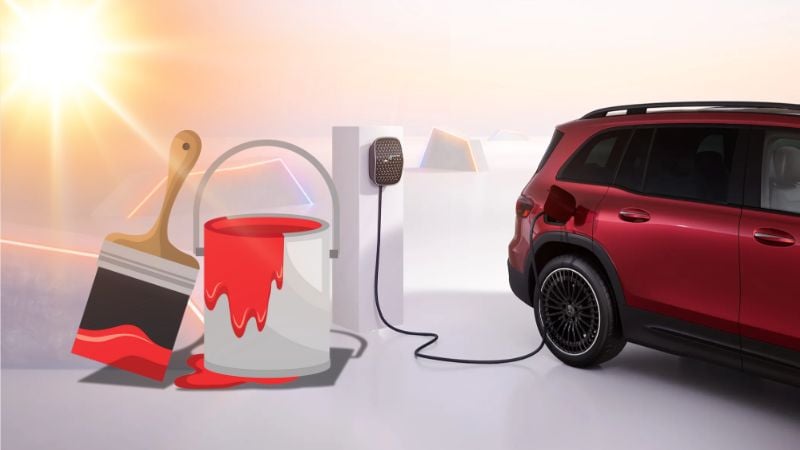
Can solar paint extend EV range? Adapted from images used courtesy of Canva and Mercedes-Benz
Mobile Sun Power
Solar-powered electric vehicles aren’t a new concept. Many designers have considered mounting solar panels on vehicle roofs and hoods. As PV panels become lighter, more flexible, and more efficient, a few companies have produced technologies that may be feasible.
A2 Solar creates curved solar panels for integration on vehicle roofs. The 200 W PV system is already used on passenger vans and shuttles in the Netherlands. However, the panels do not directly feed into the vehicle’s battery pack. Instead, the company claims it extends its range by reducing energy consumption to power auxiliary functions such as air conditioning.
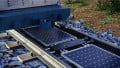
Lightyear creates a PV system that charges the batteries. The panels embed into the vehicle’s body on the roof and hood. The Vehicle Integrated Photovoltaic platform works from “photon to battery,” according to the company. The system includes panels, power conversion technology, and a data platform. The PV panels are aimed at passenger EVs, boats, and lightweight commercial vehicles.
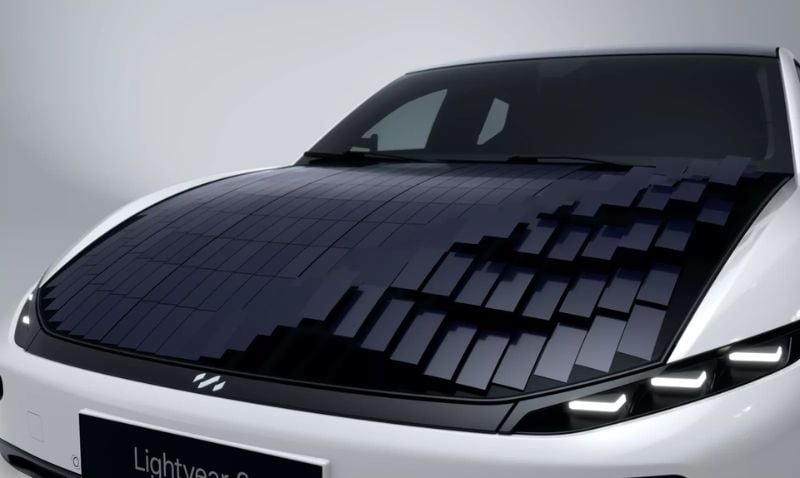
Solar panels on vehicle hood. Image used courtesy of Lightyear
Mercedes-Benz and Solar Paint
Mercedes-Benz is bypassing solar panels and instead developing a photovoltaic paint to boost EV range. The paint would cover all vehicle surfaces, capturing the sun’s rays from all directions. The PV material is applied in a layer only 5 micrometers thick and works with all vehicle colors.
The solar paint is topped with a nanoparticle-based coating, allowing 94% of the sun’s rays to pass through. The paint yields a 20% efficiency, on par with traditional solar panels. It weighs just 50 g per square meter.
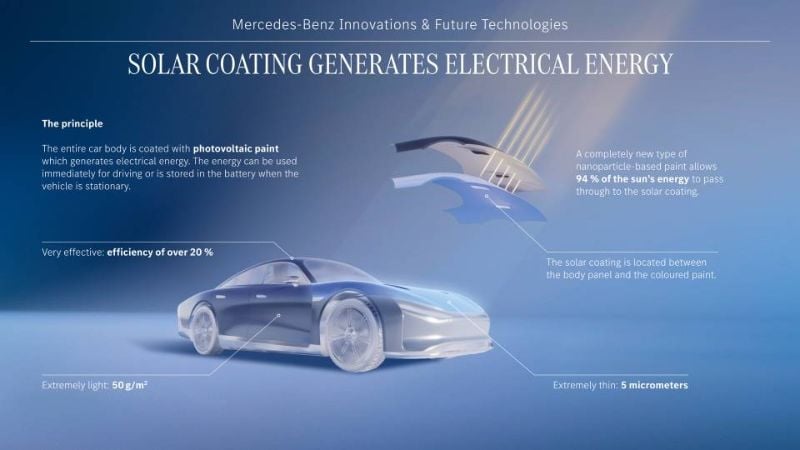
Solar coating specs. Image used courtesy of Mercedes-Benz
The vehicle’s added range will depend on geographical location, as some regions of the globe receive more solar radiation than others. Mercedes-Benz stated that a medium-sized SUV with 11 square meters of solar paint could create enough energy to travel 12,000 km annually at its facility in Stuttgart, Germany. In sunnier Los Angeles, a similar solar-painted vehicle might run all day using only solar energy.
The solar coating is non-toxic, recyclable, and contains no silicon or rare earth materials. The company says it is less expensive than conventional solar panels.
Solar Beyond EVs
Since Mercedes-Benz’s solar paint can be applied to any surface, it could be used on buildings and other structures. The paint could power microgrids or serve as grid-connected distributed energy resources.
Others are also developing versions of solar paint. At the Royal Melbourne Institute of Technology, researchers created a solar paint that generates hydrogen by absorbing water vapor from the air. It uses titanium oxide, commonly found in paint, to absorb energy from sunlight. A synthetic material, molybdenum-sulfide, acts as a semiconductor in a catalytic process, splitting water into oxygen and hydrogen. The hydrogen could be used in fuel cells.
Scientists at the National Renewable Energy Laboratory are working on two types of solar paint: quantum dots and perovskite paint. The quantum dots are semiconductor nanocrystals that could enhance existing solar panels or completely replace them.
Meanwhile, Korean researchers set a record efficiency of 18% earlier this year with its perovskite-enhanced quantum dot solar cells. The dots maintained their efficiency for 1,200 hours in normal conditions and 300 hours at temperatures exceeding 80°C.
More trials in real-life conditions are needed to determine whether solar paint could someday replace traditional solar panels. If Mercedes-Benz succeeds, the solar-painted EV could lead the way.