Facebook
 Google
 GitHub
 Linkedin
Hybrid System Features Immersion-Cooled Battery for AI Data Needs
XING and PEWC have married two battery technologies to provide greater performance and flexibility for AI data center power needs.
XING and PEWC have married two battery technologies to provide greater performance and flexibility for AI data center power needs.
Modern applications, like AI data centers, require systems that can deliver high power on demand while also supporting long-duration energy discharge. While conventional lithium-ion batteries offer fast response and high energy density, they suffer from thermal management challenges and limited cycle life. In contrast, flow batteries such as vanadium redox systems deliver exceptional longevity and thermal stability but lack the responsiveness and compact footprint needed for dynamic loads. These divergent characteristics have made it increasingly difficult for a single technology to meet all operational demands.
How does immersion cooling help hybrid battery storage systems? Video used courtesy of XING Mobility
Instead, hybrid battery architectures integrate multiple chemistries into a unified system, assigning discrete roles based on the strengths of each. As interest in this approach gains momentum, XING Mobility and PEWC have introduced a dual-chemistry platform that combines immersion-cooled lithium-ion with vanadium flow storage.
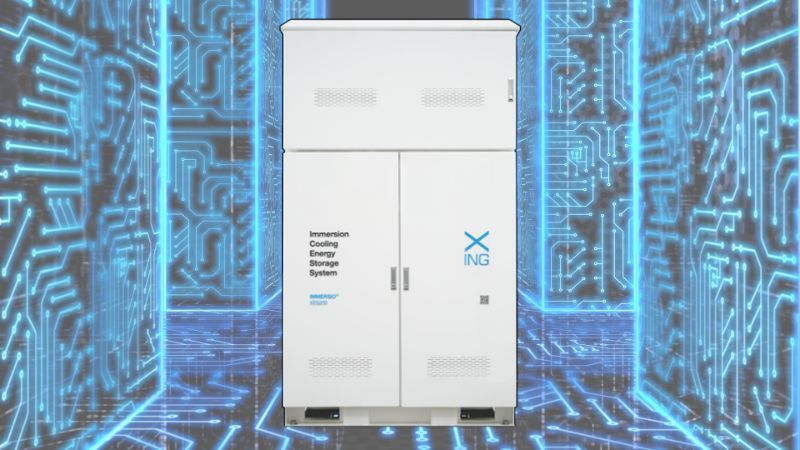
Immersion cooling battery system. Adapted from images used courtesy of XING and Canva
What is Immersion Cooling?
Liquid immersion cooling is a thermal management technique that submerges electronic components or battery cells in a dielectric fluid to achieve uniform heat dissipation. In contrast to air cooling or cold plate methods, immersion cooling eliminates thermal interface materials and heat sinks to reduce thermal resistance and enable more direct heat transfer from the source to the coolant.
In single-phase systems, the coolant remains in liquid form and circulates through a closed loop. In contrast, in two-phase systems, the fluid boils on contact with the heat source. It condenses on a heat exchanger surface, utilizing the latent heat of vaporization to remove energy.
For battery applications, immersion cooling significantly enhances thermal control at the cell level. In high-power systems, immersion cooling allows lithium-ion packs to operate at elevated C-rates without breaching thermal limits. It also suppresses the onset of thermal runaway by directly suppressing local hotspots. Therefore, this technology helps unlock aggressive fast-charging, high-current discharge, and continuous cycling without auxiliary air conditioning systems.
XING Mobility and PEWC Team Up
XING Mobility and PEWC jointly developed a hybrid energy storage system combining two distinct battery chemistries to serve large-scale energy applications. Specifically, the architecture merges XING Mobility’s immersion-cooled lithium-ion battery platform with PEWC’s vanadium redox flow battery.
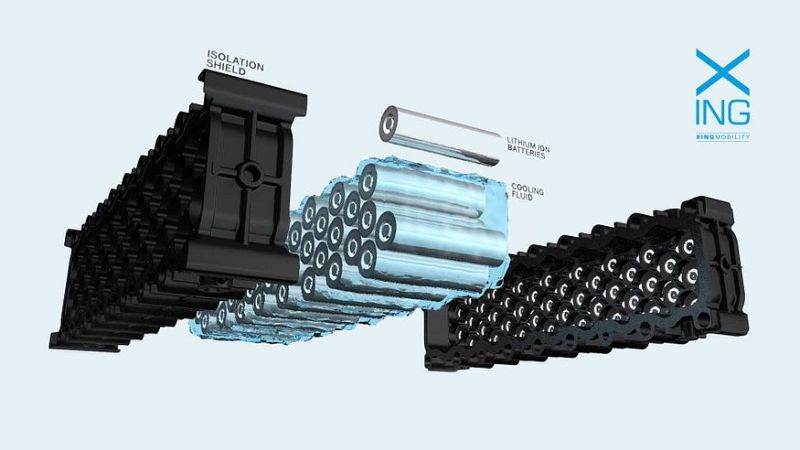
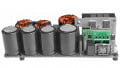
Immersion-cooled battery. Image used courtesy of XING Mobility
The lithium system features active thermal management with full submersion in dielectric fluid to provide uniform cooling and prevent thermal runaway. With liquid immersion cooling, XING’s design maintains high power density while operating in thermally stressful environments. The vanadium flow subsystem, on the other hand, uses a non-flammable, water-based electrolyte and offers a service life exceeding 20 years due to the non-degrading nature of the redox reaction.
Ultimately, the hybrid topology marries lithium-ion’s high responsiveness with vanadium flow’s energy longevity to support both fast ramp rates and sustained power delivery. The combined system improves operational flexibility in environments such as AI data centers, which are often concerned with peak shaving, buffering, and extended backup duration. The system also provides architectural redundancy and component separation to isolate faults and maintain performance continuity.
Next Steps
On a macro level, this project is a promising step forward for proponents of hybridized battery architectures. By pairing fast-discharge lithium modules with the deep-cycle flow cells, the platform could unlock unprecedented levels of performance and flexibility for operators.
According to the companies, initial field validation will occur through a demonstration project in Taiwan.