Facebook
 Google
 GitHub
 Linkedin
Can Thermoelectric Generators Replace Vehicle Alternators?
PyroDelta Energy thinks so.
While electric vehicles are gaining traction, internal combustion engines (ICE) still dominate global transportation, with projections indicating their continued prevalence through 2040. So, while the world still focuses on improving EV technology, the industry has also seen research into enhancing the efficiency of existing ICE vehicles.
Take a close-up look at the thermoelectric generator. Video used courtesy of PyroDelta Energy
One focus area is the vehicle's electrical system, particularly the alternator, which has long been a source of energy loss due to its mechanical nature. Thermoelectric generators (TEGs) have emerged as a promising alternative, offering the potential to convert waste heat into usable electricity without moving parts. PyroDelta Energy has developed a thermoelectric generator for automobiles that they believe is a potential breakthrough in vehicle efficiency.

Thermoelectric generator for ICE autos. Image used courtesy of PyroDelta Energy
Thermoelectric Generator Basics
Traditional alternators, used for decades to generate electricity in vehicles, face significant challenges in efficiency and fuel consumption.
An alternator converts mechanical energy from a vehicle's engine into electrical energy by rotating a magnetic field around stationary windings, generating alternating current. This is then rectified to direct current to power the vehicle's electrical systems and charge the battery. Because these devices rely on mechanical energy from the engine, energy loss is caused by friction and heat dissipation.

Thermoelectric generator diagram. Image used courtesy of Wikimedia Commons
TEGs are solid-state devices that convert differences in temperature and heat flow into DC power using the Seebeck effect, occurring when a temperature difference across two dissimilar materials generates a voltage. The core component of a TEG is a thermocouple, consisting of one p-type and one n-type semiconductor, connected electrically in series by a metal strip. They work by exploiting the heat flow from a hot side to a cold side, driving charge carriers within the materials and producing a DC output. This effect generates voltage, which drives current to produce useful power.
The Thermoelectric Alternator Replacement
PyroDelta Energy, a subsidiary of First Tellurium Corp, plans to produce automobile thermoelectric generators to replace alternators in ICE vehicles.
In ICE vehicles, TEGs can capture waste heat from the exhaust or engine components and convert it into electrical energy to supplement the vehicle’s power needs. This reduces the alternator load, improves fuel efficiency, and lowers emissions by utilizing otherwise lost thermal energy.
PyroDelta’s new generator utilizes tellurium-based alloys and a proprietary manufacturing method to convert temperature differentials into electrical power. The device's architecture comprises a thermoelectric pipe through which hot liquid passes while air cools it externally, creating the necessary temperature gradient for electricity generation. Unlike existing thermoelectric devices, PyroDelta's generator can withstand extreme temperatures exceeding 1,800°C, making it a viable solution for combustion engines and various industrial applications.
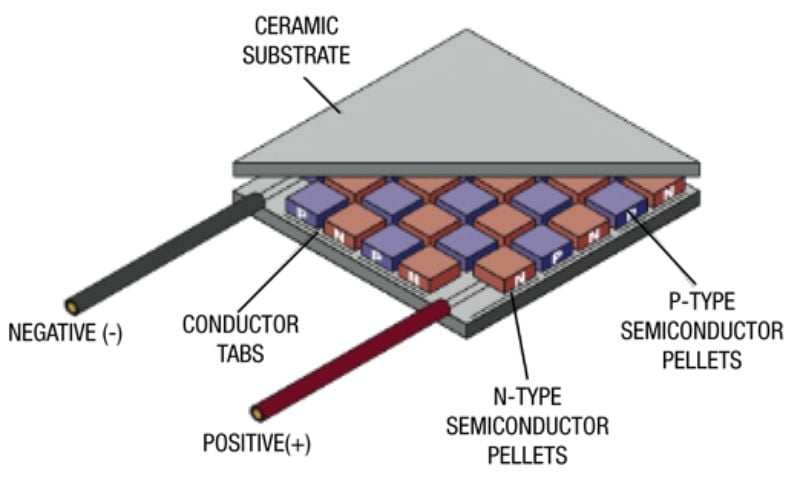
Design of a thermoelectric generator. Image courtesy of Xie et al.
According to PyroDelta, while primarily focusing on improving combustion engine efficiency, the generator aims to power all of a vehicle's electrical systems, potentially increasing fuel efficiency by eliminating the need for an alternator. The technology may also enhance electric vehicle performance by leveraging temperature differentials around batteries.
Paving the Way for Greener Transportation
PyroDelta's thermoelectric generator has been in development for eight years and is now moving toward the prototype stage. With patents pending in both the United States and Canada, PyroDelta is seeking a facility in Florida to assemble and demonstrate the device in a retrofitted automobile.