Facebook
 Google
 GitHub
 Linkedin
Bill Gates Fund Catapults Grid Tech
Bill Gates’s Breakthrough Energy Ventures unveils a grid modeling project.
Bill Gates’s Breakthrough Energy Ventures will build an open-source platform to modernize grid planning models by collecting insights from more data sources. The project, still in the early development stages, aims to improve the efficiency of planning, forecasting, and integrating renewable energy sources.
Grid operators lack the long-term demand forecasting and real-time monitoring needed to effectively scale up the transition to renewables. At the same time, peak demand is expected to rise by 38 GW through 2028, necessitating speedy planning for new generation and transmission capacity. According to a recent report from GridStrategies, grid planners nearly doubled their five-year load forecasts in 2023, revising their expectations from 2.6% to 4.7% growth.
Advanced modeling tools will ease congestion and help modernize the grid’s adaptation to variable wind and solar resources. Though Breakthrough Energy Ventures didn’t disclose specifics or a timeline for the grid modeling project, the solution would ostensibly come at an opportune time for the market.
Breakthrough Energy Ventures recently launched its third fund after the first pair invested over $2 billion in a diverse range of cleantech solutions, from thermal batteries to transmission line conductors.

Fervo, a startup backed by Breakthrough Energy Ventures, has started its geothermal drilling project to deliver 400 MW in Utah. Image used courtesy of Fervo Energy
Transmission Tech Advancements
The U.S. Department of Energy (DOE) estimates that meeting the federal government’s 100% clean electricity goal by 2035 would require a 60% increase in transmission capacity by 2030, then triple by 2050. At the same time, electricity demand is surging amid growing electric vehicle adoption and building electrification, a domestic manufacturing wave, and industrial and data center projects.
Today’s aging electric grid simply isn’t equipped for substantial load growth. While utilities have spent billions on reliability upgrades and replacing old equipment, expanding high-voltage transmission lines remains too expensive to accommodate the demand needed. Infrastructure expansion slowed throughout the 2010s, dropping from 1,700 miles of transmission lines installed annually to only 645 miles per year by the end of the decade, according to GridStrategies.
Breakthrough Energy Ventures has funded two startups offering advanced conductor technology to help optimize existing transmission assets and build new ones with more capacity.
Video used courtesy of TS Conductor
TS Conductor’s high-performance conductor serves new construction and reconductoring projects. Its encapsulated carbon fiber composite core is lightweight and designed with enhanced durability to reduce thermal sag typically seen in conventional aluminum conductor steel-reinforced and -supported conductors. The California-based company claims its product unlocks 3x capacity during peak generation and demand, with 50% less line losses during operation.
VIER, another Breakthrough-backed company, markets superconducting electric transmission lines extending up to 10 times the transfer capacity of conventional infrastructure. With a passive liquid nitrogen cooling system, VEIR’s transmission lines enhance power flow capacity, reduce sag, and operate with 90% less resistive line losses.
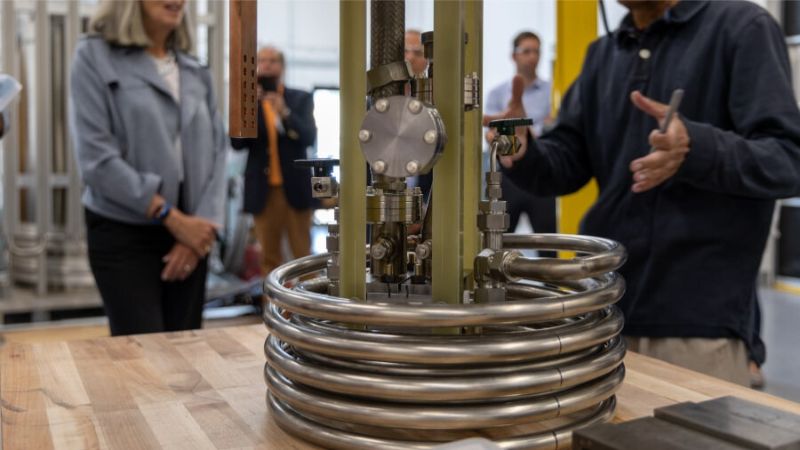
VEIR’s superconducting technology. Image used courtesy of VEIR
VEIR’s debut alternating current overhead lines serve up to 400 MW and voltages of 69 kilovolts, though it plans to scale to higher-power products soon.
Expanding Capacity with Geothermal Drilling
One of Breakthrough Energy Ventures’ strategies is investing in carbon-free firm generation resources that produce power on demand, functioning like fossil fuel plants without greenhouse gas emissions. Expanding baseload power, such as large-scale hydropower dams or geothermal technology, is vital to phasing out fossil fuels without sacrificing stability.
Geothermal power plants are a proven solution in this domain, contributing about 4 GW to power 3 million American homes today. However, the DOE estimates there could be more than 100 GW of untapped geothermal capacity nationwide.
Several companies are introducing advanced geothermal drilling techniques to leverage this resource. Fervo, a Breakthrough portfolio company, has developed a horizontal drilling system to dig into geothermal reservoirs with better efficiency and less time. The company recently demonstrated a 70% reduction in drilling times, with the system digging its fastest well in just 21 days.
Through the process, Fervo injects fluid at the well, which gathers heat as it flows through cracks in the subsurface rock. The hot fluid then returns to the surface for electricity production.
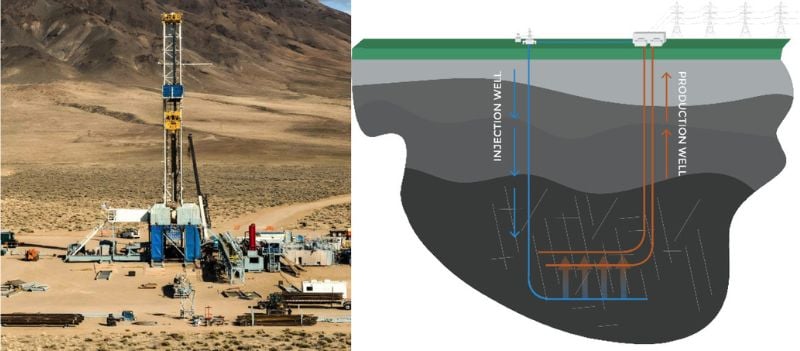
Fervo’s geothermal drilling system. Images used courtesy of Breakthrough Energy Ventures and Fervo
Fervo’s upcoming 400 MW Cape Station project is under construction in southwest Utah, with the first 70 MW phase slated to come online in 2026. The company recently secured agreements to supply 320 MW of power from the site to 350,000 homes in Southern California.
Energy Storage Innovation
Managing solar and wind's inherent variability is an overarching challenge in the renewable energy transition. Battery energy storage systems effectively meet this need, fueling their widespread adoption. Battery capacity additions are expected to break records this year, nearly doubling the nation’s existing 15.5 GW of capacity with another 14.3 GW.
Long-duration energy storage is another way to support smooth grid operations amid coal and natural gas unit retirements. Massachusetts-based Malta, a member of Breakthrough’s portfolio, has developed a solution utilizing temperature differences to store electricity for eight hours to eight days and beyond.
Malta’s electro-thermal storage technique converts electricity from the grid to heat in molten salt and as cold as a liquid antifreeze coolant. When discharging, the system combines the two to generate electricity through a heat engine.
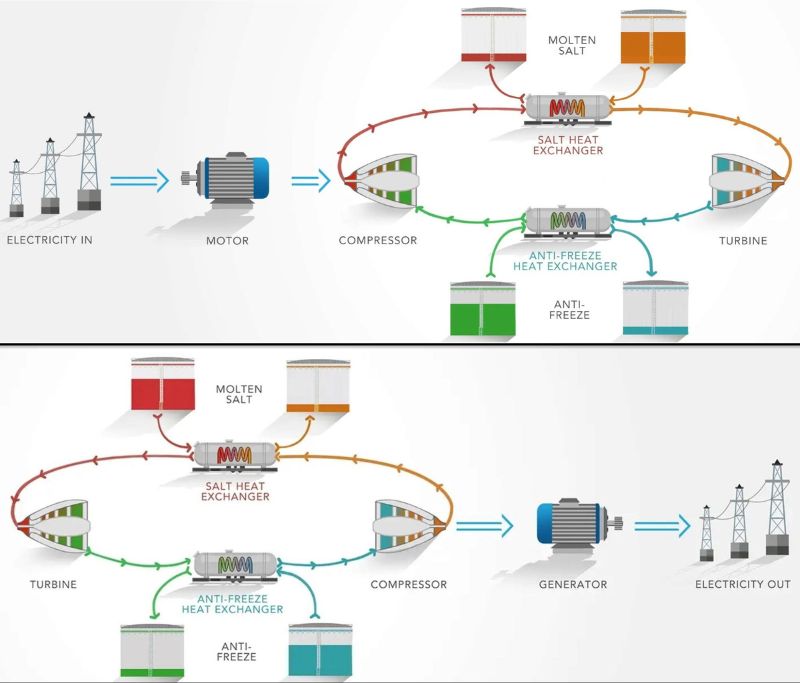
The working concept of Malta’s molten salt energy storage system. Images used courtesy of Malta
Breakthrough has also funded energy storage technology from Form Energy, which uses reverse rusting to draw and release oxygen through its iron-air battery. The company claims its units enable 100 hours of storage.
California-based Antora has introduced a thermophotovoltaic technology that stores electricity as heat in solid carbon blocks. When cheap renewable electricity is available, Antora’s thermal battery resistively heats up carbon blocks in an insulated module.
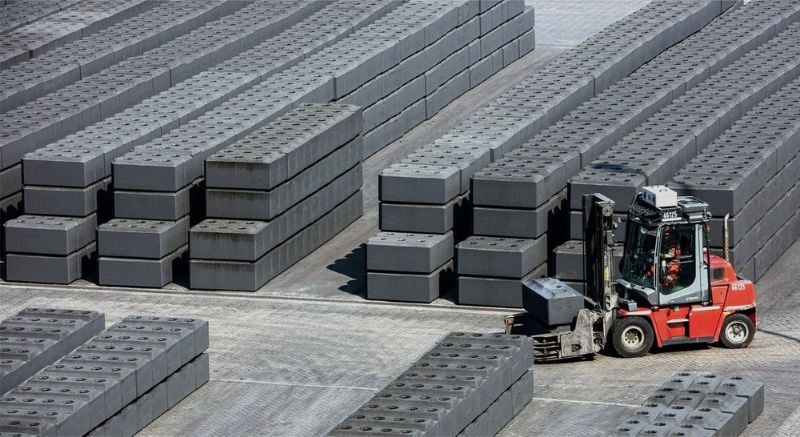
Antora’s carbon blocks. Image used courtesy of Antora Energy
The megawatt-scale blocks offer a 30-year lifetime, reduced degradation, and a compact footprint with high energy density. They can be configured for a variety of loads.
Another Bill Gates Endeavor: Advanced Nuclear Reactors
Separate from Breakthrough Energy, Gates also supports an effort to build the world’s most advanced nuclear plant. TerraPower, a company Gates founded in 2008, recently broke ground on its Natrium project in Wyoming and filed a construction permit application with the Nuclear Regulatory Commission (NRC). Gates chairs the board.
Natrium, the first advanced reactor to move from design to construction, is expected to come online by 2030. It’s envisioned as a competitive alternative to today’s commercial light water reactors, introducing a 345 MW sodium-cooled fast reactor design to supply firm power to today’s renewables-heavy grids. The reactor is paired with a molten salt energy storage system to provide 100 to 500 MW for 5.5 hours, with power ramping at 10% per minute.
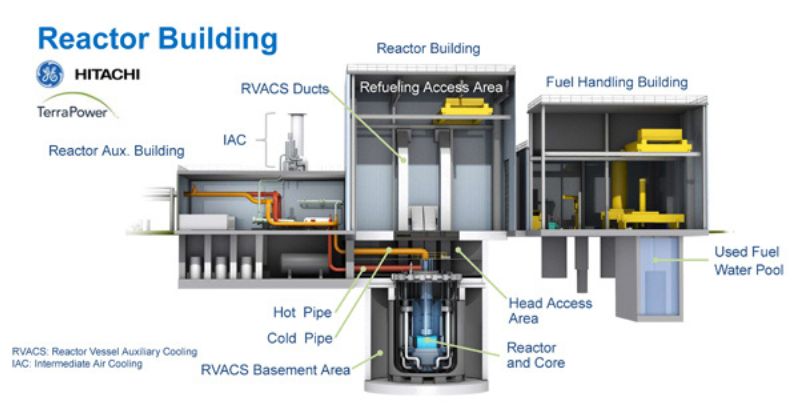
TerraPower’s 345 MW sodium fast reactor design. Image used courtesy of the NRC
While TerraPower awaits the NRC’s construction approval, it’s already building the plant’s non-nuclear components, including the steam turbines and other machines.