Facebook
 Google
 GitHub
 Linkedin
Bill-Gates Backed ‘Roller Coaster’ Wind Generator Takes Off
Airloom’s track-based wind system is set for a grid-scale pilot.
Airloom—the wind generator that functions like a roller coaster—is accelerating toward commercialization. The Bill Gates-backed startup will build a 50 kW prototype in Wyoming, where the company is based.
Learn about Airloom’s unique structure and function. Video used courtesy of Airloom Energy
Airloom will begin construction in 2025, with an expansion to utility-scale operations slated for 2026. The company has secured $14 million in new funding for the project from Breakthrough Energy Ventures and other sources.
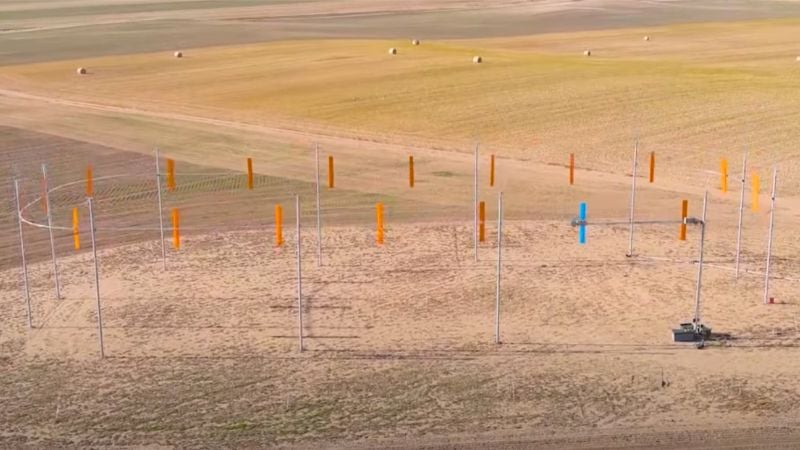
The Airloom wind generator. Image used courtesy of Airloom Energy
Airloom’s Unusual Design
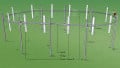
The Airloom generates energy with vertical blades, called wings, connected to an oval track. The 10-meter wings operate like a horizontal-axis wind turbine and travel the track like a roller coaster, Airloom Energy’s CEO Neal Rickner told EEPower last year. Unlike a roller coaster, the action never stops. Multiple wings make repeated circles around the track to generate electricity. The wind speed averages 5 to 7 meters per second.
Although smaller than traditional wind turbine blades, they rotate much faster—5,000 rpm compared to the 12 rpm of larger-bladed turbines. The swept area is also larger than a single conventional turbine.
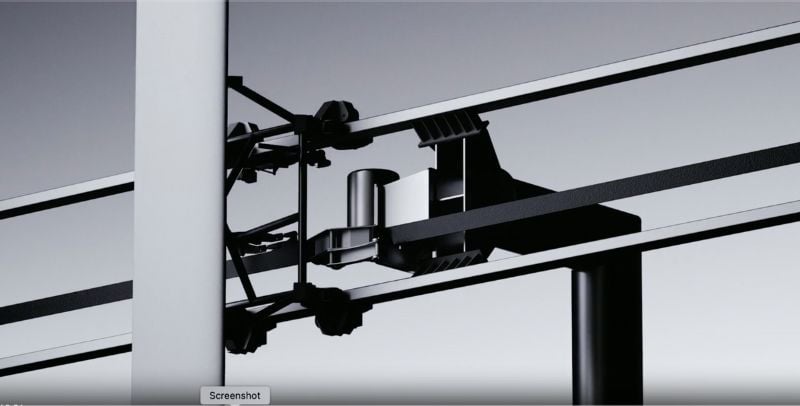
Airloom’s track. Image used courtesy of Airloom Energy
The lightweight track mounted on 25-meter posts uses tension to bind the system together. The company claims the system creates more energy in a smaller space than conventional wind farms.
The poles are adjustable in height to accommodate the chosen site. If a larger system is needed, more poles are added and the oval track is expanded. The system can also be installed on an offshore platform.
The company tested the Airloom model in both outdoor and indoor settings. Test results showed positive power production in megawatts. However, to produce the gigawatts needed for the grid, the system will need to be scaled up. This will involve building several wind-generating ovals side-by-side.
Airloom’s Advantages
The company claims that Airloom’s levelized cost of energy (LCOE) beats conventional wind turbines because of its lower capital costs and easy scalability. The smaller parts can be manufactured faster and easier than the typical turbine’s 160-foot blades and 60- to 80-ton nacelle.
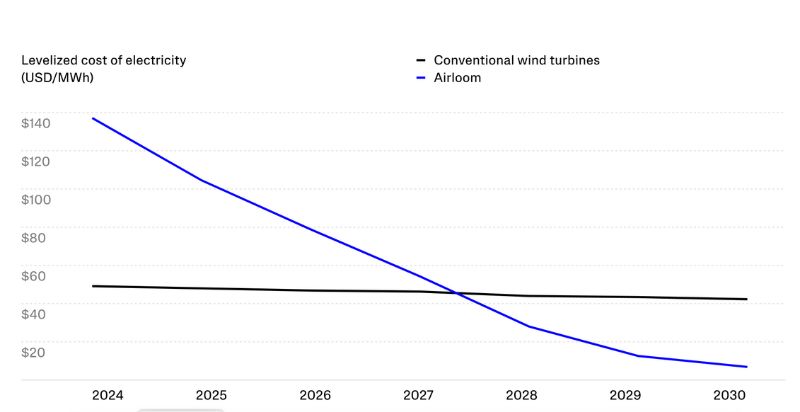
Comparison of Airloom and conventional turbine LCOE. Image used courtesy of Airloom Energy
Since traditional turbine parts are massive, they require heavy-duty trucks for transport and huge cranes for installation. By contrast, when disassembled, the Airloom’s parts fit inside a semi-truck.
Lower capital expenditures, smaller site requirements, and higher energy generation result in a lower cost per mW, according to the company.
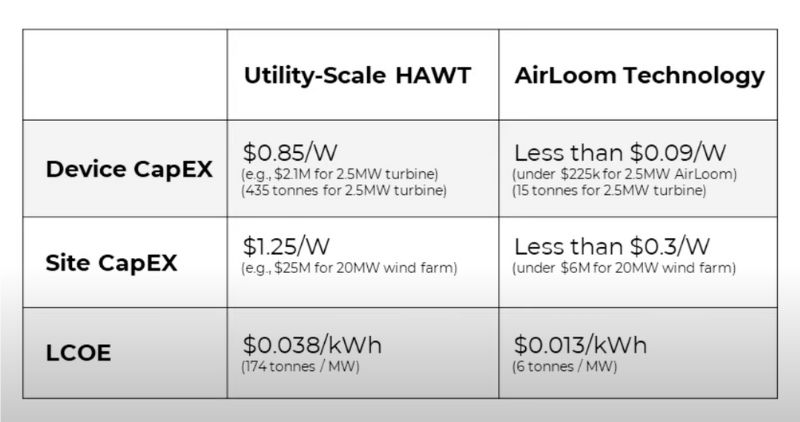
Conventional horizontal-axis turbine vs. Airloom. Image used courtesy of Airloom Energy
Big-Name Funding
Venture capitalist firms and government entities have invested in Airloom Energy. The latest round of $14 million in funding includes $7.5 million from Lowercarbon Capital. Breakthrough Energy Ventures, founded by Microsoft’s Bill Gates, also put up funds. Breakthrough and Lowercarbon helped seed the company when it launched in 2014.
Other investors include Crosscut Ventures, Wyoming Venture Capital, Adiuvans, WovenEarth Ventures, and the Kutnick Family Office. The state of Wyoming will provide $5 million in energy matching funds. The company also has a non-dilutive contract with the U.S. Department of Energy for $1.25 million.