Facebook
 Google
 GitHub
 Linkedin
Yokogawa Debuts 500 A / 200 A AC-DC Split Core Current Sensors for EV Test
The company’s new pair of palm-sized current sensors brings through-hole accuracy to clamp-on architectures, streamlining measurement in space-constrained, late-stage automotive test environments.
Yokogawa Test and Measurement has introduced a new generation of AC-DC split core current sensors, the CT500SA and CT200SA. Marking a significant step forward in measurement for high-current applications, the primary advancement of these modules is their ability to deliver wide-bandwidth, highly accurate current readings within heavily space-constrained environments.
Traditional high-accuracy current measurement often relies on through-hole sensors. While these devices offer superior precision, they demand that wires pass directly through a central aperture, creating significant logistical hurdles during late-stage vehicle production and testing.
The CT500SA and CT200SA offer a split core architecture that clamps directly over existing conductors, allowing engineers to maintain intact wiring while matching the accuracy ratings typically reserved for through-hole designs.
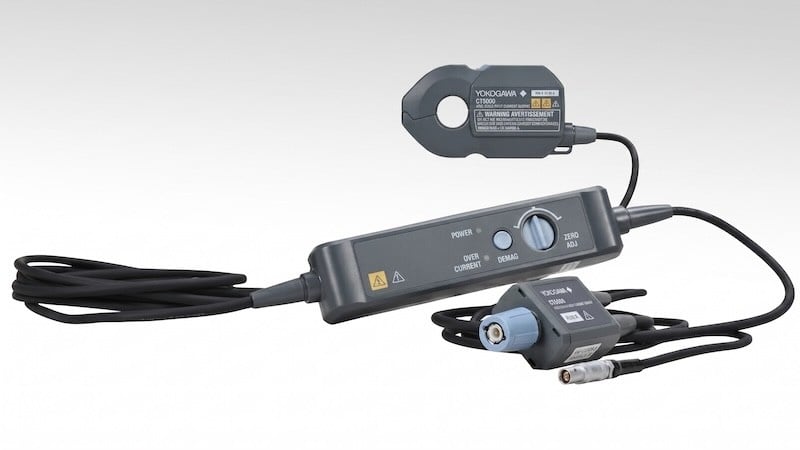
Yokogawa's CT500SA and CT200SA AC-DC split core current sensors
Operating within confined spaces, such as electrified vehicle (xEV) drivetrains, heavily restricts sensor access. By validating this clamp-on design for high-precision output, the devices provide engineers with the flexibility to quickly iterate through test phases without time-consuming mechanical teardowns, cable cutting, or disconnecting high-voltage lines.
Accuracy Meets Clamp-On Convenience
In addition to their logistical benefits, the sensors introduce exceptional precision to the clamp-on market. Leveraging a fluxgate sensor architecture rather than traditional Hall effect designs, the modules guarantee an accuracy of ±0.09 percent of reading plus 0.01 percent of full scale within a 23°C (±5°C) environment, and ±0.1 percent across a broader -40°C to 85°C operating range. Phase accuracy is held tightly at ±0.1° from 0.1 Hz to 1 kHz.
Available frequency bandwidths differ between the two units. The 500 A CT500SA delivers a bandwidth of DC to 500 kHz (-3 dB), while the 200 A CT200SA extends from DC to 1 MHz (-3 dB). This wideband capability is specifically tailored for motor inverter validation, enabling the precise measurement of switching frequencies and pulse width modulation (PWM) controlled outputs with high harmonic content.
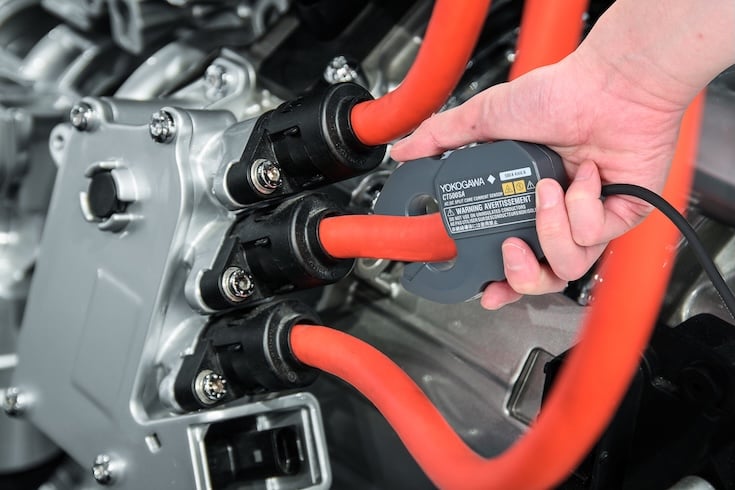
The CT500SA in action
A critical engineering benefit of the new sensors is their mechanical footprint. Both units feature a compact main enclosure measuring just 110 mm × 62 mm × 25 mm—roughly the size of a palm. The devices incorporate a single unlock-and-open button, enabling one-handed engagement in tight spaces. An integrated M4 screw hole and cable tie slots allow for secure mechanical fixation, mitigating positional shifts that could otherwise degrade output repeatability.
Dual-Instrument Connectivity
The CT500SA and CT200SA also present new integration options by natively supporting both digital power analyzers (such as Yokogawa's WT series and PX8000) and waveform measurement instruments (like ScopeCorders and the DLM series). Typically, current sensors require auxiliary conversion adapters to interface with different instrument classes.
By outputting a direct voltage signal via a BNC interface compatible across these platforms, the sensors eliminate the need for costly conversion connectors. Measuring identical signals across both power analysis and waveform instruments improves overall reliability, reduces hardware costs, and eliminates the data synchronization issues associated with swapping multiple sensor sets. More information can be found in the Yokogawa CT500SA and CT200SA product brochure.
Streamlining Vehicle and Infrastructure Validation
The capacity to quickly attach high-accuracy sensors alters the trade-offs associated with post-assembly testing. Because the sensors can be installed without disassembling cables or compromising measurement precision, testing procedures can be aggressively accelerated. This gives automotive and tier-one suppliers a clearer, faster path to validating inverter efficiency and motor drive dynamics.
According to Yokogawa, this hardware represents a highly compelling step forward for electric drivetrain evaluation. It is fascinating to see how combining fluxgate precision with a one-handed, clamp-on form factor opens up immediate workflow upgrades for high-voltage platforms.
It appears that the CT500SA and CT200SA well suited not only for in-vehicle xEV measurements on near-finished vehicles, but also for renewable energy (PV/solar) installations, commercial HVAC systems, and the burgeoning power evaluation demands of artificial intelligence data centers looking to maximize efficiency.
All images used courtesy of Yokogawa Test and Measurement.