 Facebook
 Google
 GitHub
 Linkedin
Vishay Unveils 650 V Superjunction MOSFET Power Modules in SOT-227 Package
The four 650 V superjunction MOSFET power modules in SOT-227 packages are designed to optimize efficiency and drop-in compatibility for demanding industrial DC-DC and DC-AC applications.
Vishay Intertechnology has expanded its portfolio of industrial power solutions with the introduction of four new power modules featuring 650 V superjunction MOSFETs. Housed in the industry-standard SOT-227 package, the company says the newly released components are engineered to deliver a highly optimized balance between conduction and switching losses, enabling high-efficiency power conversion across a wide range of rugged industrial applications.
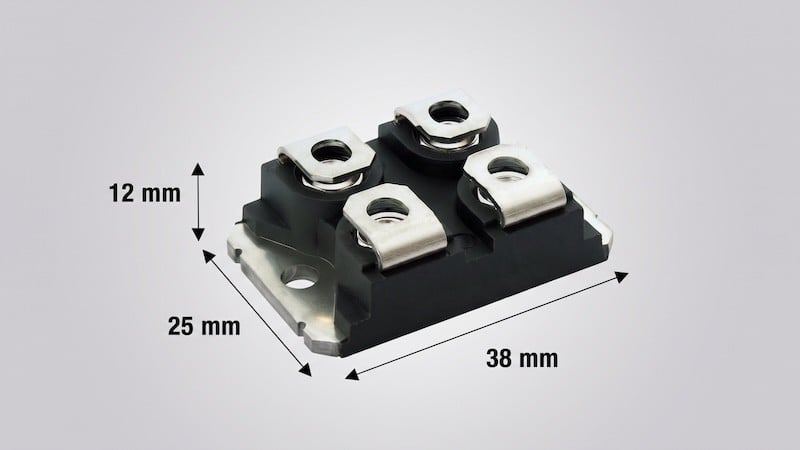
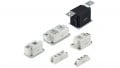
Vishay’s new 650 V superjunction MOSFET power modules are provided in the industry-standard SOT-227 package.
The new product lineup includes three devices in a single-switch configuration with nominal current ratings of 50 A, 100 A, and 150 A, as well as a specialized 50 A device configured as a low-side chopper that integrates a 650 V silicon carbide (SiC) diode.
Optimizing the RDS(on) and Qg Tradeoff
At the core of the new modules—the VS-FC50SA65, VS-FC100SA65, VS-FC150SA65, and VS-FC50LA65—is Vishay’s latest high-efficiency 650 V superjunction MOSFET technology. Superjunction structures allow power devices to sustain high blocking voltages while utilizing a highly doped drift region. When turned on, this translates to significantly lower resistance.
By achieving a highly competitive tradeoff between typical on-resistance (RDS(on)) and gate charge (Qg), the devices allow design engineers to drastically reduce power losses while maintaining the fast switching performance required in modern power stages.
Key Device Specifications:
- VS-FC50LA65: Low side chopper configuration (incorporating a 650 V SiC diode); 50 A nominal current; 45 mΩ typ. RDS(on); 167 nC Qg.
- VS-FC50SA65: Single switch configuration; 50 A nominal current; 44 mΩ typ. RDS(on); 167 nC Qg.
- VS-FC100SA65: Single switch configuration; 100 A nominal current; 22 mΩ typ. RDS(on); 338 nC Qg.
- VS-FC150SA65: Single switch configuration; 150 A nominal current; 14.8 mΩ typ. RDS(on); 508 nC Qg.
All four devices operate over a wide and robust temperature range of -55 °C to +150 °C. More information is available from the data sheets for the VS-FC50SA65, VS-FC100SA65, VS-FC150SA65, and VS-FC50LA65.
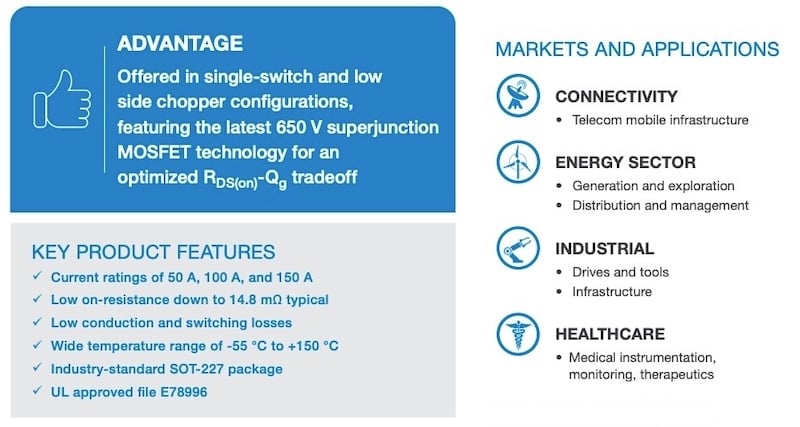
Features summary of of Vishay’s new 650 V superjunction MOSFET power modules
SOT-227 Packaging Eliminates Costly Redesigns
A major advantage of the new release is the mechanical form factor. By utilizing the industry-standard SOT-227 (miniBLOC) package, Vishay has provided the electrical and mechanical building blocks necessary for a true drop-in replacement. For engineers updating existing designs, this form factor effectively lowers production costs and accelerates time-to-market by entirely eliminating the need for costly printed circuit board (PCB) redesigns.
Target Industrial Applications
With their high-voltage capabilities and excellent thermal performance, the new superjunction MOSFET power modules are targeted at acting as DC/DC converters and DC/AC inverters in several demanding industrial sectors. Key applications include:
- Solar power inverters
- Hydrogen generation and fuel cell systems
- Auxiliary electronics and energy transportation within HVDC infrastructure
- Electric vehicle charging stations
- Switch mode power supplies (SMPS)
- Welding and cutting equipment
- Uninterruptible power supplies (UPS), lighting systems, and rail power supplies
- Medical imaging equipment, including X-ray and MRI systems
Availability
Sample and production quantities of the VS-FC50SA65, VS-FC100SA65, VS-FC150SA65, and VS-FC50LA65 SOT-227 power modules are available now. Vishay specifies current lead times of 12 weeks for the new devices.
All images used courtesy of Vishay.