 Facebook
 Google
 GitHub
 Linkedin
TI Unveils New ADC and Power ICs to Slash AI Data Center Downtime
Today, at the OCP Summit, Texas Instruments unveiled three new ICs designed to prevent power glitches, streamline high-voltage distribution, and minimize signal jitter in AI data centers.
Today at the Open Compute Project (OCP) Global Summit, Texas Instruments introduced a trio of new components aimed at scaling AI infrastructure safely and efficiently. As AI workloads grow in volume and complexity, data centers face unprecedented strains on their power, networking, and thermal management systems. The new devices aim to address the threat of undetected power glitches and signal degradation.
To learn more about TI’s three new products, we were pleased to be briefed by Karthik Vasanth, Vice President and General Manager of Data, Converters and Clocks at TI, and Matt Hann, TI's Product Line Manager for RF Sampling and High Speed Data Converters.
Hunting Transient Faults with Nanosecond Telemetry
A significant challenge in modern AI data centers is managing power instability, specifically "brownouts" that cause partial drops in grid voltage. These microscopic power glitches can force sensitive server equipment to run on weak power, risking hardware damage, unexpected reboots, and putting critical AI model elements out of commission.
"If you think of a data center as a haystack, you're looking for that little needle that's somewhere buried in this haystack," explained Vasanth.
To locate that needle, TI released the ADC34DSO75, an analog-to-digital converter (ADC) operating at 3 gigasamples per second (GSPS). The device provides 24/7, low-power, event-based remote telemetry at nanosecond resolution, catching transient faults thousands of times faster than traditional monitoring solutions.
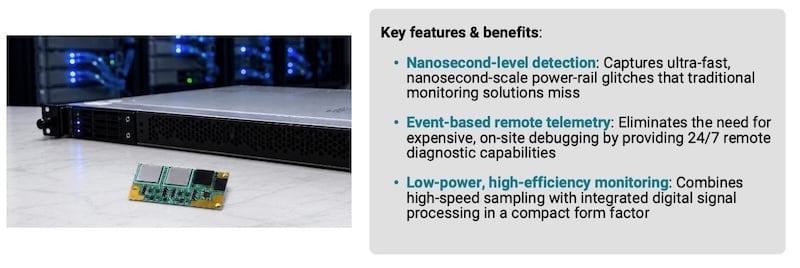
TI dubs the ADC34DSO75 as the industry’s highest performance ADC to enable 24/7, low-power, event-based remote telemetry at nanosecond resolution.
Instead of requiring operators to bring an oscilloscope on-site to debug a rack, the ADC utilizes event-based monitoring. Operators can program specific voltage thresholds or rate-of-change windows to monitor system health.
"When an event occurs, the data offloads into an internal memory buffer, and that memory buffer is what captures the event," said Hann. "You don't actually have to offload it into a very bulky and expensive FPGA; you can use a very, very low-cost MCU to transmit the data remotely."
More information is available in the ADC34DSO75 data sheet.
Consolidating 800 V Power Delivery
Data center power infrastructure is also undergoing a radical shift, moving away from multi-stage AC-to-DC step-down conversions toward bringing high-voltage DC directly to the board. To manage this complex layout, TI introduced the LMI800PS, the industry's first 800 V isolated hot-swap controller.
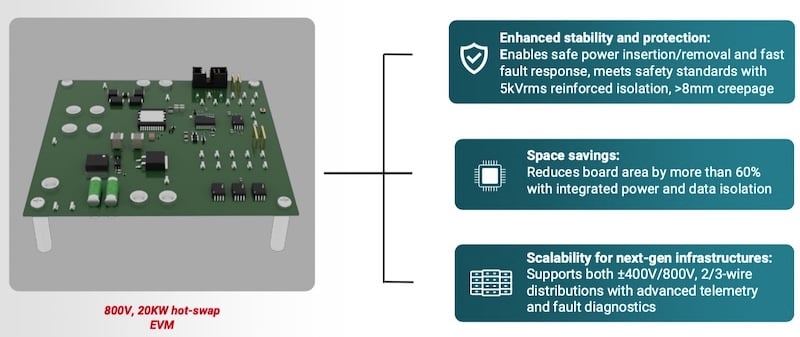
TI claims the LMI800PS as the e industry's first 800 V isolated hot-swap controller.
The LMI800PS replaces complex discrete solutions that previously required up to five separate integrated circuits. By integrating an isolated bias supply and PMBus telemetry into a single package, the controller reduces required board space by over 60 percent.
The chip is designed to safely manage inrush current during board insertions and provide fast fault isolation. It meets rigorous safety standards by featuring 5k VRMS reinforced isolation and greater than 8mm of creepage, all while supporting both ±400 V and 800 V distribution topologies.
Taming Signal Jitter at Terabit Speeds
On the networking side, data centers are pushing massive amounts of data across kilometers of cabling, migrating from gigabytes to terabytes of flow between massive GPU clusters. With data transmission rates approaching 3.2 Tbps, bit periods are reduced to picoseconds, making systems highly susceptible to bit error rates and instability caused by signal jitter.
To act as a highly accurate "heartbeat" for these networks, TI launched the LMK6B, a clocking source built on Bulk Acoustic Wave (BAW) oscillator technology. The LMK6B delivers an industry-leading jitter performance of 9.6 femtoseconds at a 625 MHz clock rate.
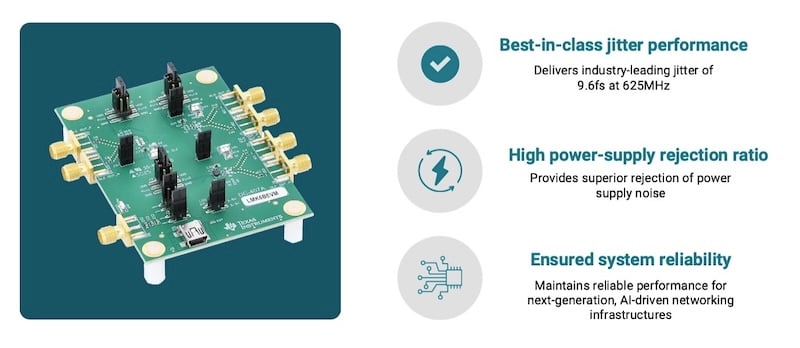
TI touts the LMK68 as a BAW-based oscillator with industry’s lowest jitter performance.
Because it must operate on crowded boards where CPUs and GPUs are actively switching thousands of amps, the oscillator features a high Power-Supply Rejection Ratio (PSRR) to maintain data integrity and reject power supply noise. More information can be found in the LMK6B data sheet.
Pre-production quantities of the ADC34DSO75, LMI800PS, and LMK6B, along with their respective evaluation modules, are available on TI's website. TI is demonstrating these technologies and covering advancements in power efficiency and thermal management at Booth E45 during the OCP Global Summit.
All images used courtesy of Texas Instruments.