 Facebook
 Google
 GitHub
 Linkedin
TDK Intros 2 kW Medical AC-DC Supplies With High Power Density
The new CUS1600M and CUS2000M models combine up to 95 percent efficiency with strict medical isolation and ultra-quiet cooling for sensitive industrial and hospital environments.
TDK has expanded its TDK-Lambda lineup with the introduction of the CUS1600M and CUS2000M AC-DC power supply series. Generating up to 2,000 W of output power, these high-density units are engineered to support space-constrained medical, industrial, and life science equipment requiring highly efficient and ultra-quiet operation.
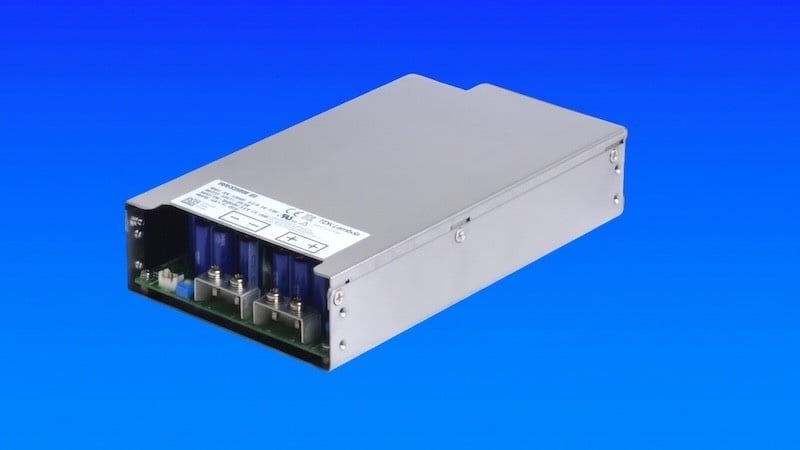
TDK-Lambda’s CUS2000M-48 AC-DC power supply
Traditional high-power supplies often rely on aggressive, noisy cooling mechanisms that can be disruptive in clinical settings. By combining a 33.3 W/in³ power density with advanced variable-speed fan control, the CUS1600M and CUS2000M mitigate these issues, offering an exceptionally quiet acoustic profile as low as 35 dBA to ensure patient comfort and simplify system footprints.
High Power Density and Output Options
Available in 1,600 W and 2,000 W capacities, the CUS-M series includes baseline models covering nominal output voltages of 12 V, 24 V, 36 V, and 48 V. Operating at an efficiency rating of up to 95 percent, the architecture minimizes internal heating losses, which enables its high power capacity to be packaged into a highly compact 203.2 x 114.3 x 42.5 mm (8.0 x 4.5 x 1.67 inches) footprint.
Standard integrated auxiliary functions across the family include a 5 V, 2 A independent standby voltage loop, remote sensing capabilities, a remote on/off interface, and a power-good status flag. This comprehensive feature set supports easier system integration and advanced power management for complex equipment.
Thermal Management and Derating
The thermal architecture of the CUS1600M and CUS2000M supports a broad operating temperature window spanning from -20°C to +70°C, with a verified cold start-up capability extending down to -25°C. Output loading derates linearly beyond 40°C down to a 60 percent capacity limit at the +70°C maximum thermal ceiling.
To accommodate a wide variety of global grids and potential brownout conditions, the units accept an 85 Vac to 265 Vac input, with the output power derating slightly to 90 percent load when line input falls between 100 and 85 Vac.
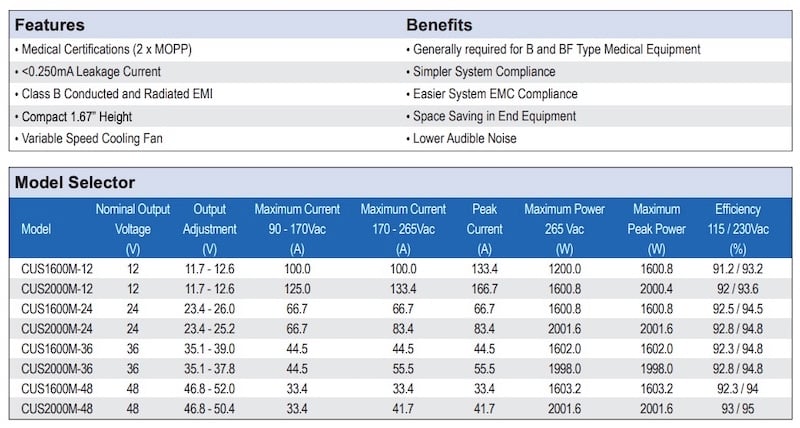
CUS1600M and CUS2000M features/benefits and model selector
The integrated variable-speed fan ensures active cooling across the output terminals while keeping audible noise down. Noise is a critical consideration in hospital environments, where cumulative sound from devices like ventilators, patient monitoring systems, and infusion pumps can disrupt patient sleep and negatively impact recovery and well-being. More information can be found in the CUS1600M/ CUS2000M data sheet.
Strict Medical Safety Credentials
To satisfy the rigorous operating constraints of the medical field, the safety and insulation boundaries are highly robust. The series features an input-to-output isolation rating of 4,000 Vac (2 x MOPP), input-to-ground isolation of 2,000 Vac (1 x MOPP), and an output-to-ground barrier of 1,500 Vac (1 x MOPP), all while restricting leakage current to less than 0.250 mA.
The supplies carry formal safety certifications to both IEC 60601-1 for medical equipment and IEC/EN/UL/CSA 62368-1 for audio/video and ICT equipment. They also meet Class B conducted and radiated EMI requirements under EN55032, EN55011-B, and FCC-B standards, easing the burden of system-level EMC compliance and speeding up time-to-market.
According to TDK-Lambda, the CUS1600M and CUS2000M series are backed by a five-year warranty. Moving forward, this hardware is well suited for demanding applications including medical imaging, medical aesthetic and surgical equipment, in-vitro diagnostics, laboratory automation, test and measurement, and semiconductor processing equipment looking to compress hardware footprints while maintaining whisper-quiet operation.
All images used courtesy of TDK-Lambda.