Facebook
 Google
 GitHub
 Linkedin
R&S Unveils Broadband Amplifiers in Power Classes up to 1000 W
The DE500 and DE1000 extend the BBA300 family to 1 to 6 GHz in single-band operation
Rohde & Schwarz has added the R&S BBA300-DE500 and R&S BBA300-DE1000 to its portfolio of power amplifiers. These two solid-state amplifiers are rated at 500 W and 1000 W for broadband RF testing from 1 to 6 GHz.
As electromagnetic compatibility (EMC) test standards in automotive, aerospace, and defense have become stricter, R&S has designed the new models to provide manufacturers with amplifiers that cover wide frequency ranges without band switching or tube-related maintenance.

R&S BBA300-DE1000. Image used courtesy of Rohde & Schwarz
R&S BBA300-DE500 and BBA300-DE1000
The BBA300-DE500 and BBA300-DE1000 power amplifiers expand the power outputs and frequency coverage of Rohde & Schwarz’s existing single-band amplifiers. The DE500 model delivers 500 W P1dB and 750 W Psat over the full 1 to 6 GHz band. R&S rates this model’s gain at 57 dB at 1 GHz, with flatness at less than ±4.5 dB and third-order intermodulation distortion at less than −20 dBc.
With the DE1000, R&S achieves 950 W P1dB and 1100 W Psat with 60 dB gain at 1 GHz and matching flatness and distortion specifications.
R&S added several features to the new models to help them pass EMC testing more easily. For example, the company built both amplifiers with full mismatch tolerance, so that they can handle up to 100% reflected power without damage. To cover the gamut of real-world signal types, R&S added AM, FM, phase modulation, and orthogonal frequency-division multiplexing (OFDM) waveform support.
The company also placed the 7/16 DIN female RF output connector centrally in the rack to shorten the cable run to the device under test, reducing antenna power loss and improving test accuracy.
Lastly, the DE500 and DE1000 integrate easily. Both models are compatible with R&S’s other amplifier families, like the BBA130 and BBA150, and come in standard 19-inch racks, with the DE500 and DE1000 having rack heights of 14 and 30 HU, respectively.
Solid-State Architecture for High-Power Applications
Wave tube amplifiers have long been the go-to solution for high-power RF. Invented in the 1940s, this technology works by accelerating an electron beam through a vacuum tube and coupling it to an RF signal propagating along a helical slow-wave structure. As the beam and the wave travel together, energy transfers from the electrons to the RF signal, producing high gain across a broad bandwidth.
But, despite their reliability, these vacuum-tube-based systems require warm-up time, periodic tube replacement, and separate amplifier bands to cover a wide frequency range.
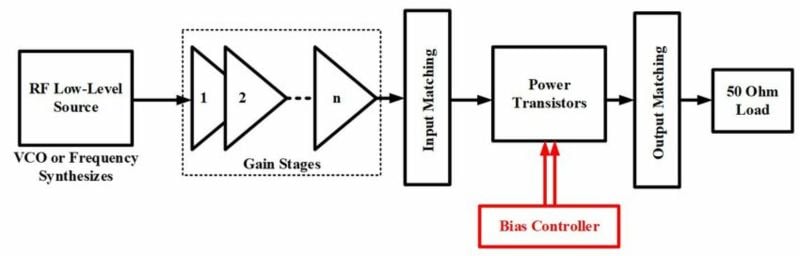
Basic block diagram of a solid-state RF amplifier. Image used courtesy of Rahimpour et al.
Solid-state amplifiers, on the other hand, replace vacuum tubes with semiconductor devices (e.g., GaN, LDMOS, or GaAs transistors). Combined in parallel through power-combining networks, such solutions can reach the kilowatt-class output levels. The result is a lower-maintenance amplifier that can turn on instantly and run for tens of thousands of hours without tube swaps.
Solid-state amplifiers also cover a much wider continuous frequency range in a single chassis, and degrade gracefully (i.e., if one transistor module fails, the amplifier keeps operating at slightly reduced power rather than going dark mid-test).
Availability and Configuration
Rohde & Schwarz is now accepting orders for the BBA300-DE500 and BBA300-DE1000, with the optional BBA-PK1 operating mode available only for the DE500 model.