Facebook
 Google
 GitHub
 Linkedin
Research Triples Blue Energy Output with ‘Slippery’ Nanopores
A prototype membrane achieves roughly 15 W per square meter, two to three times better than blue energy production using existing polymer technologies.
Researchers at École Polytechnique Fédérale de Lausanne (EPFL) have found a better way to make electricity from a mix of fresh water and saltwater.
The method uses a nanopore membrane coated in lipid bilayers to produce blue energy, or osmotic power. These “slippery ions” achieve a power density roughly two to three times higher than current polymer membrane technologies.
Mixing fresh and saltwater makes blues energy. Image used courtesy of Adobe Stock
Blue Energy and the Membrane Problem
Blue energy exploits the difference in salt concentration between two bodies of water. When a semipermeable membrane separates fresh water and saltwater, ions naturally migrate from the high-salinity side toward the low-salinity side. This creates a voltage that can be converted into an electrical current.
Coastlines, river deltas, and fjords represent an enormous potential resource for blue energy. The Electrochemical Society estimates that the global opportunity for blue energy is on the order of tens of terawatts, comparable in scale to current world electricity consumption.
While blue energy isn’t new, it has faced significant obstacles in the path to commercialization. The chief obstacle has always been the membrane itself.
Ion-selective polymer nanopore membranes provide adequate separation but create high internal friction on ions, which slows them down as they move through the channel. That friction limits current output per unit area, keeping power densities low enough that commercial osmotic plants, like the long-running pilot in Tofte, Norway, have struggled to justify their capital costs.
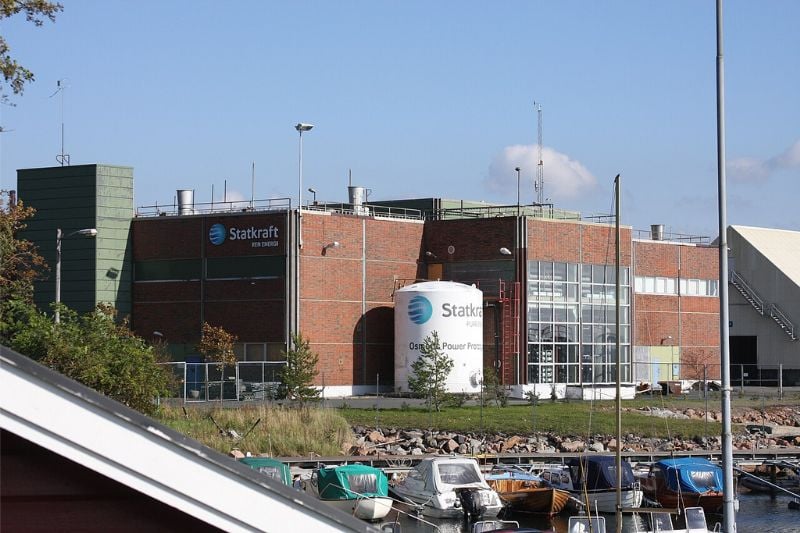
The Statkraft blue energy plant in Norway. Image used courtesy of Wikimedia Commons
Improving the rate at which ions can move through a membrane without sacrificing selectivity has been the defining challenge for the field.
How Lipid Lubrication Works
To address that friction problem, the EPFL team turned to lipid bilayers, the same molecular structures that form biological cell membranes.
When a lipid bilayer coats the interior wall of a nanopore, the hydrophilic heads of the lipid molecules attract and hold a layer of water just a few molecules thick. This "hydration lubrication" film reduces the resistance ions encounter as they pass through the channel, allowing them to move more freely while the pore's geometry still enforces ion selectivity.
The prototype device housed 1,000 lipid-coated nanopores arranged in a hexagonal pattern. Despite its modest scale, the membrane reached a power density of approximately 15 W/m2. This figure stands well above the 5-7 W/m2 typical of polymer systems under comparable conditions.
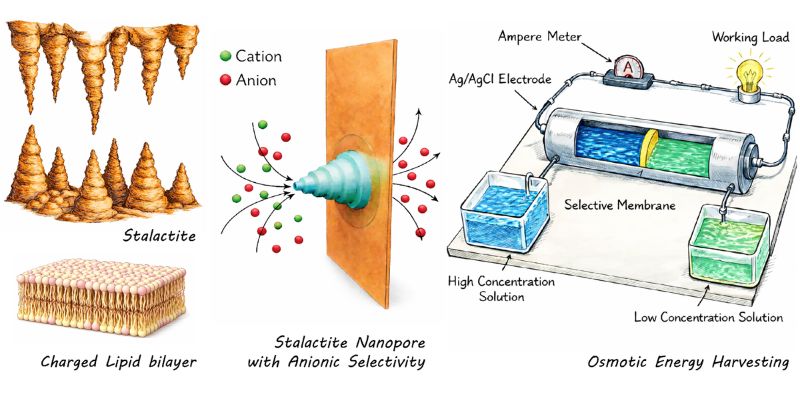
The study concepts. Image used courtesy of EPFL
The LBEN group has developed extensive experience working with aerolysin nanopores in medical contexts. Separate collaborators at EPFL have applied biological nanopores alongside deep learning algorithms to detect protein modifications linked to Parkinson's disease, work that demonstrates the versatility of precisely engineered nanopore structures. The blue energy application borrows from that same foundation.
The Road to Scale
The big engineering question now is durability. Natural lipid bilayers are inherently delicate. Sustaining them under the pressure differentials, ionic gradients, and flow volumes required for industrial osmotic systems is a different proposition than a lab-scale prototype. The team designed its hexagonal membrane layout to be scalable, but long-term stability testing under real operating conditions remains ahead.
Blue energy holds logistical advantages over many other renewable sources because it generates electricity continuously, requires no sunlight, and produces power at precisely the locations where fresh water meets the sea. Many such sites already have grid connections. Indeed, this resource has been known for decades, but the limiting factor has been finding membranes that can convert it efficiently.
If the lipid-lubrication approach proves rugged enough for sustained deployment, it could meaningfully change that. The mechanism itself, which borrows the frictional properties of biological membranes to ease ion transport, is conceptually simple and does not depend on exotic materials, but whether it translates from a thousand-nanopore hexagonal array to large-format industrial membranes will determine how significant a contribution EPFL's work ultimately makes to a long-neglected corner of renewable energy.
The study appeared in Nature Energy.