Facebook
 Google
 GitHub
 Linkedin
Recom Offers AC-DC DIN Rail Power Supplies for 240 W and 480 W
The compact, convection-cooled power supplies target high-density industrial control and automation systems.
Recom has expanded its DIN-rail power portfolio with the RACPRO1-S240E and the higher-power RACPRO1-S480, both designed for single-phase industrial installations that require high output power from compact designs. The solutions feature convection-cooling, dense form factors, and compliance with global safety and EMC standards.
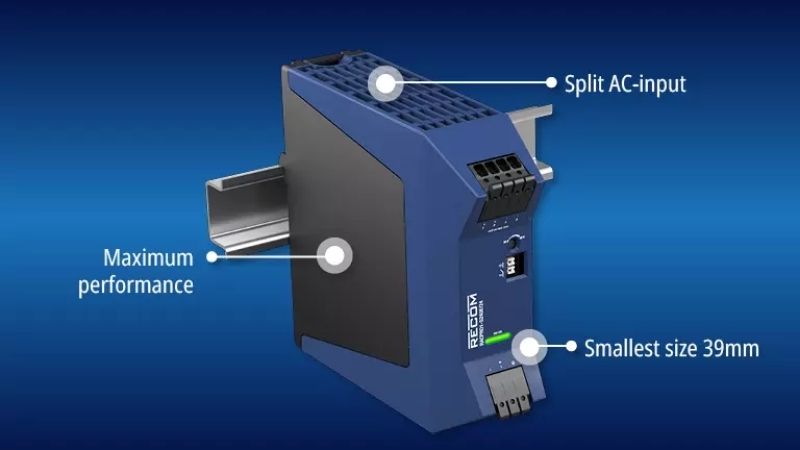
Features of the RACPRO1-S240E DIN rail AC/DC series. Image used courtesy of Recom
The PSU Series
The first release from Recom is the RACPRO1-S240E series, which delivers up to 240 W continuously from -40 to +60 °C with output options of 12, 24, or 48 VDC. At moderate ambient temperatures, the unit provides a thermal power bonus of 288 W at +45 °C and a short-term boost of 150% for 5 seconds to handle surge loads. Typical efficiency reaches 94% at different output voltages, while no-load power consumption remains below 1 W.
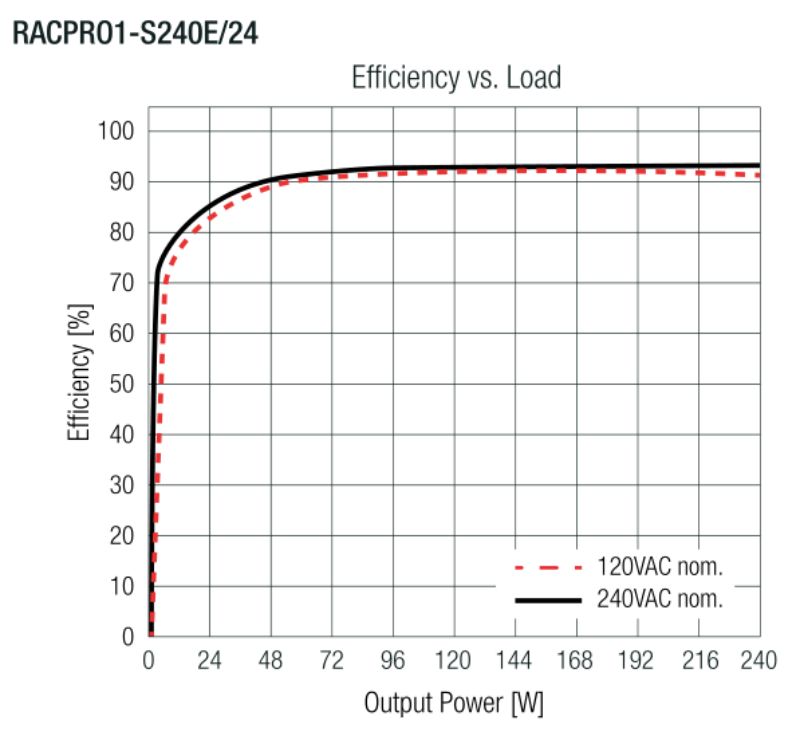
RACPRO1-S240E efficiency under load. Image used courtesy of Recom
For higher-power applications, the RACPRO1-S480 series provides 480 W continuous output at -40 to +60 °C with convection cooling. The supply is available with 24 V or 48 VDC outputs and reaches a typical efficiency of 95.4%, with active power factor correction resulting in a power factor of 0.95 at full load.
At elevated but controlled temperatures, the unit can deliver 576 W at +45 °C and provide a 150% power boost for 5 seconds. The design also includes electrical protection features, such as active inrush current limiting, hiccup-mode short-circuit protection, overvoltage protection, and a DC-OK relay signal for system monitoring.
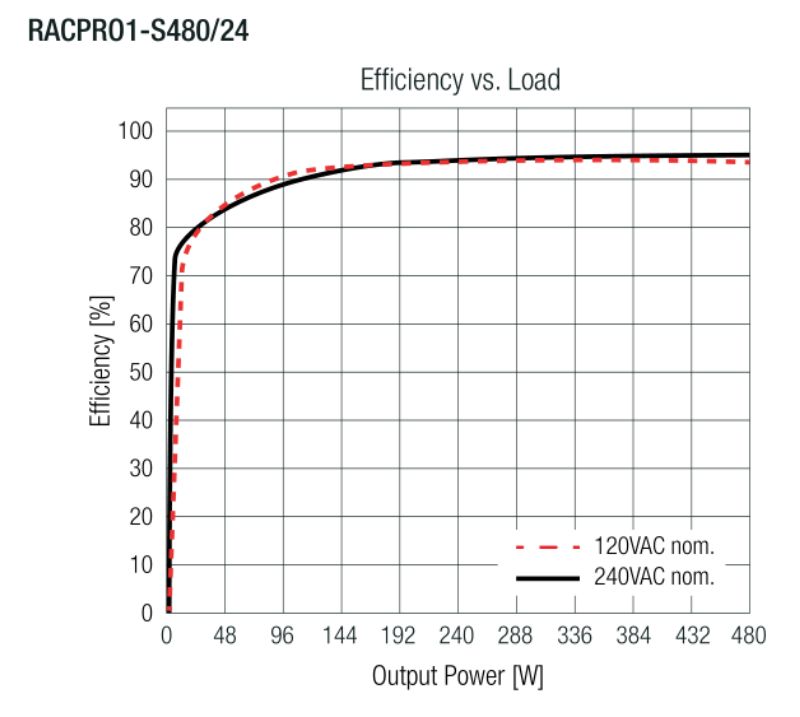
RACPRO1-S480 efficiency under load. Image used courtesy of Recom
Even with a higher power rating, the 480 W supply comes in a 135 x 52 x 155 mm form factor. Additional functionality includes selectable constant-current or parallel load-sharing modes via DIP switches and load-indication LEDs.
Both series are certified to IEC/EN/UL 61010-1 and IEC/EN/UL/CSA 61010-2-201 and meet EN 61000-6-2 immunity and EN 61000-6-3 or -6-4 emission requirements, depending on configuration.
Managing Backfeeding and Surge Loads
In industrial control systems, backfeeding occurs when energy flows upstream into a source or distribution node that was not designed to absorb power. In regenerative motor drives and battery systems, for example, this reverse current can raise bus voltage and damage upstream converters.
Designers can address this risk through active power-flow control, isolation stages, and directional protection. Blocking elements, such as ideal diode controllers and solid-state relays, can prevent unintended reverse conduction while minimizing conduction losses compared to discrete diodes.
In higher-power systems, engineers can also rely on bidirectional DC-DC converters that regulate energy flow explicitly rather than attempting to block it.
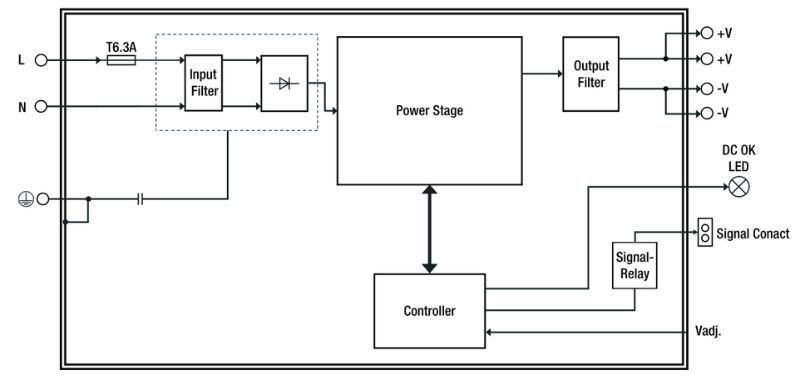
Block diagram of Recom’s newest DIN-rail power supplies. Image used courtesy of Recom
Surge loads present a different but related problem, as inrush current during startup and load steps can exceed nominal ratings by an order of magnitude. These events can ultimately stress downstream components and significantly limit system lifetime.
To prevent this, engineers can employ techniques including soft-start circuits, pre-charge paths, active current limiting, and bulk capacitance sized for transient energy rather than average power. Coordination between protection devices also matters. A fuse or circuit breaker must trip after semiconductor protection reacts, not before, to avoid nuisance failures.
Looking Ahead
Both the RACPRO1-S240E and RACPRO1-S480 series are available now through RECOM and its authorized distributors.