Facebook
 Google
 GitHub
 Linkedin
Pulse Introduces Through-hole Power Bead Inductors for Desktop Architectures
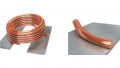
Pulse announced what it claims is the industry’s first series of through-hole power bead inductors for desktop architectures. Pulse’s PA1894NL and PA2080NL series use a single-turn conductor with a ferrite core instead of a multi-turn conductor wound on a powdered iron toroid core. According to the company, this improved structure allows for a 2 to 3% increase in Vcore voltage regulator efficiency, a 35 to 55% reduction in inductor footprint, and enables the tightest direct current resistance (DCR) tolerance available in the industry at ±4%. The operating temperature is -40 to +130°C. The use of ferrite core material makes these inductors immune to thermal aging, increasing system reliability.
The PA2080NL series is 10.5 x 7.5 x 8.9mm maximum with inductance ranging from 140nnH to 220nH, a DCR of 0.49mΩ ±4%, and up to 80Apk. The PA1894NL series is 10.0 x 9.0 x 10.0mm maximum with inductance ranging from 185nH to 335nH, a DCR of 0.64mΩ ±4%, and up to 72Apk. The footprint of the inductor series is designed to fit the pin-pitch of existing toroid solutions for easy test and verification. Pulse’s power bead inductors are used in power supplies for microprocessors (Vcore power circuit) in desktop, gaming, server, and workstation applications.
"Traditionally, inductors for desktop applications used wire-wound toroids," explained John Gallagher, Field Applications Engineer for Pulse’s Power Division. "They worked well enough in the past, but as electrical, mechanical, and thermal requirements have become more stringent, the high power losses, loose inductance and resistance tolerances, and large footprint of the toroids make them much less desirable and through-hole power bead inductors much more so."
Pulse’s PA1894NL and PA2080NL series inductors are RoHS compliant.