Facebook
 Google
 GitHub
 Linkedin
Paragraf Launches 12-Channel Graphene FET Platform and Real-Time Reader
The PMF2002 multiplexes 12 customer-functionalized graphene sensing channels on one device, while the new Enterprise Reader adds direct electronic readout and real-time analysis.
Graphene electronics maker Paragraf has expanded its sensing portfolio with two products for researchers and diagnostic developers: the PMF2002, a 12-channel graphene field-effect transistor (GFET) platform, and the Enterprise Reader, a data acquisition system that provides direct electronic readout and real-time analysis.

The PMF2002 and Enterprise Reader.
The U.K.-based company announced the pair three months after launching its three-channel PMF2000. Both products are now commercially available.
A 12-Channel, Common-Gate Sensing Architecture
A GFET replaces the channel of a conventional transistor with a sheet of graphene, a single atom thick. Because every atom in the channel sits at the surface, charged molecules binding to the graphene measurably shift its carrier concentration and, with it, the channel's conductance. Functionalizing the surface with a receptor layer makes that shift selective to a chosen target, giving GFETs label-free, fast, all-electronic detection without the optical instrumentation that many conventional assay techniques require.
Paragraf calls the PMF2002 its most advanced multiplexing GFET platform to date. The device arranges 12 sensing channels around a common gate, with separate source and drain connections for each channel, enabling simultaneous measurement across multiple channels from a single sample. In the company's words, the architecture delivers greater insight from less material in less time.
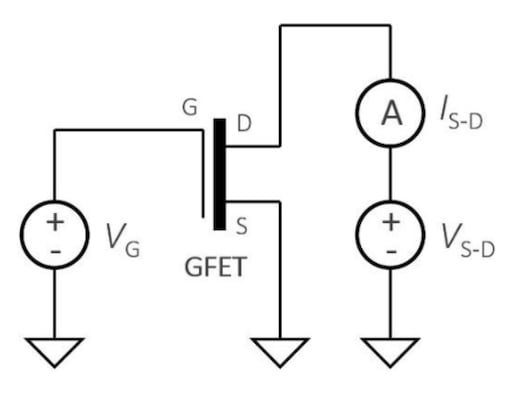
Typical test circuit for an electrolyte-gated graphene FET.
The layout is a fourfold jump in channel count over the PMF2000, which offered three independent graphene channels around an in-plane gate electrode. In practice, the extra channels enable parallel assays from a single sample: multiple targets, replicates for statistical confidence, or on-chip reference channels that help correct for drift and nonspecific binding—all of which are persistent challenges in GFET sensing. For diagnostic work, where sample material is often scarce, extracting 12 measurements from a single aliquot is a meaningful efficiency gain.
Because the customer functionalizes the sensing surface, the same hardware can be configured for whichever species matters to the application. Paragraf cites water quality monitoring, soil analysis, gas detection, and molecular biosensing as target uses, and the company has previously published application notes covering pH sensing, potassium detection in serum, and acetone gas sensing on its earlier GFET platforms.
Pairing the Sensor With Real-Time Readout
GFET research has typically required teams to assemble their own source-measure and data-acquisition electronics; the PMF2000, for instance, was specified as compatible with standard data-acquisition systems rather than coming with its own. The Enterprise Reader provides direct electronic readouts and real-time analysis, pairing the sensor with turnkey instrumentation so developers can move efficiently from concept to results.
Real-time visibility is important in assay development because a sensor's response unfolds over seconds to minutes as molecules bind to the functionalized surface. Watching that curve live, rather than post-processing logged data, lets developers tune functionalization chemistry and detection thresholds in far fewer iterations.
Products From a Dedicated Graphene Foundry
Both products are manufactured at Paragraf's device foundry in Huntingdon, Cambridgeshire, which the company describes as the world's first dedicated to graphene and 2D-material electronics. Paragraf's proprietary process grows graphene directly on standard semiconductor substrates rather than transferring it from copper foil, avoiding the polymer contamination that transfer introduces and keeping the material compatible with established semiconductor manufacturing flows.
A spin-out of the University of Cambridge's materials science department, Paragraf has raised more than $150 million in private investment and operates across five sites in the U.K., the U.S., China, and the United Arab Emirates. Its earlier products include the GHS series of graphene Hall-effect sensors, which operate from cryogenic temperatures to 250°C, and the PV01 GFET platform that preceded the PMF2000.