Facebook
 Google
 GitHub
 Linkedin
MaxLinear Unveils Control-Plane Portfolio for Next-Gen AI Infrastructure
MaxLinear, well known for RF and mixed-signal products, recently introduced a comprehensive new portfolio of products for rack-level control-plane architectures for AI, cloud, enterprise, and edge infrastructure. Dubbed RackCommander, the new portfolio collects the company’s existing products, including the Coronado and Laguna USB-UART, and groups them by rack controller functions.
RackCommander
Server operators need an AI rack management solution that stays accessible even when the production network is down. In RackCommander, MaxLinear splits this management solution into console access, infrastructure communications, monitoring and control, and power protection.
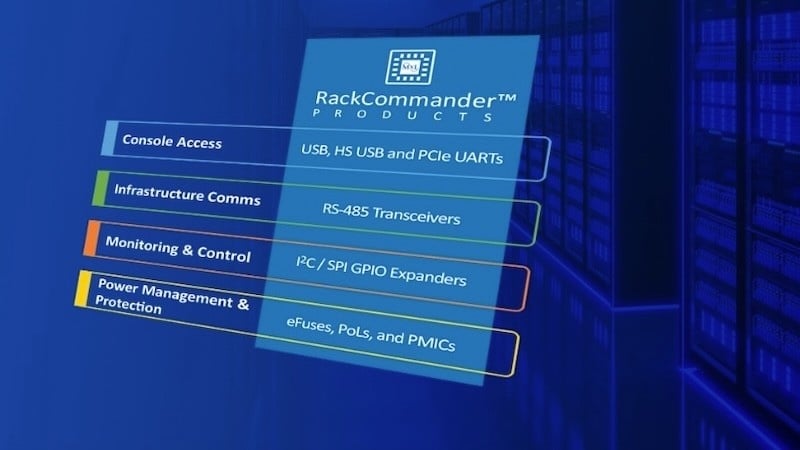
RackComander is a portfolio of products for rack-level control-plane architectures for AI, cloud, enterprise, and edge infrastructure.
To start, MaxLinear covers console access across three USB-UART devices, each aimed at a different design priority. Coronado runs USB 2.0 from a 5 x 5 mm QFN and includes a programmable 48 MHz oscillator, which removes the external crystal from the console circuit. For boards already designed around an incumbent bridge, MaxLinear positions Laguna as a pin-to-pin compatible part with 512-byte FIFOs. Carmel sits above both on throughput, pairing 480 Mbps High-Speed USB with four UART channels at up to 15 Mbps each. All three specify ±15 kV ESD protection.
A power shelf or a cooling manifold has no console port to plug into, so reaching it takes a different kind of link. MaxLinear covers those endpoints with the MxL83214 RS-485 transceiver, which carries traffic between rack management systems and power, cooling, and sensor hardware on a single pair shared by many devices.
Meanwhile, for level-based telemetry signaling, MaxLinear offers its GPIO expander family, which includes MxL82200, MxL82201, MxL82203, MxL82403, and MxL82423. According to the company, the expanders gather health, fault, and sideband control lines from around the rack so one controller reads them all through a handful of pins.
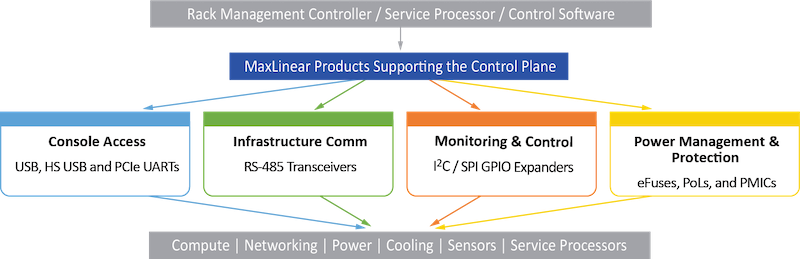
RackCommander products support control-plane functions for AI infrastructure.
Ultimately, none of that reporting helps if the management hardware itself loses power. MaxLinear closes that gap with the MxL745950 and MxL745951P eFuses for protection and inrush control, and with the MxL76502, MxL76503, MxL76505, and MxL76508 step-down regulators for point-of-load rails.
Why Rack-Scale Systems Outgrew the Server Management Model
Since Intel introduced the IPMI specification, datacenter operators have managed each server separately. With its own compute, power, and cooling, every IPMI server had its own baseboard management controller (BMC) that monitors the sensors, power state, and serial console for itself. Industry groups standardized this arrangement with server management specifications like Redfish so one tool could manage any vendor’s hardware.
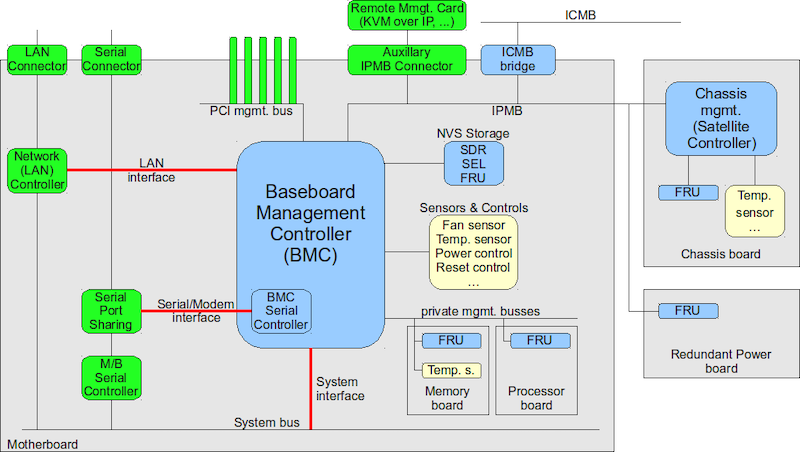
Schematic of IPMI components. Image used courtesy of Thomas-Krenn.
With AI rack-scale systems, operators could no longer use an IPMI server management model. One reason is their differing architectures. Whereas older servers each had self-contained power conversion, AI server designers moved power conversion into a shared shelf that feeds a DC busbar.
These designers also moved heat removal out of the server into a liquid loop with its own pumps, valves, and leak sensors. Both the power conversion and cooling subsystems generate important telemetry for datacenter operators, but neither has the BMC that IPMI server management tools need to collect that data.
Additionally, in AI servers, each rack controller must monitor many more endpoints, like serial consoles, sensor buses, and plain status wires. And each of these endpoints needs a different type of connection. Engineers ultimately need to combine multiple communication schemes, like serial buses, USB-to-UART bridges, and RS-485, into one path that survives independently of the production network.
Device Availability
While MaxLinear showcased all of its RackCommander devices at the OCP APAC Summit 2026, most are not yet available for purchase. Coronado is scheduled for production in the second half of 2026, with Laguna following by year-end, and Carmel samples are expected to be available in Q4 2026.
All images used courtesy of MaxLinear unless otherwise specified.