Facebook
 Google
 GitHub
 Linkedin
Infineon Expands Solid-State Isolators for Industrial Applications
The ISSI20BxxF solid-state isolator family targets high-volume industrial applications, housed in a compact PG-DSO-8 150-mil package.
Infineon has expanded its solid-state isolator (SSI) lineup, bringing coreless-transformer gate drive into a PG-DSO-8 150-mil package, the same footprint long occupied by photovoltaic isolators and relays.
The move puts Infineon's higher-drive-current isolation technology, previously reserved for larger packages, within reach of high-volume industrial designs that have never had room for anything but an optocoupler.
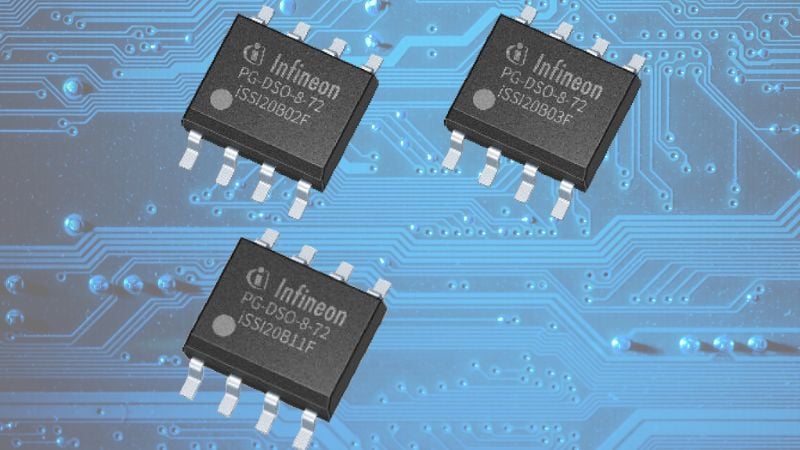
The iSSI20B02F, iSSI20B03F, and iSSI20B11F let designers swap in coreless-transformer isolation without changing board footprint.
Eliminating the Secondary Gate Supply
Photovoltaic isolators (PVIs) and photovoltaic relays (PVRs) have dominated the small-footprint isolation market for a simple reason: nothing else fit in a DSO-8 and drove a MOSFET or IGBT gate without a separate isolated bias supply.
The tradeoff has always been drive current. A photovoltaic coupler generates gate bias by shining an LED onto a stack of photodiodes, a process that tops out in the tens of microamps and slows gate turn-on in higher-power designs. It also degrades over time, as LED output falls off with age and use, gradually reducing the available drive current over the life of the product.
Electromechanical relays avoid the drive-current problem entirely but bring their own liabilities: mechanical wear, contact bounce, and arcing, all of which limit switching life and introduce noise. The ISSI20BxxF family targets both incumbents at once. By transferring both signal and energy across the isolation barrier through a coreless transformer, it removes the aging mechanism that limits PVI lifetime while delivering far more gate current than an optocoupler can supply—without adding a separate gate-bias supply rail.
That combination is aimed squarely at solid-state relay modules, PLC digital I/O cards, lab DC power supplies, automated test equipment, low-voltage building automation, and telecom infrastructure, where board space is tight and long service life matters.
What’s Inside
The family comprises three devices: the ISSI20B02F, ISSI20B03F, and ISSI20B11F. All three variants share the same core specifications. The input supply voltage ranges from 2.85 V to 3.5 V, drawing a typical 16 mA, and can be extended up to 24 V by adding a current-limiting resistor useful for designs running off a higher rail without a dedicated 3.3 V regulator.
The output stage delivers up to 18 V at the OUT pin with no load—enough headroom to fully enhance a CoolMOS, OptiMOS, or TRENCHSTOP IGBT gate directly from a 3.3 V logic rail. Isolation is rated at 3 kVrms with 4 mm of creepage and clearance and UL 1577(planned) recognition, meeting standard basic isolation requirements for industrial designs.
Three Variants Address Different Design Requirements
The three parts differ in drive strength and protection. The iSSI20B02F combines direct gate drive with dynamic Miller clamping and selectable overcurrent or over-temperature protection.
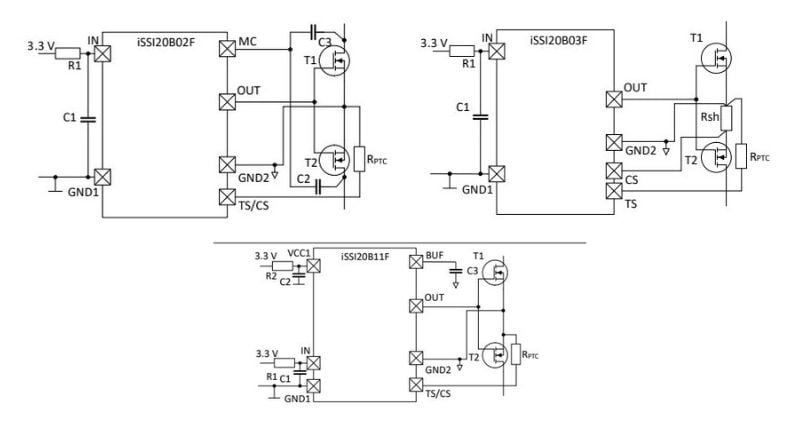
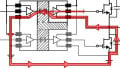
Application schematics detail the iSSI20B11F's fast turn-on, iSSI20B03F's sensing capabilities, and iSSI20B02F's Miller-clamp protection.
The iSSI20B03F supports simultaneous overcurrent and over-temperature monitoring, while the iSSI20B11F pairs selectable overcurrent or over-temperature protection with a buffered output capable of fast turn-on by storing energy in an external capacitor before rapidly charging the MOSFET gate. During fast turn-on, the buffered variant can deliver up to 400 mA of peak output current, compared with approximately 175 µA direct-drive current for the standard variants.
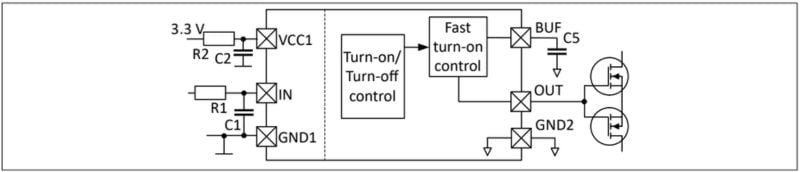
Fast turn-on feature of iSSI20B11F.
When an overcurrent or over-temperature fault triggers on any of the three variants, the device latches the output off rather than cycling back on automatically. The power transistor stays off until the input side is reset with a defined off-time.
Junction temperature is rated up to 150°C (absolute maximum), with a recommended operating range of -40°C to 125°C for continuous use. For full electrical specifications and application circuits, see the combined datasheet covering all three variants.
What Comes Next for Solid-State Isolation
The bigger question is whether coreless-transformer isolation becomes the default choice for new industrial designs or stays a premium option reserved for applications that can justify the switch.
PVIs and PVRs are deeply entrenched in existing bills of materials, so the ISSI20BxxF family's real test will be how much design inertia Infineon can overcome, and whether rival isolation vendors respond with their own coreless or capacitive alternatives sized to the same DSO-8 footprint.
All Images used courtesy of Infineon.