Facebook
 Google
 GitHub
 Linkedin
EV Battery Connectors Offer Engineers Flexibility, Efficiency
A prismatic battery cell contact system could redefine connectivity and electric vehicle battery module efficiency.
The advent of electric vehicles (EVs) has transformed how people move and offer a more sustainable transportation solution. However, engineers are still experimenting with EV batteries to maximize performance efficiency, range, and cost.
To enhance cost-effective assembly options for prismatic cells in EV batteries, Ennovi recently introduced its Ennovi-CellConnect-Prism. This article examines the existing hurdles in EV assembly and provides deeper details about Ennovi’s offering.
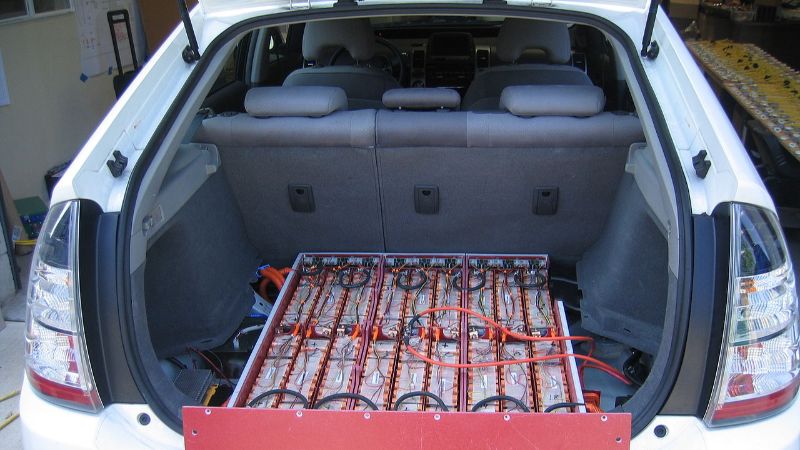
Electric vehicle battery pack. Image used courtesy of Wikimedia Commons
Exploring EV Battery Assembly
The most common EV battery assemblies include cylindrical, prismatic, and pouch.
Cylindrical cells offer advantages in mass production because their geometry lends to more efficient cell packing and ease of assembly. Prismatic cells, with a rectangular shape, allow for higher power density due to their close grouping in battery packs. Pouch cells, encased in flexible aluminum foil, tend to offer lighter weight. As such, each type caters to distinct market needs and manufacturing preferences, shaping the landscape of EV battery technology.
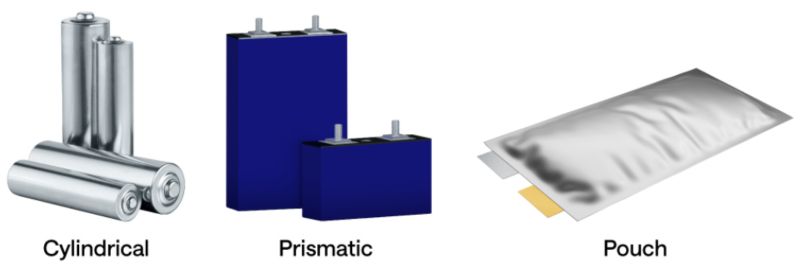
Different cells for EV batteries. Image used courtesy of Ennovi
Battery manufacturers face a crucial challenge leveraging prismatic cells to optimize power density and minimize battery module size. The present assembly method, employing current collector assembly (CCA) technologies, presents inherent inefficiencies in the complex multi-step processes involving the lamination and assembly of carriers with low-voltage sensor circuits, current collectors, and terminal busbars.
The assembly process typically involves attaching the current collectors to the carrier using hot lamination techniques, which bond the current collectors to the carrier. However, it can also introduce inefficiencies due to energy consumption, imperfect bonding, and the need for precise temperature control.
Optimizing the battery assembly process is crucial to unlock the full potential of EVs.
Bridging the Gap in Battery Innovation
To solve some of these issues, Ennovi has developed a new concept in prismatic battery cell connectivity.
Departing from conventional CCA methods, Ennovi-CellConnect-Prism adopts a flexible die-cut circuit (FDC) approach, completely eliminating complex lamination and assembly processes. The FDC approach combines multiple process steps into a single lamination step, allowing precise shaping of the conductive material to fit specific design requirements. This method reduces production time and cell contacting system cost by up to 15% by eliminating conventional assembly process steps.
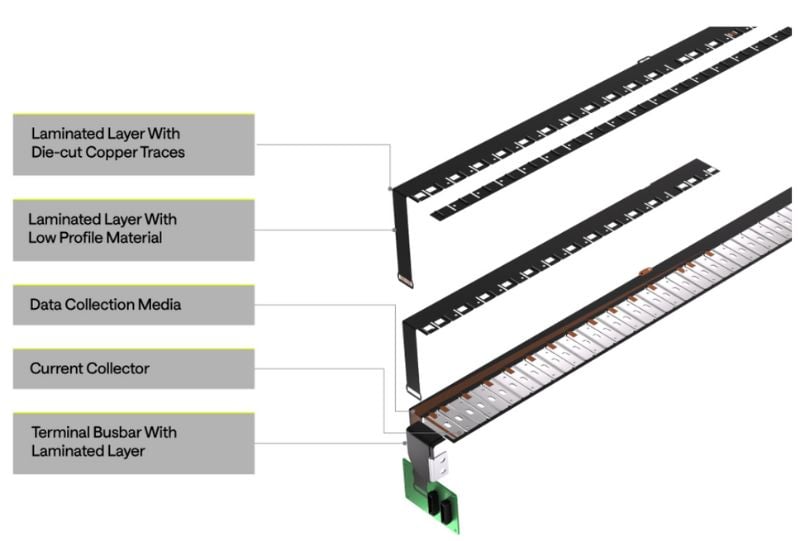
Ennovi’s CellConnect-Prism. Image used courtesy of Ennovi
Further, the Ennovi-CellConnect-Prism process eliminates the need for traditional insulation methods. This is done by integrating voltage and temperature sensing directly into the assembly so material usage and production efficiency are optimized.
Overall, the company claims its solution provides engineers with unprecedented flexibility. It ultimately facilitates the integration of individual prismatic cells to form larger battery modules or advanced configurations like cell-to-pack and cell-to-chassis. The solution is also compatible with various cell formats.
An Electrifying Tomorrow for EV Batteries
By streamlining assembly processes and enhancing efficiency, Ennovi’s solution potentially has far-reaching implications. It offers an avenue for manufacturers to significantly improve the assembly efficiency and scalability of prismatic cell-based battery packs and potentially reduce costs and enhance the performance of EVs. As electric vehicle adoption grows, Ennovi's approach could serve as a key enabler for next-gen electric vehicle technology.