Facebook
 Google
 GitHub
 Linkedin
EMC Filter Cuts the Noise for EV Fast Chargers
The EMIS MF620 EMI filter suppresses noise in high-power electric vehicle DC fast chargers.
EMIS has released the MF620 DC EMI filter designed specifically for high-power electric vehicle DC fast charging systems. The filter complies with safety standards defined by IEC/EN 61851-23 Electric Vehicle Conductive Charging System and UL 2202 Electric Vehicle Charging System Equipment.
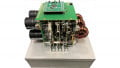
The EMC (electromagnetic compatibility) filter employs a dual-stage design and can accommodate currents up to 1600 A and voltages as high as 1500 VDC. It is chassis mountable with a compact design facilitating integration within the EV supply equipment.
Using specific capacitance and inductance values within the filter allows for rejecting internally generated common and differential mode interferers at frequencies of interest to ensure the EV charging system operates at its peak performance.
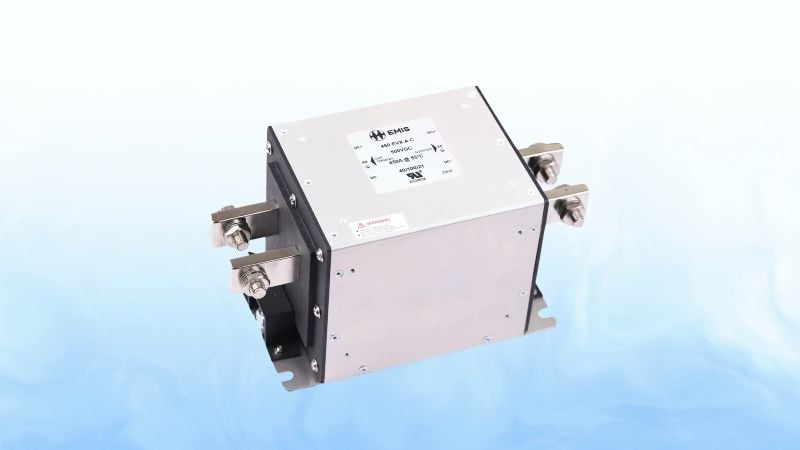
MF620 high-power DC EMI filter. Image used courtesy of EMIS
DC Fast Charging
DC fast chargers, also called Level 3 chargers, offer the highest power levels for EV charging with the shortest charge times. To achieve their power levels, DC fast chargers charge an EV’s battery pack directly through the high-voltage battery bus, bypassing the AC-DC onboard charging circuit used for Level 1 and 2 chargers.
In an EV fast charger, high-voltage DC sufficient to charge a 400 V (or higher) battery bus is generated from AC utility line power (3 phase, 60 Hz, 480 VAC) through power factor correction rectification and DC-DC converter switching power circuits.
Noise Suppression for DC Fast Chargers
The internal power conversion switching circuitry can generate interfering signals for AC-DC power conversion applications like DC fast chargers. These signals can degrade a DC fast charger’s efficiency, regulation, and power quality performance.
EMI filters reject these unwanted interfering signals. For a DC fast charger, the MF620 DC EMI filter can help suppress any high-frequency common mode or differential signals that might bleed through from the charger’s internal switch mode power supply circuits and corrupt the EV battery bus.
In vehicle-to-grid operations, the MF620 might also help reject any interfering signals that could be conducted back to the grid from the EV.
EMI Filter Design and Performance
The MF620 DC EMI filter is constructed with capacitive and inductive circuit properties. For high-frequency differential interfering signals, the shunt capacitors will act as a short across the input, blocking these signals. For common mode EMI, the series inductive circuits present a high impedance, or open circuit, that prevents these signals from passing.
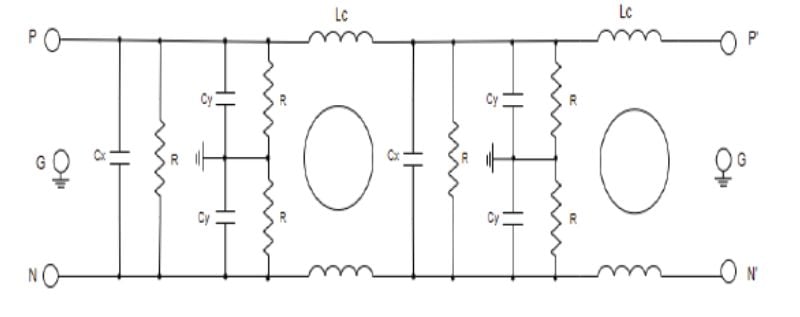
MF620 DC EMI filter circuit. Image used courtesy of EMIS
Within the MF620 family, 72 total model numbers support current ratings from 150 to 1600 A, 500, 1000, or 1500 VDC voltages, and total capacitance to ground values of 0 to 2000 nF.
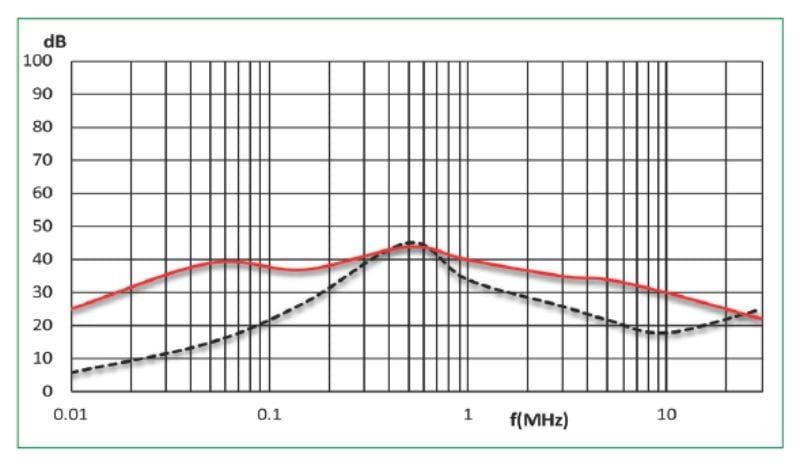
MF620-1600BB insertion loss performance. Image used courtesy of EMIS
The MF620-1600BB is rated for 1500 VDC, 1600 A, and 1000 nF of capacitance to ground. This model offers more than 40 dB of insertion loss (per CISPR 17) for common mode and differential signals between roughly 200 and 700 kHz and more than 20 dB of insertion loss beyond 10 MHz.