 Facebook
 Google
 GitHub
 Linkedin
Allegro Debuts 48 V Power ICs and Precision Sensors for Humanoid Robotics
The new sensing and power portfolio addresses critical size, weight, and safety challenges in physical AI, enabling near-human dexterity and high torque density in modern robotics.
Allegro Microsystems has introduced a new suite of 48 V power and precision sensing solutions targeted at the physical AI and humanoid robotics sectors. As the rapid evolution of autonomous humanoids drives the need for advanced manipulation, this new portfolio is specifically designed to solve critical hardware challenges associated with size, weight, torque density, and functional safety for human-robot collaboration.

Allegro’s new portfolio of power and sensing ICs target humanoid robot designs.
Meeting the Demands of Physical AI
Unlike fixed industrial robots that can easily accommodate thick power cables, large external drives, and active liquid cooling systems, modern humanoid robots featuring 30 or more degrees of freedom (DoF) have strict weight and space limitations. Andreas Friedrich, Senior Director of Technology & Strategy at Allegro MicroSystems, noted that every gram and millimeter is critical in the design of autonomous humanoids.
He explained that Allegro’s integrated 48 V power management components, combined with robust drivers and compact, stray-field-immune sensors, provide engineers with the safety-ready building blocks needed to maximize joint torque and achieve fluid motion in tight spaces.
These components are already seeing real-world adoption. Harpal J.S. Mandaher, CEO and co-founder of Sarcomere Dynamics, emphasized that accurate sensing, precise motion control, and efficient power management are essential for advanced robotic manipulation. Sarcomere Dynamics is actively integrating Allegro’s controllers, sensors, and power ICs into its Scorpion gripper, with plans to expand this hardware collaboration to its upcoming 24-DoF ARTUS Dex robotic hand to achieve near-human dexterity.
Single-Chip 48 V Power Management
As humanoid designs increasingly adopt 48 V architectures to lower cabling weight and minimize resistive power losses, hardware engineers face hurdles in safely stepping down these higher voltages within restricted enclosures. Allegro addresses this bottleneck directly with the A81481, a single-chip 48 V Power Management IC (PMIC) engineered specifically for safety-critical robotics and automotive platforms.
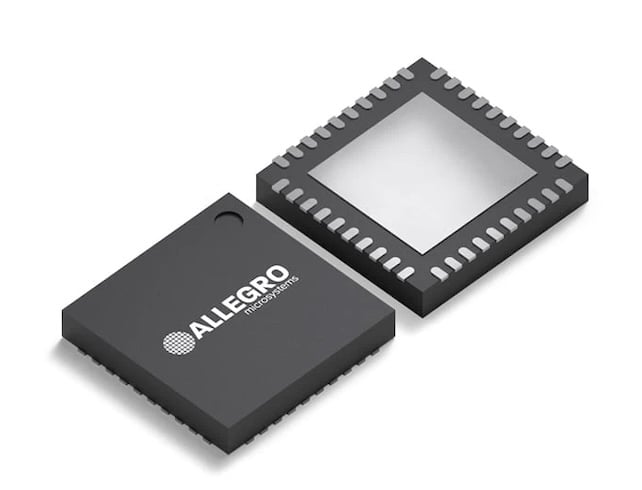
The A81481 48 V PMIC is provided in a 6 mm x 6 mm QFN package.
By providing complete system power and safety regulation directly from a 48V bus, the A81481 eliminates the need for external pre-regulators. This high level of integration simplifies board layout and can cut the total system footprint and bill-of-materials (BOM) costs by approximately 50%.
Key design specifications and features for the A81481 include:
- High Integration: Combines dual buck regulators and five low-dropout (LDO) outputs into a highly compact 6 mm x 6 mm QFN package.
- Comprehensive Protection: Features an ASIL-D-capable triple-watchdog architecture to ensure fail-safe operation, seamlessly tracking and powering remote sensing clusters and CAN networks.
- Wide Operating Range: Supports an operating input voltage of 12 V to 72 V, with an 80 V absolute maximum rating to handle severe inductive voltage spikes and electrical transients.
Precision Sensing for High-Torque and Micro-Joints
To support fluid, natural motion across a robot's mechanical structure, Allegro’s portfolio includes advanced position and angle sensors optimized for both massive high-torque actuators and constrained micro-joints.
For larger, high-torque joints like hips, knees, and shoulders, the A17802 and A17803 inductive position sensors provide reliable measurement in demanding motor control environments. These sensors tolerate mechanical air-gap variations through built-in on-chip compensation and advanced filtering. Their inherent stray-field immunity also removes the need for expensive and heavy magnetic shielding. The A17803 is notably offered in an ultra-compact QFN package for additional space savings.
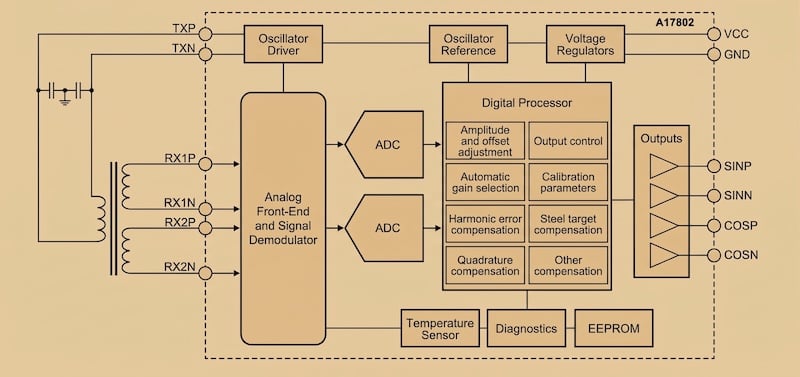
Functional block diagram of the A17802 position sensor
For the intricate mechanical constraints of robotic fingers and hands, Allegro introduced two compact angle sensors designed to replace bulky wire-wound resolvers and optical encoders:
- CT310 XtremeSense TMR Sensor: Delivers contactless, sub-degree angular accuracy (less than 0.30° error after one-time compensation) in a micro 2 mm x 2 mm DFN package, providing high resilience to mechanical shock, runout, and contamination.
- A33023 Hall-Effect Angle Sensor: Offers low-latency performance alongside multiple digital output options, catering to applications that require robust diagnostics and hardware-level functional safety support.
Availability
The new robotics building blocks—including the A81481 PMIC, A17802 and A17803 inductive sensors, CT310 TMR sensor, and A33023 Hall-effect sensor—are currently available for sampling and evaluation to help OEMs accelerate their robotic development pipelines.
All images used courtesy of Allegro Microsystems.