Facebook
 Google
 GitHub
 Linkedin
Universal Design: Standardizing Solid-State EV Batteries
Korean researchers have introduced the first universal design principles for designing solid-state batteries.
The electric vehicle industry is constantly searching for the next best battery technology. Solid-state batteries have been widely lauded for their promise of higher energy storage, improved safety, and faster charging times. Despite its potential, solid-state battery development has challenges, such as non-standardized materials, inconsistent manufacturing techniques, and component interface instability.
Can solid-state batteries move beyond the prototype stage? Video used courtesy of Toyota
Korean researchers have unveiled the first universal design principles for solid-state battery production, potentially addressing key hurdles to commercial viability and EV adoption.

Can standardization make solid-state batteries commercially viable for EVs? Image used courtesy of Adobe Stock
Solid-State Batteries
Unlike traditional lithium-ion batteries, which use liquid electrolytes to facilitate ions moving between the anode and cathode, solid-state batteries employ solid electrolytes. This solid medium is typically made of ceramics, sulfides, or polymers and offers several advantages, such as improved safety, faster charging times, and higher energy density.
By eliminating the flammable liquid electrolyte, these batteries are less prone to overheating and fires, making them more stable and reliable. In addition, they store more energy in a smaller space, particularly valuable for EVs.
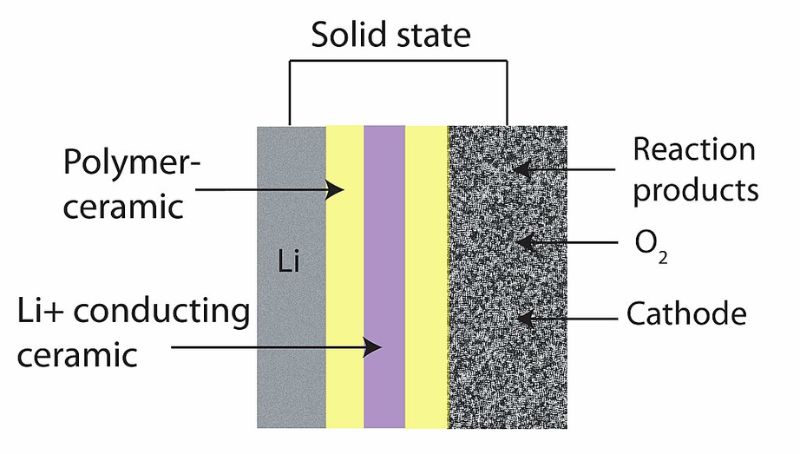
Solid-state lithium-air battery. Image used courtesy of Wikimedia Commons
However, the development of solid-state batteries is not without challenges.
The lack of standardized materials and manufacturing processes increases costs and complicates mass production. Different solid electrolytes, such as ceramics, sulfides, and polymers, exhibit varying ionic conductivities and mechanical properties. This variability complicates scaling production, as each material demands specific processing techniques and operating conditions.
Additionally, achieving consistent interface stability between the solid electrolyte and electrodes is difficult, often leading to issues like dendrite formation, poor ion transfer, and reduced battery life. The absence of industry-wide standards for these materials and methods makes cost-effective, high-yield manufacturing a major technical hurdle.
Overcoming Solid-State Battery Challenges
Korea Institute of Energy Research and Ulsan National Institute of Science and Technology research teams have developed the first universal blueprint for solid-state battery production. The design toolkit, named SolidXCell, offers detailed guidelines on key parameters such as electrode thickness, voltage fluctuations, and material configurations.
The researchers focused on achieving higher specific energy in multi-layer pouch cells with polymer electrolytes. The main challenge was designing a practical high-energy battery while addressing issues such as optimizing the microstructure and achieving a balance between active materials and solid electrolytes.
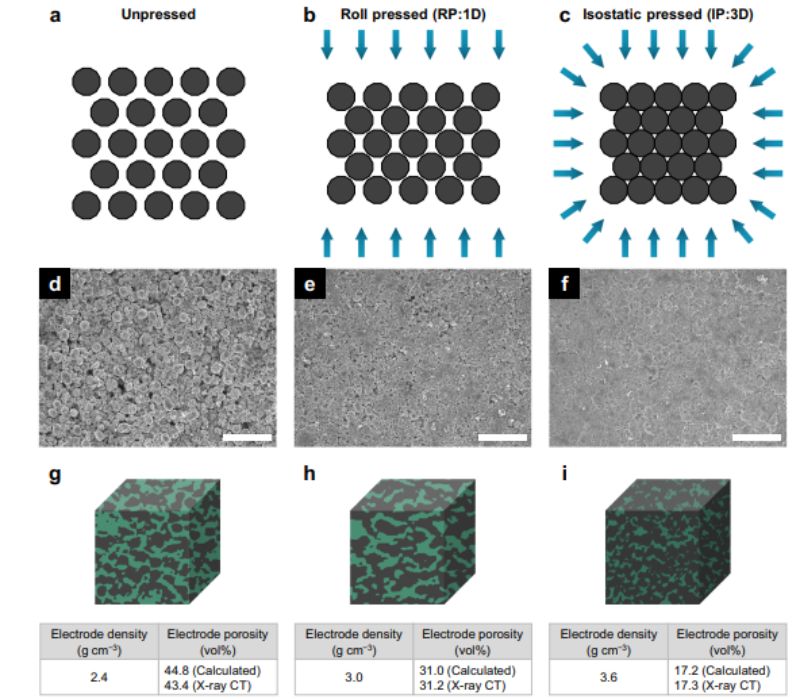
Different compression methods for electrode material. Image used courtesy of Lee et al.
The researchers used a 10-layer and 4-layer solid-state lithium pouch cell architecture, applying a stack pressure of 3.74 MPa at 45°C. These cells achieved initial specific energies of 280 Wh/kg and 310 Wh/kg, respectively, with energy densities of 600 Wh/L and 650 Wh/L. The cells featured a solid polymer electrolyte, allowing for safe, efficient energy transfer without the risk of flammable liquid electrolytes.
The team’s approach involved advanced parametrization of the electrode and electrolyte components to enhance interfacial contact and reduce ionic resistance. This led to better energy storage performance and stability.
The Future of Batteries Is Solid
Introducing universal design principles for solid-state batteries lays a foundation for the future of energy storage, particularly in the EV industry. If more manufacturers adopt these standardized guidelines, the path to overcoming key challenges like material variability and production scalability becomes clearer. With a continued focus on refining solid-state technology, industries beyond EVs, such as renewable energy storage, could benefit from safer, more efficient batteries.
Related Content