Facebook
 Google
 GitHub
 Linkedin
UCLA Builds Supercapacitors From Plastics
The high-capacity supercapacitors could perform better than lithium-ion batteries in electric vehicles and renewable energy systems.
UCLA researchers have found a way to make supercapacitor electrodes from plastic materials.
Supercapacitors are increasingly used in electric vehicles and renewable energy applications, bridging the gap between conventional capacitors and rechargeable batteries and offering unique advantages in applications requiring rapid energy storage and release. In EVs, they can augment the lithium-ion battery pack by providing additional bursts of power for rapid acceleration. They can also store energy from regenerative braking faster than lithium-ion batteries can capture it.
Supercapacitors can also be used in grid storage systems to smooth out fluctuations from intermittent renewable sources like wind and solar and to provide rapid response for grid frequency regulation. They offer several advantages for these applications, including rapid charge/discharge capabilities, long cycle life, and high power density.
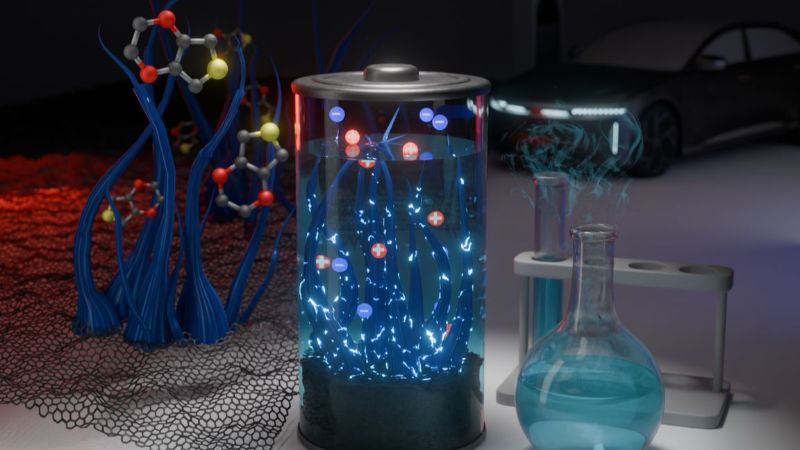
UCLA created PEDOT nanofibers to build a supercapacitor. Image used courtesy of UCLA
How Supercapacitors Work
A supercapacitor stores electrical energy by forming an electric double layer at the interface between its electrodes and electrolyte. Its two electrodes are made of porous materials (typically activated carbon), and an electrolyte solution sits between the electrodes. When voltage is applied, ions in the electrolyte migrate to the oppositely charged electrodes, positive ions accumulate at the negative electrode, and negative ions at the positive electrode. An electric double layer forms at each electrode-electrolyte interface, and this layer is extremely thin, often just one molecule thick. Electrical energy is stored electrostatically in these double layers—no chemical reactions occur, unlike in batteries.
Commercial supercapacitor electrodes are primarily made from powdered carbon-based materials, with activated carbon (made from coconut shells) being the most commonly used. More recently, plastic polyethylene terephthalate (PET) waste from plastic bottles has been repurposed for supercapacitor electrodes. The PET waste can be converted into carbon black through pyrolysis, and electrodes made from this material have shown promising results.
Using Conductive Plastics
In general, plastics are considered electrical insulators. However, the discovery that some plastics can conduct electricity was made in the 1970s, with a breakthrough coming in 1977 and a Nobel Prize in Chemistry in 2000.
In the late 1980s, PEDOT (poly(3,4-ethylenedioxythiophene)) was first developed by scientists at Bayer AG. Its high conductivity, optical transparency, high stability, and flexibility helped it to become one of the most successful and versatile conductive polymers. Applications include antistatic coatings for photographic films and electronic components, transparent electrodes for touchscreens, organic light-emitting diodes, flexible organic solar cells, and biosensors and strain-sensing devices for wearable electronics.
Although PEDOT was viewed as a potential electrode for supercapacitors, the relatively low electrical conductivity and surface area prevented them from holding large amounts of electrical energy.
UCLA’s PEDOT Research
UCLA researchers used PEDOT as a starting point but then created a new material using vapor deposition to create vertical PEDOT nanofibers on a graphite sheet doped with graphene nanoflakes.
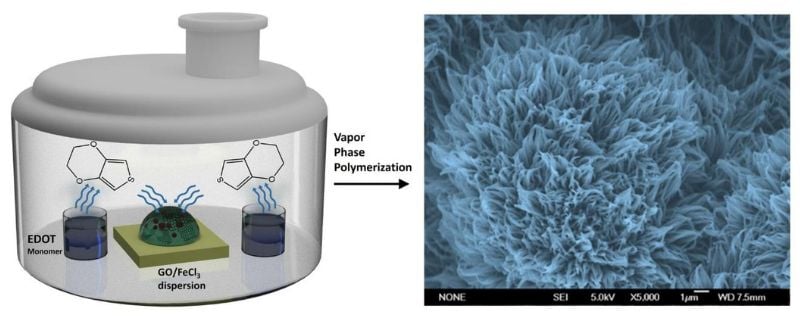
EDOT reacts with graphene oxide and ferric chloride to form PEDOT nanofibers. Image used courtesy of UCLA
The result is a fur-like structure with dramatically higher surface area (up to four times higher) when compared to flat sheets of PEDOT. The nanofiber structure was then incorporated as the supercapacitor’s electrode, creating a device with excellent charge storage and cycling stability (reaching nearly 100,000 cycles).
The material’s conductivity is 100 times higher than conventional PEDOT products. The resulting supercapacitor has a charge storage capacity nearly ten times higher than a supercapacitor made with ordinary PEDOT.
These advantages make plastic-based electrodes a promising option for developing sustainable, high-performance supercapacitors for various applications, including EVs, portable electronics, and grid energy storage systems.