Facebook
 Google
 GitHub
 Linkedin
Solar, EV Batteries, and Lithium Extraction Heat Up
Energy research has progressed using machine learning to improve photovoltaic performance, waste heat harvesting, self-repairing EV batteries, and sustainable lithium extraction.
Improving energy efficiency can maximize production and lower carbon emissions. It can also reduce the need to mine critical rare earth minerals used in many electronics.
Four recent studies offer more environmentally friendly to increase energy production and ease the burden of obtaining rare minerals. These developments include improving photovoltaic development with machine learning, managing waste heat, developing self-healing electric vehicle batteries, and extracting lithium from salt brines.

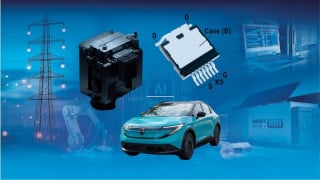
Sustainable practices help EVs and industries. Adapted from images used courtesy of Canva
Machine Learning Predicts Material Performance for Perovskite PVs
Perovskite solar cells are considered the next step in advancing photovoltaic (PV) technology. The technology is not as mature as silicon, but perovskite has already been competitive in single junction architectures. Manufacturing processes will mature further, but some issues still need resolution before perovskite can replace silicon technology. Combining bulk perovskites for high-efficiency PVs and flexible 2D perovskites for flexible solar cells promises to shake up the PV market.
Researchers from Karlsruhe Institute of Technology (KIT) demonstrated how deep learning algorithms—machine learning algorithms that use neural networks—could be a critical tool for improving the data analysis methods used for commercial perovskite PV fabrication. Their study appeared in Energy & Environmental Science.
Using deep learning, the researchers made predictions of the best PV material characteristics and efficiency levels at much higher scales than possible within lab-scale tests. The researchers also analyzed datasets for thin film perovskite PVs to determine any correlations between the process data and target variables, such as power conversion efficiency. They also used identified production errors in advance, saving time.
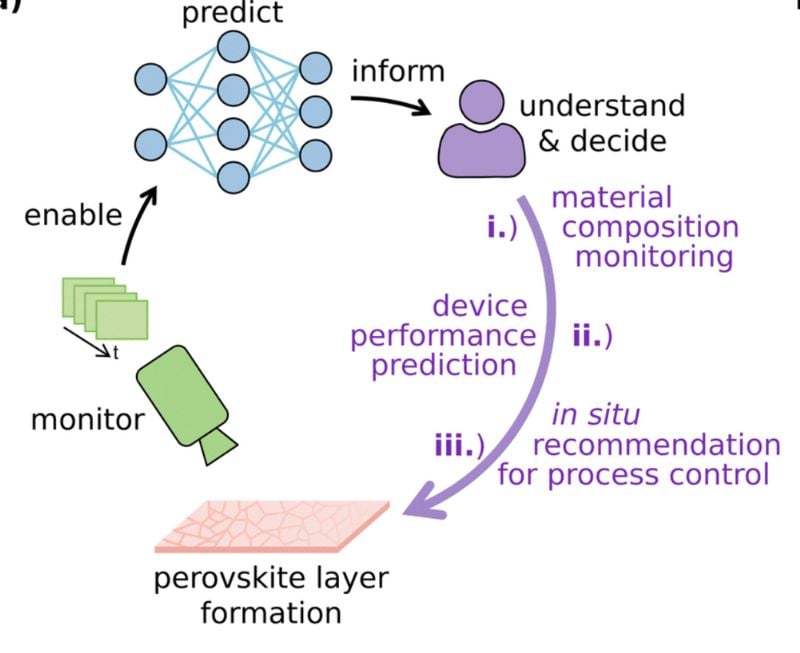
Deep learning analysis process for PVs with perovskite. Image used courtesy of Laufer et al.
The team also deduced that using machine learning will be critical for producing perovskite thin-film PVs.
Erythritol Slurries Show Potential for Waste Heat Recovery
Energy-efficient industrial processes can boost sustainability in industry, but much low-temperature residual heat—heat below 230°C—is often wasted within factories. Harvesting this heat is a simple way to reduce energy loss in industrial processes and help companies meet sustainability goals.
Japanese researchers investigated how the flow behavior and non-Newtonian properties of phase change material (PCM) slurries can be used for managing waste heat. The team performed rheological and chemical engineering-focused experiments on erythritol (sugar-based) slurries to see how the PCM slurries’ different solid fractions, carrier concentrations, flow rates, Reynolds number, and viscosity can be optimized for heat recovery applications.
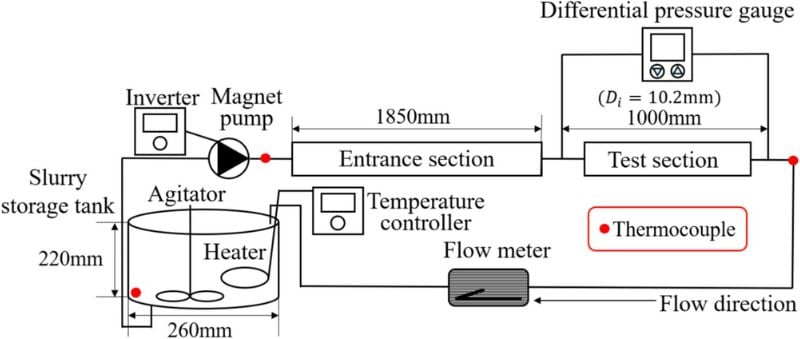
Experiment design. Image used courtesy of Ebihara et al.
When PCM slurries undergo a phase transition, they exchange heat that can be used in various industrial heat recovery applications. Examples include:
- Factories and power plants to capture heat and transport low- to medium-temperature waste heat
- Residential and commercial hot water supply and HVAC systems, where heat can be stored during off-peak hours and used during high-demand periods to reduce the building’s electrical load
- Combined heat and power (CHP) systems generate heat and electricity from a single energy source to improve efficiency
EU Project Develops Self-Repairing EV Battery
An EU research project known as IntelLiGent drew expertise from industry and academia to develop more environmentally friendly and self-repairing EV batteries. Researchers from Norway’s Foundation for Scientific and Industrial Research (SINTEF) used lithium-nickel-manganese oxide cathode, which is cobalt-free and contains less lithium and nickel than most commercial batteries today. Relying less on mined critical minerals provides a lower environmental footprint for the battery. This cathode offers a high average voltage and energy density in a smaller volume to provide a long EV range.
The battery also uses a silicon-graphite anode. Silicon has long been touted for many batteries due to its improved energy density, but volumetric expansion issues have stunted its commercial growth. This project used the graphite in the anode mix to suppress any potential volume changes during cycling to improve performance and lifespan. The battery’s self-repairing aspect comes from the binders used on the electrode, as they repair any minor damage to the electrode, enabling the electrodes to maintain their structure.
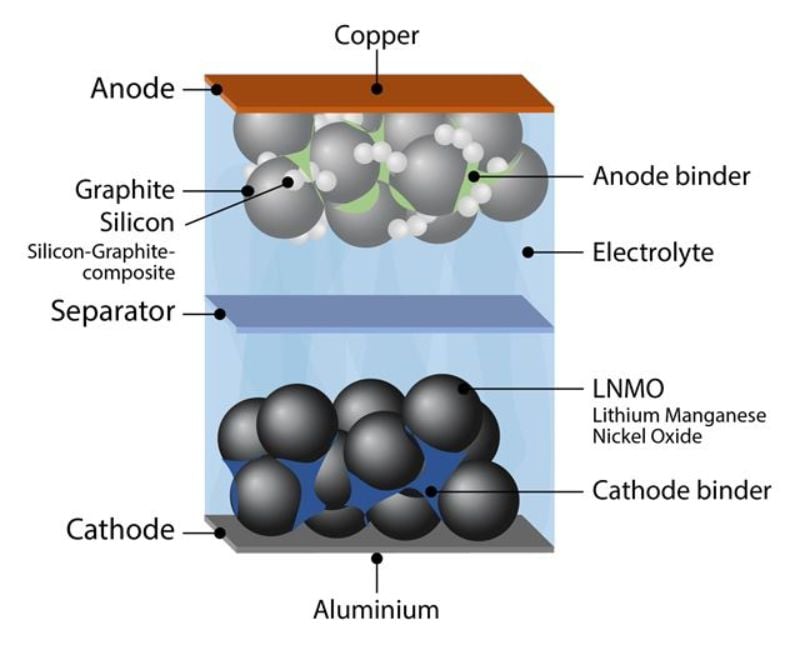
Self-healing battery structure. Image used courtesy of SINTEF
Extraction of Lithium from Salt Lakes
Most methods for lithium extraction are environmentally damaging. Current processes either use considerable water or release harmful chemicals into soil and water during the extraction process.
University of Birmingham researchers developed an environmentally friendly method to remove lithium from salt brines using electrodialysis. This method used an electric current to drive ions through the membrane, allowing the lithium to be separated from other ions in the brine by the membrane’s selective structure.
The membrane relied on charge differences and size exclusion to separate the lithium ions. The membrane distinguished between single- and double-charged ions. The membrane’s tiny channels let lithium ions in but exclude the larger ions, such as sodium. Inside the channels, a range of chemical functional groups interacted with ions as they passed through the channels. The researchers showcased its commercial applicability by converting the extracted lithium into battery-grade lithium carbonate.