Facebook
 Google
 GitHub
 Linkedin
Research Round-Up: Solar, Battery Sustainability Via Design
Researchers worldwide are exploring methods in sustainable batteries and renewable energy technologies.
The ongoing push for global decarbonization presents many challenges to the power electronics designer. Solar power, for example, faces shortcomings concerning efficiency, durability, and the environmental impact of its manufacture. Meanwhile, the battery industry is innovating rapidly, but reliance on environmentally harmful materials poses significant environmental risks.
Perovskites in a circular economy, clean hydrogen from offshore wind, and hydrogen transportation research developments. Video used courtesy of National Renewable Energy Laboratory
The electronics industry has experienced multiple advancements to improve sustainable electronics and solve existing roadblocks. From solar cells to battery technology, these innovations contribute to sustainability goals.
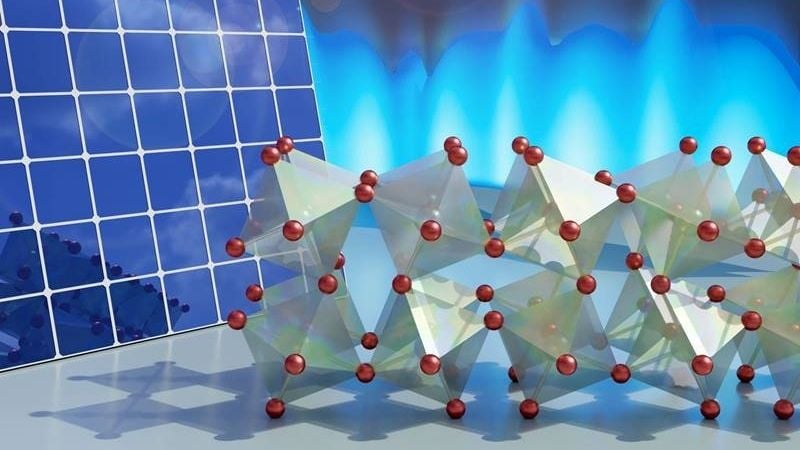
Perovskite solar cells. Image used courtesy of Oak Ridge National Laboratory/Jill Henman
Building a Circular Solar Economy With Perovskite
Developing sustainable solar panel technology has led the National Renewable Energy Laboratory to focus on perovskite photovoltaics.
Perovskite solar cells are a photovoltaic technology utilizing a perovskite-structured compound, typically a hybrid organic-inorganic lead or tin halide-based material, as the light-absorbing layer. Perovskites are known for their high efficiency, low production costs, and potential for flexible and lightweight solar applications. This emerging technology offers an opportunity to design for recyclability and sustainability from scratch, which has significantly plagued current silicon-based panels.
In a paper published in Nature Materials, the NREL researchers propose a circular economy approach for perovskite solar panels emphasizing materials sourcing, product lifetime, and end-of-life management. Specifically, they suggest replacing expensive precious metals like silver and gold with low-cost alternatives such as aluminum, copper, or nickel in commercial modules. To reduce lead content, they propose diluting it with chemically similar metals like tin, though this currently affects efficiency and durability. Additionally, fluorine-tin oxide is recommended for front electrodes instead of scarcer indium-tin oxide.
NREL also highlights the importance of developing recycling pathways for specialized glass components. By focusing on durability and designing for disassembly and component reuse, they aim to reduce net energy consumption, shorten energy payback periods, and lower carbon emissions throughout the panel's lifecycle.
KERI's Urban Solar Innovation
Urban environments present unique challenges for solar energy adoption, including space constraints, partial shading, and fire risks. To address these issues, researchers at the Korea Electrotechnology Research Institute (KERI) have recently developed a self-tracking, flexible, flame-retardant solar cell.
The group’s design encapsulates individual cells in silicone, which the team claims eliminates the need for flammable plastics and enables glass-free, flexible structures. The module also incorporates a shape memory alloy for integral tracking, resulting in a 60% increase in daily power output compared to flat modules. The cell's architecture utilizes a tempered glass-eva-cell array-EVA-polymeric back sheet laminated structure with low-cost materials.
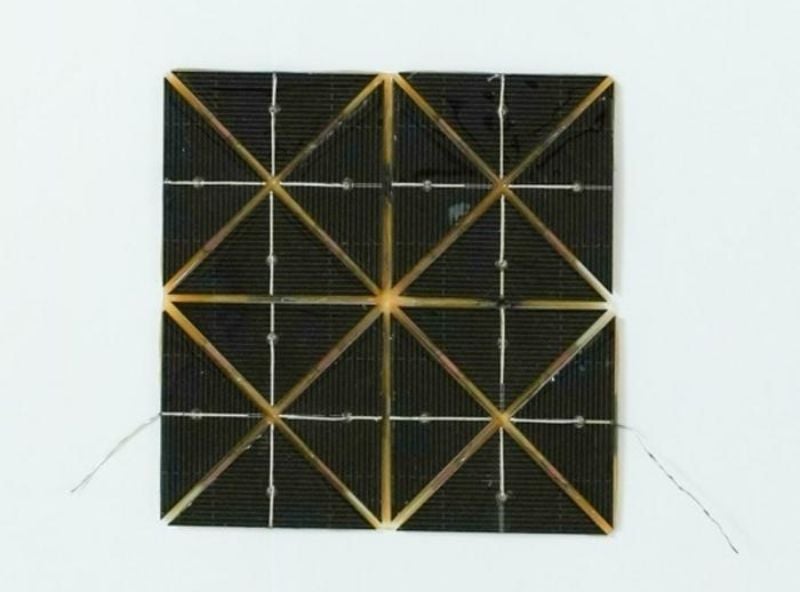
Flame-retardant solar cell. Image used courtesy of KERI
The module's electrical connectivity employs a hybrid serial/parallel connection, creating multiple paths for electricity flow. This approach maintains high power output and prevents hot spot generation, even under partial shading conditions.
Overall, this solar cell's flexibility, self-tracking, and fire-resistant properties make it a significant advancement, especially in urban solar energy harvesting.
The Low-Fluorine Lithium Metal Battery Solution
Lithium metal batteries face the significant challenge of balancing high energy density with environmental sustainability and safety. Researchers at ETH Zurich have developed a novel electrolyte design to address this issue by dramatically reducing environmentally harmful fluorine while maintaining battery stability and performance.
In their paper, the researchers proposed using a very low fraction (around 0.1 wt%) of fluorinated methylpyridinium cations in the electrolyte. These cations are electrostatically attracted to the negatively charged Li-metal anode, leading to a high local concentration at the anode surface despite the overall low concentration in the electrolyte. This attraction forms a robust, fluorine-rich SEI, effectively mitigating dendrite formation and enabling dense Li deposition.
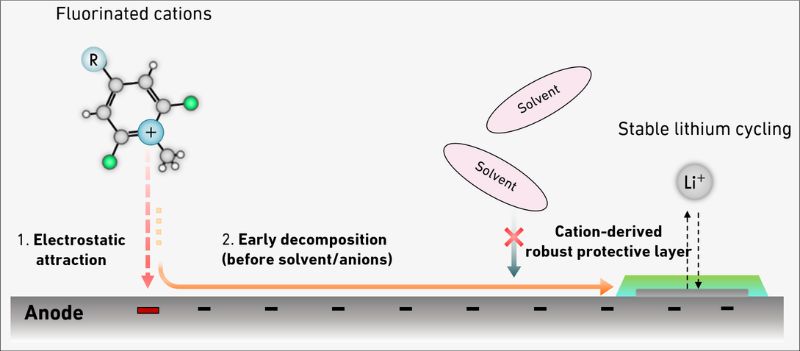
Fluorine transport in the newly developed battery. Image used courtesy of ETH Zurich
The study demonstrated that adding millimolar amounts of these fluorinated cations to a conventional electrolyte increased the coulombic efficiency of Li plating/stripping from 96.4% to 99.6%. This significant improvement was attributed to the cations' early reduction potentials, facilitating the SEI formation before the solvent molecules' decomposition.
Experimental results showed prolonged cycling stability in Li0–Li0 symmetric cells at 10 mA cm^2, where the overpotential remained stable for at least 3000 hours with the fluorinated cations, compared to rapid failure in additive-free electrolytes. Scanning electron microscopy revealed a smooth and dense Li morphology with the additive, contrasting with the rough and porous deposits in its absence.
Sustainable Electronics for the Future
Engineers must overcome many design challenges as the industry continues to push toward sustainable technology. With these solar and battery technology advancements, the industry is clearly attuned to these issues.
Related Content