Facebook
 Google
 GitHub
 Linkedin
NREL Simulates Future Smart Grid Renewables Scenarios
The ARIES platform models power flow in response to renewable energy and other grid situations.
The National Renewable Energy Laboratory (NREL) is replicating emerging energy challenges through its Advanced Research on Integrated Energy Systems (ARIES) platform, which simulates large-scale power networks and grid-edge devices in physical and virtual environments.
How do engineers use the ARIES platform? Video used courtesy of NREL
Engineers use the platform to explore energy storage integration, cybersecurity threats, control instability, and more scenarios relevant to today’s grid. These considerations come as utilities struggle to balance supply and demand from variable renewable energy resources like wind and solar, which claim a growing share of nationwide energy generation—21% in 2023. At the same time, smart buildings and electric vehicles have made it more difficult to control millions of interconnected and decentralized devices varying in physical size and capacity.
ARIES’s controllable grid interface (CGI) models power flow in various situations, such as faults shutting down a wind-powered microgrid or an oil generator failing on a renewables-dominant island.
The CGI quadrupled in power this year after nearly half a decade in operation, allowing engineers to study energy uncertainties at scale.
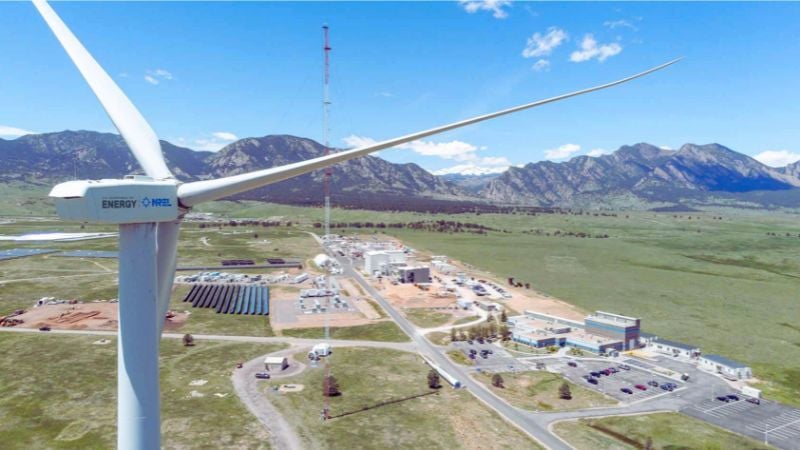
The ARIES platform can simulate large-scale renewable energy solutions. Image used courtesy of NREL/John Bauer and Taylor Mankle
ARIES Features and Capabilities
After the latest update, the CGI can accommodate two customized scenarios at 7 MVA and 20 MVA. While projects were previously bottlenecked by limited availability, the expansion frees up resources so researchers can switch between machines as needed.
These two systems can validate generation and storage technologies' active and reactive power control functions in 13.2 kV medium-voltage conditions. The platform recreates 3D models of power grids with thousands to millions of energy systems, from large-scale nuclear plants to individual electric vehicle chargers and smart devices.
ARIES is highly versatile and can meet the evolving power grid’s challenges. Crucially, engineers can replicate wind, solar, and battery resources to comply with interconnection standards, including power quality performance, fault ride-through, and reliability services to ensure grids function safely and smoothly.
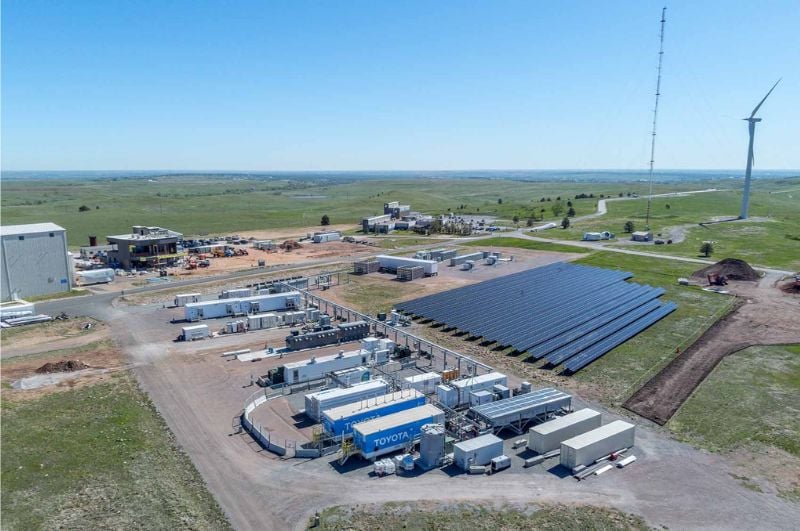
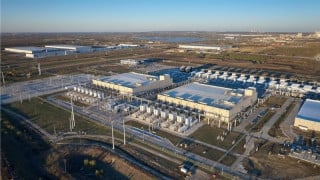
An ARIES testing facility at NREL’s Flatirons campus in Colorado. Image used courtesy of NREL/Josh Bauer and Taylor Mankle
Engineers can test various combinations of power resources to see how they interact in the real world. For example, NREL’s FlexPower project used ARIES to investigate hybrid configurations combining wind, storage, water, and solar power. Meanwhile, the SuperFACTS project simulated a battery on one CGI interface and a solar photovoltaic array on another. By modeling their operation 1,000 miles apart, engineers could better understand how each responded to frequency variations on the same grid.
In Cordova, Alaska, NREL developed a hydropower simulator to model grid stability solutions for the village’s microgrid, which relied on two hydropower plants and diesel generators. The 2.5-MW emulator was informed by real data from local hydropower plants, allowing researchers to test various combinations of batteries or solar panels.
Two Use Cases: Grid Security and Hydrogen Integration
Utilities seek solutions to maintain control over grid-interactive devices, a challenge further complicated by inconsistent standardization between legacy and modern systems. They must also anticipate emerging cyber-physical threats that could cause widespread system-wide outages.
The ARIES Cyber Range digitalizes, simulates, and visualizes energy system experiments to account for such scenarios. The platform links to more than 20 MW of energy system hardware.
NREL’s CloudZero project deployed several synthetic power models to simulate distribution and transmission scenarios in Austin, Texas. Engineers connected the ARIES Cyber Range with Amazon Web Services to study the feasibility, risks, limitations, and costs of using cloud services to supplement utilities’ on-premises solutions. Their co-simulations identified critical opportunities and considerations for utilities to safely leverage cloud services for grid operations, including load forecasting, bulk electric system reliability, and availability.
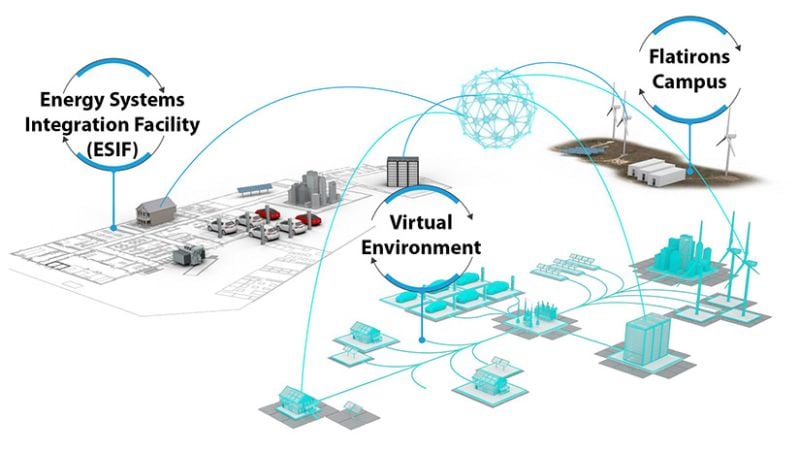
ARIES processes at NREL’s campus. Image used courtesy of NREL
ARIES supports hydrogen energy integration research across various applications, including fuel cells, storage tanks, water deionizers, and electrolyzers. The megawatt-scale platform lets engineers test hydrogen systems before scaling them on the grid. NREL is currently working to validate a pipeline for underground hydrogen storage caverns using metal hydride technology.