Facebook
 Google
 GitHub
 Linkedin
MC34063: The Switching Regulator That Defined Cheap Power
Motorola’s 1980s DC-DC controller became the universal answer to “good enough” power conversion.
Introduced in the early 1980s, Motorola’s MC34063 condensed the essentials of a switching regulator into a single 8-pin IC that could buck, boost, or invert with a handful of passives. It never led in efficiency, but its cost, simplicity, and ubiquity made it one of the longest-lived analog control ICs in production.
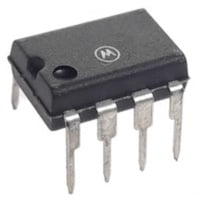
The modest MC34063 operates from 3 V to 40 V input. Image used courtesy of Futurlec
A Jellybean Power Supply for the Masses
Retro components often endure because they were first, like the Intel 1103 DRAM that proved semiconductors could dethrone magnetic core memory, or because they crystallized an abstraction, like the µA741, which standardized the modern op amp. The MC34063 survived for a different reason entirely: it hit the sweet spot of “just enough” functionality at the exact moment the electronics world needed cheap, universal DC-DC conversion.
When it appeared in the early 1980s, most low-cost designs still defaulted to linear regulators. They were simple and predictable, but tremendously wasteful. Dedicated switching controllers existed, but they were specialized, often mode-specific, and rarely inexpensive. Motorola instead offered a monolithic solution that could be configured as a buck, boost, or inverting converter; required no external oscillator; and integrated a 1.25 V reference, comparator, driver stage, and a 1.5 A peak current switch.
It was neither elegant nor efficient, but it was astonishingly flexible. Within a few years, the IC spread everywhere. Automotive adapters used it to drop 12 V to 5 V. Modems and set-tops used it to generate modest negative rails. Hobbyist kits adopted it because you could design with it using nothing more than the datasheet formulas. In the same way the CD4000 series became CMOS logic’s universal glue, the MC34063 became the jellybean controller of the switching world.
Inside the 34063
Technically, the MC34063 was conservative even for its era. Unlike the more advanced PWM controllers emerging in the 1980s, it used a constant-on-time, variable-frequency architecture built around a simple ramp generator. A timing capacitor (CT) charged and discharged between two thresholds, setting a maximum on-time, while a comparator monitored feedback against the internal 1.25-V reference. The result was a relaxation-oscillator-driven switch that turned on when the output dipped and turned off when CT reached its upper limit.
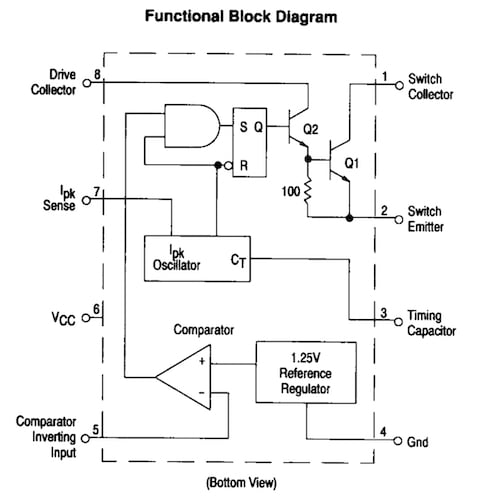
A block diagram of the MC34063. Image used courtesy of Alldatasheet
Because the chip couldn’t terminate a cycle early, load transients often produced skip-cycle behavior and visible ripple. The frequency wandered with input voltage and load, making EMI performance unpredictable without extra filtering. And the internal bipolar switch, depending on configuration, carried enough saturation voltage to waste precious power in low-voltage applications.
But the design had its uses. With only one capacitor setting the timing, the behavior was easy to predict and easy to teach, much like how the 741’s internal compensation made it approachable for generations of analog designers. The current-limit circuitry, based on sensing a few hundred millivolts across a small resistor, ensured the chip tolerated abuse. And while the IC lacked modern amenities like thermal shutdown, it could be dropped into countless topologies with little redesign.
Internally, it used just over 50 transistors—modest integration on silicon processes that even small manufacturers could reproduce. That’s why clone versions proliferated under dozens of names, keeping the architecture alive long after Motorola’s semiconductor business changed hands.
The Regulator Engineers Loved to Outgrow
The MC34063 carved out its niche not by outperforming competitors but by embodying the same paradox that powered the rise of many long-lived ICs: the combination of broad utility and low expectations. The Intel 2708 EPROM demanded three supply rails and a UV window, but was indispensable to early microcomputers because it solved a system-level problem nobody else addressed cleanly. The MC34063 played a similar role in power electronics. It wasn’t the best regulator, but it was the one that made DC-DC conversion accessible to anyone building inexpensive hardware.
As switching power supplies became standard, designers moved to faster, more efficient controllers. Synchronous topologies, MOSFET drivers, fixed-frequency PWM, and integrated power stages left little technical justification for the MC34063 in modern products. Yet it remains in distribution because its feature set still matches the needs of small appliances, industrial controllers, and low-volume designs where cost and simplicity outweigh performance.
To this day, you can open a bargain-bin car charger or an off-brand router and find a variant of the same 8-pin controller regulating a few hundred milliamps with components hand-soldered onto fiberglass that looks older than the chip itself. It persists for the same reason the CD4000 CMOS and the 741 op amp persist—because in many corners of the engineering world, “good enough” still wins.