 Facebook
 Google
 GitHub
 Linkedin
Layered Control and Time to Power: Delta’s Semih Isik on Microgrids for AI Data Centers
AI loads can swing by large amounts in milliseconds, and grid connections can take years. Delta's grid controls director explains how microgrid control helps to address both challenges.
AI data centers have changed the first question developers ask about power. It used to be how much a site needs. Now it is how quickly the site can get that power, and how reliably it can keep it.
Semih Isik, Ph.D., director of grid control systems at Delta Electronics, works on that problem from the controls side. He is part of the solutions group Delta launched in late 2025. This was a strategic shift for a company that has built and sold individual products for more than 50 years. EEPower spoke with Isik to get his insights on the rapidly changing power industry and his recommendations for the next generation of power engineers.
Delta employs more than 4,000 power electronics engineers and is now moving from selling individual products to delivering complete systems backed by long-term service agreements. "Delta has always been an OEM, manufacturing individual products and selling them," Isik said. "Now we deploy the solution as a product, not one product as a product."
Microgrid Control Is a Stack of Time Scales
Isik explains a data center microgrid as a set of control layers. "I think the layering is the most important idea in the whole subject," he said.
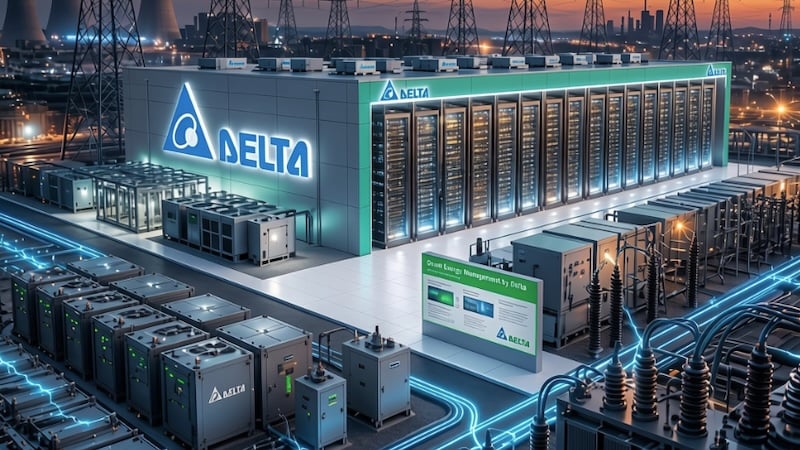
This week at RE+ 2026, Eaton is highlighting its microgrid solutions for AI data centers. Image used courtesy of Eaton.
At the bottom are the unit controllers and power conversion equipment. For AI data centers, this requires millisecond-level response to deliver reliable power and protect each asset.
Above that, the microgrid controller decides in real time how utility power, on-site generation, and storage share the load. It prioritizes critical loads and manages transitions between grid-connected and islanded operation without disrupting the facility.
At the top, the energy management system (EMS) optimizes peak demand, cost, and response to utility conditions. These operate over longer time horizons.
"Each layer works on a different time scale and has a different responsibility," Isik said. "The real value comes from coordinating them without letting them interfere with each other. The hardware delivers the power, but the control decides how the system behaves."
Delta builds this stack on IEC 61850, the standard many utilities have adopted for digital substations. Field devices report upward using sampled values; protection relays communicate over GOOSE, and other devices use MMS.
The layers communicate, but they do not depend on that communication to keep running. "Even if the communication is lost on the lower levels, the controls still do their business autonomously," Isik said. In some layers, a communication fault can go unrepaired for more than 24 hours without shutting the system down.
Isik also noted that for remote sites, customers can operate the microgrid remotely. This is supported through MQTT, DNP3, or OPC UA communication.
AI Turned Power Into a Speed Problem
Asked what has changed most in five years, Isik pointed to AI, which changes the power problem in two ways.
First, data centers want far more power, and they want it sooner than grid upgrades can deliver. A microgrid that brings utility power, on-site generation, and storage under one control layer can shorten the path to getting power online.
Second, AI loads are far more dynamic than traditional IT loads. They ramp up or drop off by large amounts within milliseconds. Power generators respond too slowly to follow the fast part of a swing. The grid sees those swings as disturbances that stress both the utility and the facility.
"Traditional power systems were designed around slower and more predictable demand," Isik said. Energy storage paired with fast controls absorbs the fluctuations locally. Together, they act as a shock absorber between the AI load and the utility. The controls split the work between fast and slow resources, so the utility sees a much smoother profile. The practical result is more usable capacity from the same grid connection.
Availability Is the New Hurdle
Experience with renewables and battery storage helps, Isik said, but powering a data center is a different problem from connecting a gigawatt of solar to the grid.
"All the data center developers or hyperscalers are looking for four nines, five nines," he said.
Four nines is shorthand for 99.99% availability, which corresponds to less than an hour of anticipated downtime per year. Five nines is 99.999% availability or about 5 minutes of downtime per year.
Deploying renewables is now well understood, but meeting data center availability with an end-to-end microgrid controller is not.
Where a Greenfield Design Starts
For a new site, Isik's first questions are about time to power and whether the site will be grid-connected or islanded. Utility interconnection timelines vary widely by region. In ERCOT, he said, developers can wait five to seven years for a connection, while some other utilities can offer one much sooner.
That answer shapes the control strategy. If the utility allows a connection, the microgrid can run in grid-following mode. This lets it rely on a strong, existing grid if on-site generation has a problem. If the connection will not come for three to five years, the question becomes whether on-site generation alone can meet the customer's requirements for that whole period.
From there, the team defines how to achieve reliability, resiliency, and availability. "Storage can carry the load instantly, on-site generation can take over for longer events, but the control coordinates the handoff between them so that nothing is left to chance," he said.
The second stage is learning which other vendors' equipment will be on the site. This can include gas turbines, gensets, and battery energy storage systems (BESS). Then the Delta team must confirm that the control systems can synchronize all of it.
A Hybrid Approach to Vendor Integration
Many companies promote open control ecosystems, Isik said, but getting a microgrid controller to work with each vendor's PCS, battery management system, turbine, or genset remains a fundamental problem.
The weak link is the unit controller. A site controller may command a unit to deliver a certain amount of power, but the unit controller must work with the vendor's own fast internal controls to actually deliver it. "Some companies think this is plug and play, but it's extremely challenging to understand the vendor's product," he said.
Where Delta supplies the hardware, much of that problem goes away. Its BESS offerings package the PCS, transformer, and controls together, so interfaces, signals, response times, and failure behaviors are "defined up front instead of discovered at commissioning," Isik said. The system is validated as a whole, not assumed to work because each part was. Keeping the pieces in-house also lets his group tell Delta's product teams what it needs from the next generation of hardware.
But Delta does not build gas turbines, gensets, or PV, and Isik does not think any single vendor can cover everything. "No one vendor can satisfy the demand from the industry," he said. "The key point is how you prepare your technology so it can easily be adopted by someone else's product."
Previously, every new vendor meant an engineer-to-order effort to work out Modbus registers and control commands with that vendor's engineers. Delta now splits its unit control scheme into a back end, a middleware layer, and a front end, so engineers change only the front-end adapters for a new vendor. Isik said this cuts engineering hours by a factor of 15. Before deployment, Delta tests each integration with hardware-in-the-loop setups and at its grid-connected microgrid near Detroit.
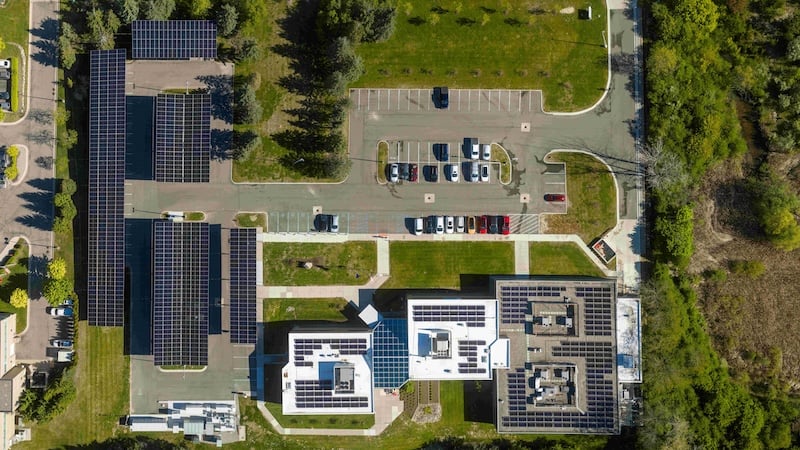
Eaton operates its own microgrid near Detroit to support advanced system testing in real-world conditions. Image used courtesy of Eaton.
SSTs, 800 VDC, and the High-C-Rate Battery
Delta's new prefabricated system integrates its own SSTs, DC-DC converters, and controllers to convert medium-voltage AC directly to 800 VDC for AI factories and data centers.
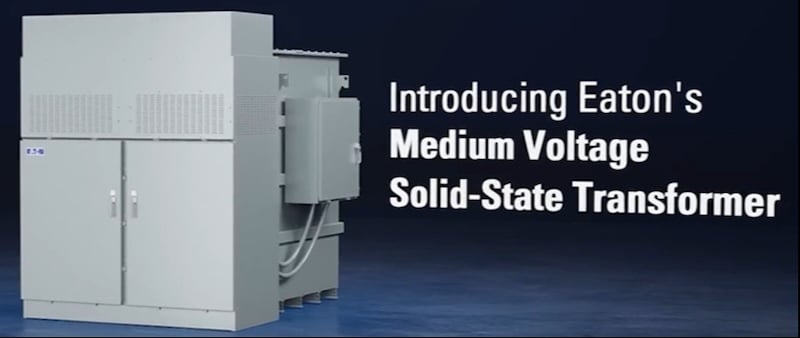
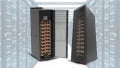
The Eaton NeoCore medium-voltage solid-state transformer can directly convert medium-voltage AC power to low-voltage DC for AI data centers. Image used courtesy of Eaton.
"Solid-state transformers are a truly exciting technology because they combine the transformer function and the power conversion in a power electronic stage that's actively controlled," Isik said. The SST cuts conversion steps between the grid and the load. This improves efficiency, shrinks the footprint, and creates a controllable interface between source and load.
That controllability links the SST to the microgrid, giving the control system a fast, precise way to manage power flow. The prefabricated design reduces on-site work and leaves room for future expansion.
Depending on site requirements, the system can include a high-C-rate battery. C-rate describes how quickly a battery can charge or discharge relative to its capacity. A high-C-rate battery is built to deliver or absorb a lot of power quickly. "That's exactly what a fast-moving AI load is asking for," Isik said.
Opportunities Over the Next Five to 10 Years
Isik sees four main directions. First, high-voltage DC architectures such as 800 VDC will push conversion technologies like SSTs to the center of AI facility design. "The shorter the conversion chain, the more controllable and efficient the system can be," he said.
Second, controls will take on more responsibility as loads become more dynamic and less predictable, requiring faster coordination among storage, power conversion, and the grid connection, and tighter integration between control layers.
Third, customers will expect validated, prefabricated, locally supported systems that shorten time to power. "Waiting for power is now one of the biggest constraints on AI growth," he said.
Fourth, he pointed to U.S. manufacturing. With most new data center growth happening in the U.S., by his estimate, Delta is expanding domestic manufacturing and testing, including planned PCS production in Plano, Texas, by the end of 2027.
Advice for Engineering Students
For students who want to improve the grid, Isik's advice is to first build strong fundamentals. Then question how things have always been done and ask how coursework applies to real-world problems.
"Everything is built on top of the fundamentals," he said. "But don't always follow what the experts are doing. Try to think from the other perspective and ask, can this be done in a different way, in a quicker way?"
He pointed to large AI loads as an example. Power engineers have long planned around losing generation. Large AI loads flip that question: What happens when the system suddenly loses a very large load? Answering it, he said, means engineers need "to think much more differently than we used to."